Business Model Canvas
How a Business Actually Makes Money on One Page
The Business Model Canvas is the closest thing strategy has to a universal language. Nine boxes, one page, and a quiet promise: if you can't fit your business on this sheet, you probably don't understand it yet. The right side is about value and the people who pay for it. The left side is the machinery that delivers that value. The Value Proposition sits in the middle, holding the two halves together like a keystone.
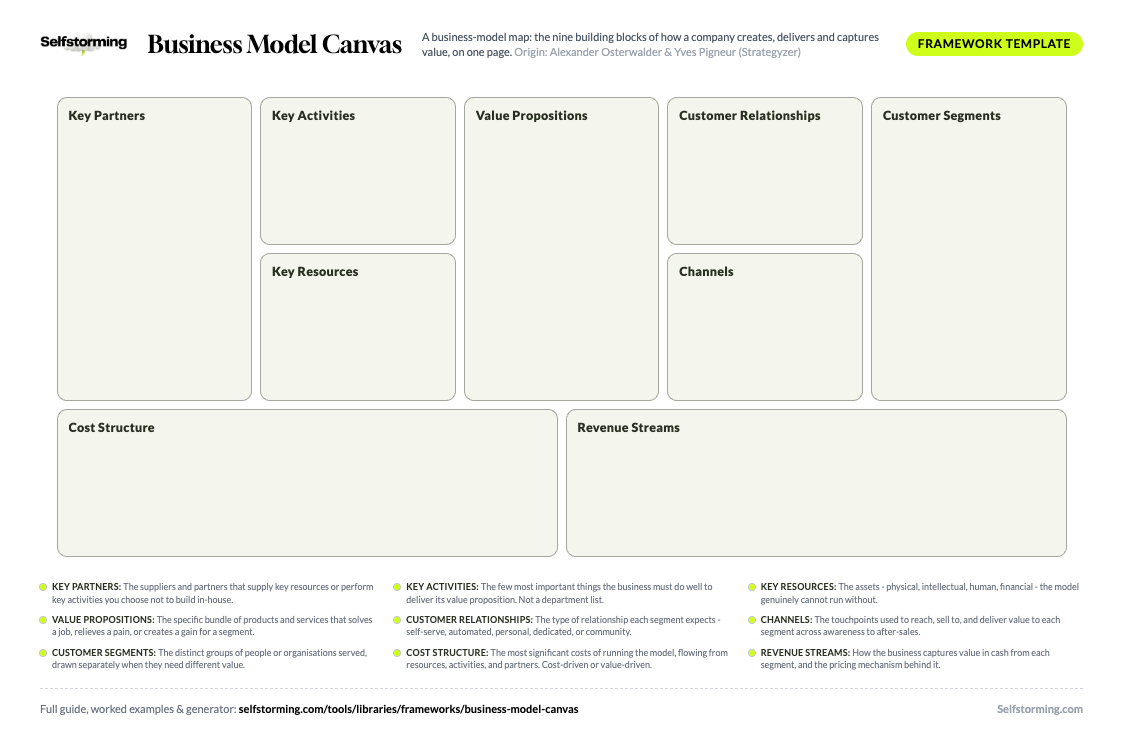
Print it. Fill it in.
The Business Model Canvas as a printable A4 worksheet - write straight into the framework, on paper or in any PDF app.
Download the PDF templateKnowledge Worth Paying For
A working library of brand strategy frameworks - with worked examples on real brands, sources, and decision criteria. Not vibes.
One good deck covers the subscription. The rest is profit.
Nine building blocks on one page: Customer Segments (who you serve), Value Propositions (why they care), Channels (how you reach them), Customer Relationships (how you keep them), Revenue Streams (how you get paid), Key Resources (what you need), Key Activities (what you do), Key Partners (who helps), and Cost Structure (what it all costs). Right side = value and customers, left side = infrastructure, value proposition in the centre. Use it to map and pressure-test a business model fast - not to replace strategy or competitive analysis.
Spotify
Music streaming platform (Sweden, founded 2006)A textbook multi-sided model where the nine blocks only make sense together. Free listeners are the resource that attracts advertisers, Premium subscribers fund the catalogue, and the whole thing is hostage to one block: key partnerships with the record labels who own the music.
Warby Parker
Direct-to-consumer eyewear (USA, founded 2010)Shows the canvas being used to break a category open. Every block is engineered against the incumbent (Luxottica), and the value proposition - affordable designer glasses by mail - only works because the channels, partners, and cost structure were rebuilt from scratch.
Patreon
Creator membership platform (USA, founded 2013)A clean two-sided platform model where the canvas makes the dependency obvious. Creators are simultaneously the product and a customer segment, the value proposition points two directions at once, and the revenue stream is a percentage cut - so Patreon only wins when its creators do.
Spotify, Warby Parker, Patreon - filled in, line by line. Unlock to read them.
Spotify (Music streaming platform (Sweden, founded 2006))
A textbook multi-sided model where the nine blocks only make sense together. Free listeners are the resource that attracts advertisers, Premium subscribers fund the catalogue, and the whole thing is hostage to one block: key partnerships with the record labels who own the music.
Customer Segments: Free ad-supported listeners. Premium subscribers. Advertisers buying access to the free tier. Artists and podcasters as creators.
Value Propositions: All the music in the world, instantly, with discovery that learns your taste. For artists: distribution and listener data. For advertisers: a captive, segmented audience.
Channels: Mobile and desktop apps, web player, smart-speaker and car integrations, app stores, and a free tier that acts as the top of the funnel.
Customer Relationships: Largely automated and personalised - algorithmic playlists, Wrapped, recommendations - with self-serve account management and minimal human support.
Revenue Streams: Premium subscription fees (the bulk of revenue) plus advertising sold against the free tier. Recurring and predictable on the subscription side.
Key Resources: The recommendation algorithm, the listening-data set, the licensed catalogue, and the brand. The data flywheel is the hardest asset to copy.
Key Activities: Platform and recommendation engineering, content and podcast acquisition, label negotiations, and continuous personalisation.
Key Partners: The major record labels (Universal, Sony, Warner), music publishers, device makers, and podcast studios. The labels hold real pricing power.
Cost Structure: Royalty payments to labels and rights holders (by far the largest cost), engineering, infrastructure, and marketing. A structurally low-margin business.
Warby Parker (Direct-to-consumer eyewear (USA, founded 2010))
Shows the canvas being used to break a category open. Every block is engineered against the incumbent (Luxottica), and the value proposition - affordable designer glasses by mail - only works because the channels, partners, and cost structure were rebuilt from scratch.
Customer Segments: Younger, design-conscious buyers who resented paying $400 for glasses and were comfortable shopping online first.
Value Propositions: Designer-quality prescription glasses at a flat, fair price, with a home try-on programme that removes the risk of buying eyewear you can't try on.
Channels: Owned e-commerce site, the five-pairs-at-home try-on programme, and a growing network of branded retail stores for trust and fittings.
Customer Relationships: Self-serve and friendly by default, with human help for fittings and prescriptions, plus a buy-a-pair-give-a-pair mission that builds loyalty.
Revenue Streams: Direct product sales at a single transparent price point, increasingly supplemented by eye exams and contact lenses.
Key Resources: The brand, the in-house design team, the optical lab capability, and the customer data from millions of try-ons.
Key Activities: In-house design, supply-chain and lab management, e-commerce and retail operations, and brand building.
Key Partners: Frame manufacturers, lens suppliers, optical labs, and shipping carriers that make the try-on programme economically viable.
Cost Structure: Frame and lens production, free two-way shipping on try-ons, retail store rent, and marketing. Engineered to undercut the incumbent's markup.
Patreon (Creator membership platform (USA, founded 2013))
A clean two-sided platform model where the canvas makes the dependency obvious. Creators are simultaneously the product and a customer segment, the value proposition points two directions at once, and the revenue stream is a percentage cut - so Patreon only wins when its creators do.
Customer Segments: Independent creators (podcasters, artists, writers, YouTubers) on one side, and their fans willing to pay for membership on the other.
Value Propositions: For creators: recurring income directly from fans, free of ad-platform whims. For fans: closer access and exclusive work from someone they already follow.
Channels: The Patreon web and mobile apps, plus creators themselves promoting their pages on YouTube, podcasts, and social as the primary acquisition engine.
Customer Relationships: Self-serve for both sides, with tiered membership tools for creators and a community feel between creator and fan that Patreon facilitates but doesn't own.
Revenue Streams: A percentage cut of creator membership income plus payment-processing fees. Revenue scales directly with creator success.
Key Resources: The platform, the payments and membership infrastructure, the creator network, and the brand association with creator independence.
Key Activities: Platform development, payment processing, creator tools and support, and trust and safety operations.
Key Partners: Payment processors (Stripe, PayPal), the social and video platforms where creators build audiences, and merch and shipping partners.
Cost Structure: Payment-processing fees, platform engineering, creator support, and fraud and chargeback management. Margins depend on creator retention.
1. Key Partners
Who are the suppliers and partners that make the model work, and which activities or resources do we get from them rather than build?
The network of suppliers, allies, and partners that reduces risk, supplies resources, or handles activities outside your core. The block that asks an honest question: what should you not build yourself? Optimisation and economies of scale often live here.
Good answer: Spotify's survival depends on partnerships with the major record labels - Universal, Sony, Warner - who supply the catalogue. Without those partners there is no product, which is also why margins are tight.
Wrong answer: Various strategic partners and vendors. Placeholder language for a block you skipped. Name the partners the model would collapse without, and be honest about the leverage they hold over you.
2. Key Activities
What are the few most important things the business must do well to deliver its value proposition?
The critical actions required to make the model work - production, problem-solving, platform or network management. The discipline is naming the handful that genuinely matter, not transcribing the whole org chart. If everything is a key activity, nothing is.
Good answer: For Netflix the key activities are content acquisition and recommendation engineering - buy or make shows people want, then surface the right one before they get bored and close the app.
Wrong answer: Marketing, sales, operations, HR, finance, and product. That's a list of departments, not key activities. The block asks what is strategically essential, not what appears on payroll.
3. Key Resources
What assets - physical, intellectual, human, or financial - are absolutely required to make this model work?
The most important things you must have to deliver the value proposition, reach markets, and earn revenue. Could be a patent, a brand, a data set, a supply chain, a community, or a balance sheet. Names what the business genuinely cannot run without.
Good answer: Airbnb's key resource is its two-sided marketplace and the trust data inside it - reviews, verified profiles, and pricing history. It owns no property, which is exactly the point.
Wrong answer: A talented team and great technology. Generic and unfalsifiable. Every company claims this. The block should name the specific asset a competitor would struggle to copy, not a LinkedIn slogan.
4. Value Propositions
What bundle of products and services creates value for a segment, and which specific job, pain, or gain does it address?
The reason a customer picks you over the alternative, including doing nothing. The keystone of the canvas - every other block exists to deliver or capture this. Strong value propositions are specific about the job done, not a list of adjectives about the product.
Good answer: Notion: one tool that replaces your wiki, your docs, and your task tracker so your team stops switching tabs. It names the pain (tool sprawl) and the gain (one surface) in plain language.
Wrong answer: A best-in-class, innovative platform that delivers seamless value. No job, no pain, no human. This sentence could be glued onto any company on the planet without anyone noticing the swap.
5. Customer Relationships
What type of relationship does each segment expect us to establish and maintain - self-serve, personal, automated, community?
The kind of ongoing connection you build with each segment, from one-off transactions to dedicated personal assistance to self-serve and community models. Drives both acquisition and retention, and quietly determines a large chunk of your cost structure.
Good answer: Duolingo runs an almost entirely automated, gamified relationship - streaks, reminders, and a passive-aggressive owl - so it can keep millions engaged with near-zero per-user human cost.
Wrong answer: We will provide excellent customer service. Everyone says this and nobody can act on it. The block should name the model (self-serve vs dedicated), not promise a vibe.
6. Channels
Through which touchpoints do we reach, sell to, and deliver value to each segment - and which ones actually work?
How a value proposition travels from you to the customer across awareness, evaluation, purchase, delivery, and after-sales. Channels can be owned or partner, direct or indirect. The block exposes whether you can actually get the value into the customer's hands at a cost that works.
Good answer: Warby Parker pairs a frictionless website with a home try-on programme and a network of physical stores - online for reach, try-at-home to kill purchase anxiety, stores for trust and returns.
Wrong answer: Social media and word of mouth. Listing channels you hope will appear for free, with no acquisition cost and no plan for evaluation or delivery. Hope is not a channel.
7. Customer Segments
For whom are we creating value, and which groups are different enough to need a different value proposition?
The distinct groups of people or organisations you aim to serve. The most important block, because everything else flows from who pays attention. Segments that need genuinely different value, channels, or relationships should be drawn separately rather than blurred into 'everyone'.
Good answer: Spotify draws Free listeners and Premium subscribers as separate segments - one is monetised through advertisers who form a third segment entirely, the other pays directly. Three groups, three logics.
Wrong answer: Our customer is everyone aged 18 to 65 with disposable income. That isn't a segment, it's a census category. If the box could describe a supermarket and a private jet broker, it does no work.
8. Cost Structure
What are the most significant costs the model incurs, and is it driven more by cost-cutting or by value creation?
All the major costs of running the model, flowing naturally from the resources, activities, and partners on the left. Helps you see whether you are a cost-driven business (lowest price wins) or value-driven (premium experience), because trying to be both usually means being neither.
Good answer: Ryanair is unapologetically cost-driven - secondary airports, single aircraft type, fees for everything - so its entire cost structure is engineered around the lowest possible seat price. The model is coherent because it picks a side.
Wrong answer: We'll keep costs lean and reinvest in growth. A sentiment, not a structure. The block should surface the two or three line items that dominate the P&L, not reassure a future investor.
9. Revenue Streams
For what value is each segment genuinely willing to pay, how do they want to pay, and what is the pricing mechanism?
How the business captures value in cash - one-time sales, subscriptions, licensing, usage fees, advertising, brokerage. The block where aspiration meets reality: a revenue stream you can describe but no segment will actually fund is a fantasy with a label.
Good answer: Adobe shifted from one-time Creative Suite licences to Creative Cloud subscriptions - same software, a recurring revenue stream that smoothed cash flow and roughly doubled the company's market value over the following years.
Wrong answer: We'll monetise later through premium features and partnerships. Vague, deferred, and untested. If no segment is paying today and you can't name the mechanism, this box is empty no matter how many words are in it.
Decide your starting point. You don't have to fill nine empty boxes in a silent room - right here on Selfstorming you can find inspiration and directions, or generate a first-draft Business Model Canvas in minutes. Treat that draft as a head start, then pressure-test it against the steps below. Workshop-from-scratch and AI-draft-then-validate are both valid - most teams move faster from a draft.
Start with Customer Segments and Value Propositions, not the boxes you find easy. The right-centre is where the business lives or dies. If you can't name a specific segment and the specific job your value proposition does for them, the other seven blocks are guesses dressed as facts.
Fill the right side first, then earn the left. Work segments to value to channels to relationships to revenue. Only once the market-facing half is real do you ask what resources, activities, and partners are required to deliver it - and what it all costs.
Treat every block as a hypothesis, not a statement. Write each box in pencil. A canvas full of confident certainties on day one is a canvas nobody has tested. Mark which boxes are validated and which are still bets you need to go and check.
Run the coherence test across blocks. Does the cost structure on the left match the revenue streams on the right? Do the channels actually reach the segments? A business model is a system - the value is in the contradictions between boxes, not inside any single one.
Sketch a separate canvas for each distinct segment. One canvas trying to serve three different customers usually serves none of them well. If a segment needs a different value proposition, channel, or revenue logic, give it its own sheet.
Add what the canvas leaves out, on purpose. It has no box for competition, no box for trends, no box for metrics. Note your main competitor and your riskiest assumption in the margin - the canvas won't prompt you, and that blind spot is its most documented flaw.
Keep it alive. A Business Model Canvas printed and framed is a Business Model Canvas already going stale. Revisit it after every meaningful experiment, pivot, or new piece of customer evidence. The version on the wall should never be more than a quarter old.
Best for: Mapping and pressure-testing an entire business model fast - in a workshop, a pivot conversation, or an investor sketch. Getting a cross-functional team arguing from one shared picture. / Detailed financial modelling, competitive strategy, or execution planning. The Business Model Canvas is a map of the territory, not a route through it.
Output: A single page with nine connected blocks, each filled with short, specific, testable statements. Right side market-facing, left side infrastructure, value proposition in the centre. / A 40-page business plan with five-year projections and a SWOT appendix. That's a document; the canvas is a thinking surface you can redraw in an hour.
Time to complete: A focused session (1-3 hours) to draft a v1, then iterative refinement as you validate each block against real customers and real numbers. / Multi-month strategic planning cycles with market research and board sign-off. The canvas feeds those; it doesn't replace them.
vs Value Proposition Canvas: Business Model Canvas covers the whole model end to end - nine blocks, all the way from partners to revenue. Use it to see the business as a system. / The Value Proposition Canvas zooms into just the value-segment fit (customer jobs, pains, gains vs products, pain relievers, gain creators). Use it when the centre block needs depth, not the whole model.
vs Playing to Win: Business Model Canvas answers 'how does this business work?' - the mechanics of value creation and capture, with no inherent view on rivals. / Playing to Win answers 'where do we play and how do we win?' - an explicit, choice-based competitive strategy. Use it for the strategic questions the canvas deliberately ignores.
vs Lean Canvas: Business Model Canvas suits established or multi-sided businesses where partners, key resources, and relationships are central to how value is delivered. / Lean Canvas (Ash Maurya) swaps four blocks for Problem, Solution, Key Metrics, and Unfair Advantage. Use it for early-stage startups chasing problem-solution fit, where risk lives in the unknowns the BMC doesn't surface.
The Business Model Canvas was created by Alexander Osterwalder based on his PhD work on business model ontology, supervised by Yves Pigneur at the University of Lausanne. The nine building blocks were first proposed around 2005, then refined and popularised by the 2010 book Business Model Generation, which Osterwalder and Pigneur co-wrote with a community of 470 practitioners from 45 countries. The pair went on to found Strategyzer, the company that turned the canvas into a global standard taught in business schools and used inside corporations and startups alike. The tool spread because it gave a previously fuzzy concept - the business model - a shared visual grammar that anyone could learn in an afternoon.
The Business Model Canvas draws consistent criticism for being a static snapshot that captures what a model is at one moment but says nothing about how it evolves or competes. Critics point out it has no box for competition or strategy, no place for metrics or unit economics, and that it reduces a dynamic business ecosystem to nine tidy boxes that can foster a dangerous illusion of strategic completeness. The fair version of the critique: it's an excellent map and a poor strategy. The honest way to use it is as a fast shared picture you pressure-test against real customers, real numbers, and a real view of the competition - not as proof the model works.
What is the Business Model Canvas?
The Business Model Canvas is a one-page strategic tool that describes how a business creates, delivers, and captures value across nine building blocks: Customer Segments, Value Propositions, Channels, Customer Relationships, Revenue Streams, Key Resources, Key Activities, Key Partners, and Cost Structure. The right side is market-facing, the left side is infrastructure, and the Value Proposition sits in the centre linking the two. It's used to map, design, and pressure-test a business model quickly.
Who created the Business Model Canvas?
It was created by Alexander Osterwalder, based on his PhD research supervised by Yves Pigneur at the University of Lausanne. The nine blocks were first proposed around 2005 and popularised by their 2010 book Business Model Generation, co-developed with 470 practitioners worldwide. The two went on to found Strategyzer, which made the canvas a global standard.
What is the difference between the Business Model Canvas and the Lean Canvas?
The Lean Canvas, created by Ash Maurya, is an adaptation of the Business Model Canvas for early-stage startups. It keeps the one-page format but swaps four blocks - Key Partners, Key Activities, Key Resources, and Customer Relationships - for Problem, Solution, Key Metrics, and Unfair Advantage. Use the Business Model Canvas for established or multi-sided businesses where partners and resources matter; use the Lean Canvas when you're still hunting problem-solution fit and risk lives in the unknowns.
What is the difference between the Business Model Canvas and the Value Proposition Canvas?
The Value Proposition Canvas zooms into two blocks of the Business Model Canvas - Value Propositions and Customer Segments - and breaks them into customer jobs, pains, and gains on one side and your products, pain relievers, and gain creators on the other. The Business Model Canvas maps the whole business as a system; the Value Proposition Canvas adds depth to the centre when that fit is the thing you most need to get right.
Is the Business Model Canvas a strategy?
No, and treating it as one is the most common mistake. The Business Model Canvas describes how a business works, but it has no box for competition, no place for where-to-play choices, and no metrics. It tells you what your model is, never whether it beats a rival's. Pair it with a real strategy tool like Playing to Win to answer the questions the canvas deliberately ignores.
Does the Business Model Canvas work for startups?
Yes, with a caveat. It's a great way for any founder to see the whole business on one page and spot where the model doesn't add up. But for the earliest stage - before you've confirmed anyone has the problem you're solving - the Lean Canvas often surfaces risk more directly, because it has dedicated Problem, Key Metrics, and Unfair Advantage boxes that the Business Model Canvas lacks.
How often should we update the Business Model Canvas?
Revisit it after every meaningful experiment, pivot, or new piece of customer evidence - and at minimum once a quarter. The canvas is a static snapshot by nature, so its biggest risk is quietly describing a business that no longer exists. A canvas that's been framed on the wall for a year is decoration, not a tool.
A business-model map: the nine building blocks of how a company creates, delivers and captures value, on one page.
The trap is treating it as a form to fill in. Plenty of teams write nine confident boxes, pin the canvas to a wall, and feel strategic - while quietly avoiding the one question that matters: does the money on the right actually exceed the cost on the left, and would anyone notice if you switched your value proposition with a competitor's? A good canvas is a stress test. A bad one is a colouring book. This page walks through each of the nine blocks, the question that unlocks it, and how to tell a canvas that does work from one that just looks busy.
Related Frameworks
Playing to Win
Five linked choices, top to bottom: Winning Aspiration (what winning looks like, for whom), Where to Play (the specific market, segment, geo
OKRs
One Objective (qualitative, ambitious, memorable - the hill worth taking) plus three Key Results (numeric, measurable, with zero grey area -
SWOT Analysis
Four boxes, two axes: Strengths and Weaknesses are internal and controllable, Opportunities and Threats are external and mostly not. Left si
Eisenhower Matrix
Score every task on two axes: important (does it matter to your goals?) and urgent (does it need attention now?). That gives four boxes. Do