Mission is what you do today and for whom. Vision is the future you're trying to create. How to tell a working statement from a laminated one, with IKEA, Airbnb and Dove from our library.

There's a small test I like to run in brand workshops. I read out the client's mission statement, then a competitor's, and ask the room which one is theirs. Usually somebody gets it right. But usually it's just a guess.
That's the real problem with mission and vision. People do know the textbook difference. It's just that most statements are written to be agreed with, not to decide anything. So let's do the definitions quickly and then spend the rest of the time on the part that matters: how to tell a working statement from a laminated one, with examples from our library.
The short answer
A mission is what you do today and for whom. Present tense, concrete, something you could watch happen on a Tuesday.
A vision is the future you're trying to create. Future tense, ambitious, and ideally specific enough that one day you could say "we made it" or "we didn't".
There's a third one that usually turns up uninvited: purpose, the reason you exist beyond money. In our Purpose, Vision & Mission framework the three stack up. Mission answers what, vision answers where to, purpose answers why. Each one answers a different question, in a different tense. Most bad statements fail because they try to answer all three at once.
The labels are a mess. The questions aren't
Here's a detail I enjoy. IKEA's own website calls "to create a better everyday life for the many people" its vision, and says it explains why the company exists. Airbnb called "belong anywhere" its mission. By the definitions above, both sentences behave more like a purpose. Nobody at IKEA is confused about it, and the furniture is still flat-packed.
So don't lose a workshop arguing about which word goes on which line. Ask the three questions and see which ones your statements answer. In the IKEA example from our library, the mission is the famous business idea: well-designed, functional furniture at prices so low that as many people as possible can afford it. The flat-pack, the self-service warehouse and the allen key you can never find all follow from that one sentence.
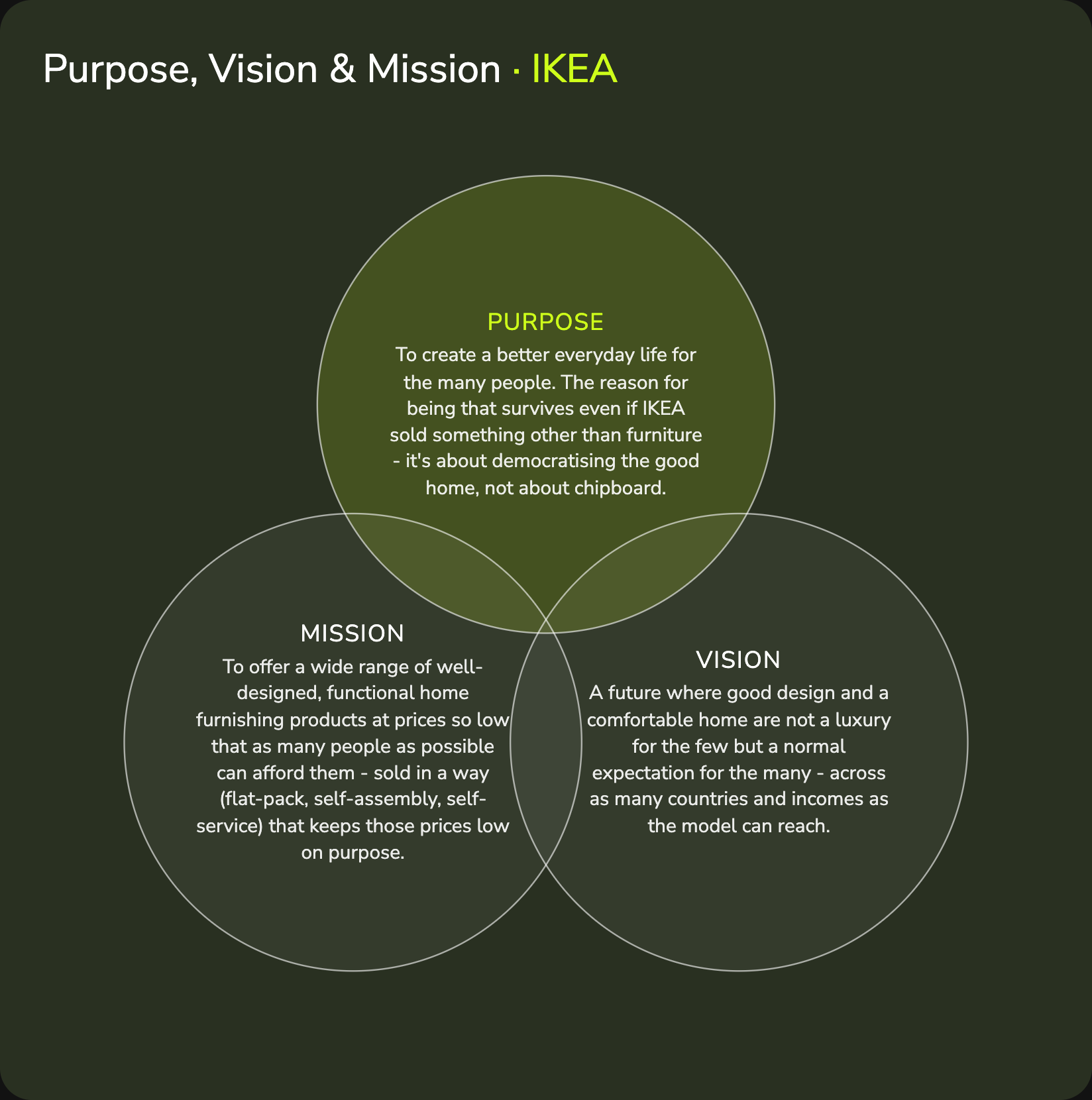
Purpose, Vision & Mission: IKEA - see the full breakdown
That's what a mission is for. It explains why the company makes the annoying decisions it makes. If yours can't explain a single annoying decision, it's decoration.
What a good mission sounds like
The classic is Google's: to organise the world's information and make it universally accessible and useful. It has a verb you can watch, a scope, and a test. On any given day an engineer can ask whether a project helps organise information or make it more useful, and get a yes or a no.
Compare it with the one you've read a hundred times: "to deliver exceptional value to our customers, employees and shareholders". It has no verb you can watch and no audience you could point at. It describes the existence of a company, not its work. If the sentence fits your competitor, it isn't your mission.
What a good vision sounds like
A vision is a picture of the future, and the useful ones can be checked. Microsoft's early "a computer on every desk and in every home" is the standard example, because one day you could walk into homes and count. Jim Collins and Jerry Porras wrote the reference piece on this in Building Your Company's Vision for HBR in 1996, which is also where the "big hairy audacious goal" comes from.
Airbnb is a good case of mission and vision pulling apart. The mission in our library example is plain and bookable: help people find unique places to stay, hosted by locals. The vision is bigger: a world where staying in a stranger's spare room is a normal, trusted way to belong somewhere new. One describes the product. The other describes the change in behaviour the product is betting on.
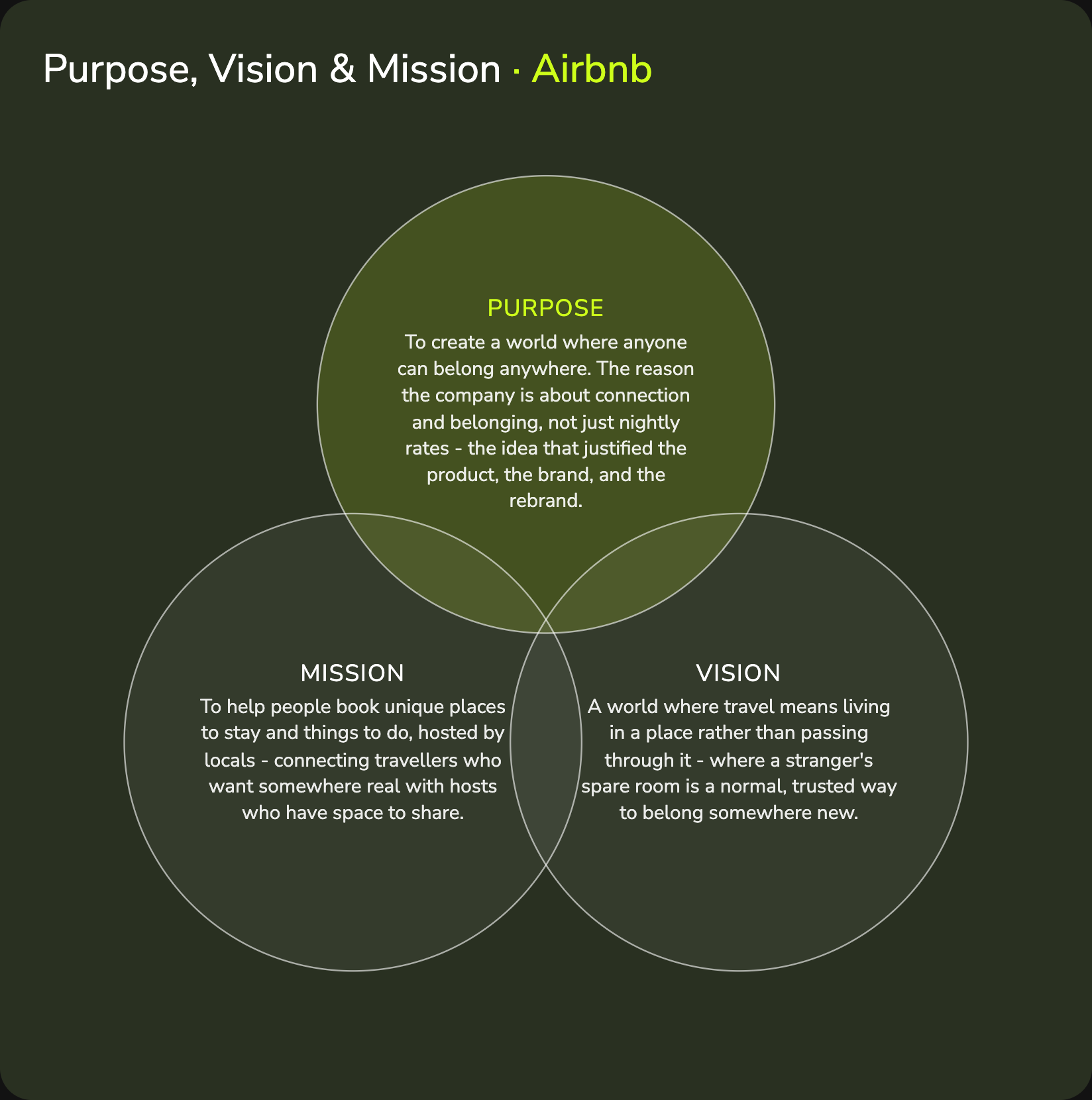
Purpose, Vision & Mission: Airbnb - see the full breakdown
The Belong Anywhere film never mentions a nightly rate. It sells the feeling of arriving somewhere unfamiliar and being let in. That's the vision and purpose doing the talking while the mission waits for you in the app.
Watch: Airbnb: Belong Anywhere - see it in our campaigns library
When it actually changes something
Statements only matter when they cost something. Dove decided its reason to exist was women's self-esteem rather than soap, and then spent against it for two decades: the Real Beauty work, the Self-Esteem Project, a pledge not to digitally distort the women in its ads. You can disagree with purpose marketing in general and still admit this one has receipts.
Watch: Dove: Real Beauty - see it in our campaigns library
The test I use with clients is the same one from the start of this post, plus one more question. Could a competitor sign your statement without changing anything? And what is one thing you said no to last year because of it? If there's no answer to the second question, the statement isn't doing any work yet.
How to use the two together
Write the mission first. It's the easiest to check, and it keeps the vision from floating off.
Write the vision as a future you could recognise, with a rough date, and leave out the adjectives.
Add a purpose only if it explains decisions the other two can't. Plenty of good companies run fine without one.
Turn the vision into something you can measure this year. That's where OKRs come in.
The full framework, with the three tiers, the common mistakes and three worked examples, is in the marketing frameworks library. Before you rewrite anything, print your current mission next to your biggest competitor's and cover the logos. If you can't tell them apart, you know where to start.