Nine frameworks for paid social - Hi5, 3-3-3 testing, Customer Awareness Stages, Market Sophistication, the Value Equation, Hook-Story-Offer, Hook-Retain-Reward, PASTOR and STEPPS - and when each one earns its place.
Most agencies still run paid social like a relay race. The brand team writes the idea, hands over the baton, and the performance team turns it into 27 versions that differ mostly in button colour. I've watched this handover for years at TRIAD, where I'm a co-owner, and I've started to think the baton is the problem.
Since Meta rebuilt ad delivery around Andromeda, the algorithm picks who sees each ad by reading the ad itself. You no longer aim the ad at an audience. The creative is the targeting. So when an account says it needs "more creative", it rarely needs more production. It needs more different things to say.
That is the job of the Performance & Social category: nine frameworks for working out what to say, how many genuinely different ways to say it, and how to build an ad that people actually watch to the end.
The newest frameworks are from 1966
The odd part is that the most useful tools for an algorithm launched in the 2020s were written by a copywriter called Eugene Schwartz in Breakthrough Advertising, a book older than the colour TV in most European homes. The algorithm is new. The buyers' heads work exactly as they did.
Customer Awareness Stages sorts people by what they already know: Unaware, Problem-Aware, Solution-Aware, Product-Aware, Most-Aware. The claim that sells to someone with your tab already open is noise to someone who doesn't know they have the problem. Diagnose the stage first, then write the ad.
The diagram below runs one product, a daily greens powder, through all five stages. Same scoop, five different ads.
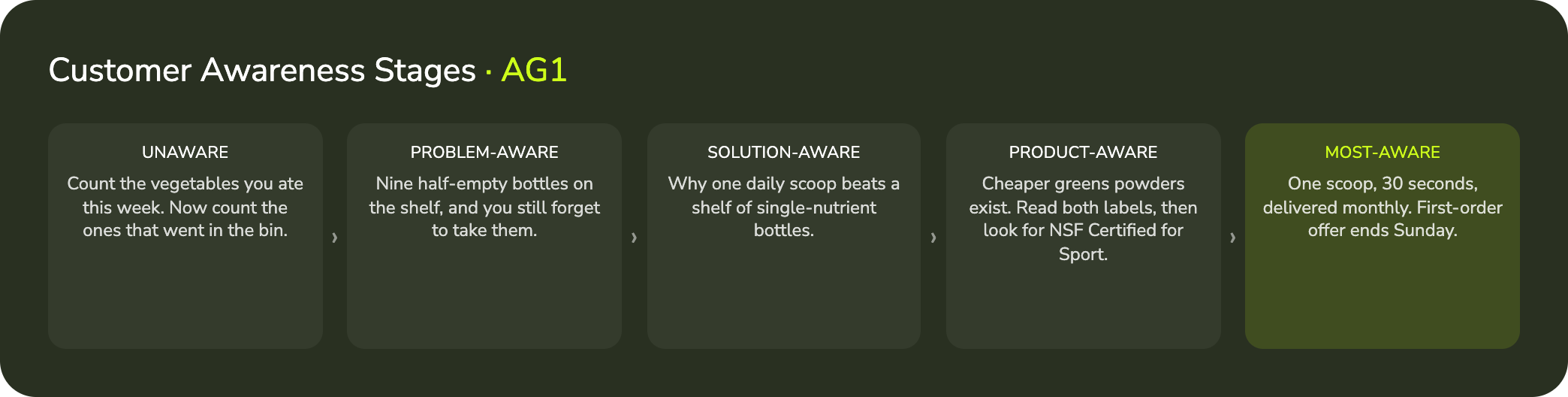
Customer Awareness Stages: AG1 - see the full breakdown
Its sister, Market Sophistication, asks the same question about the market instead of the buyer. How many claims has this category already heard? In a fresh market you lead with the claim. In a tired one, like hydration drinks or protein bars, every claim has been made twice, so you move to a unique mechanism and finally to identity. If you get the level wrong, a perfectly true claim sounds like everyone else's.
Volume without 27 copies of one thought
Once the algorithm wants a wide pool of ads, the honest question is where the ideas come from. "Make 50 ads" usually produces one ad 50 times, because the team had one thought and many fonts.
The Hi5 Framework is our answer to that, and yes, it's ours. It crosses three axes, five values each: Awareness (Schwartz again), Persona and Desire. That gives you 5 × 5 × 5 = 125 cells, and every cell is a different brief, a different person in a different state of mind chasing a different outcome. Walk the cube and you get volume with diversity built in, which is exactly what Andromeda rewards.
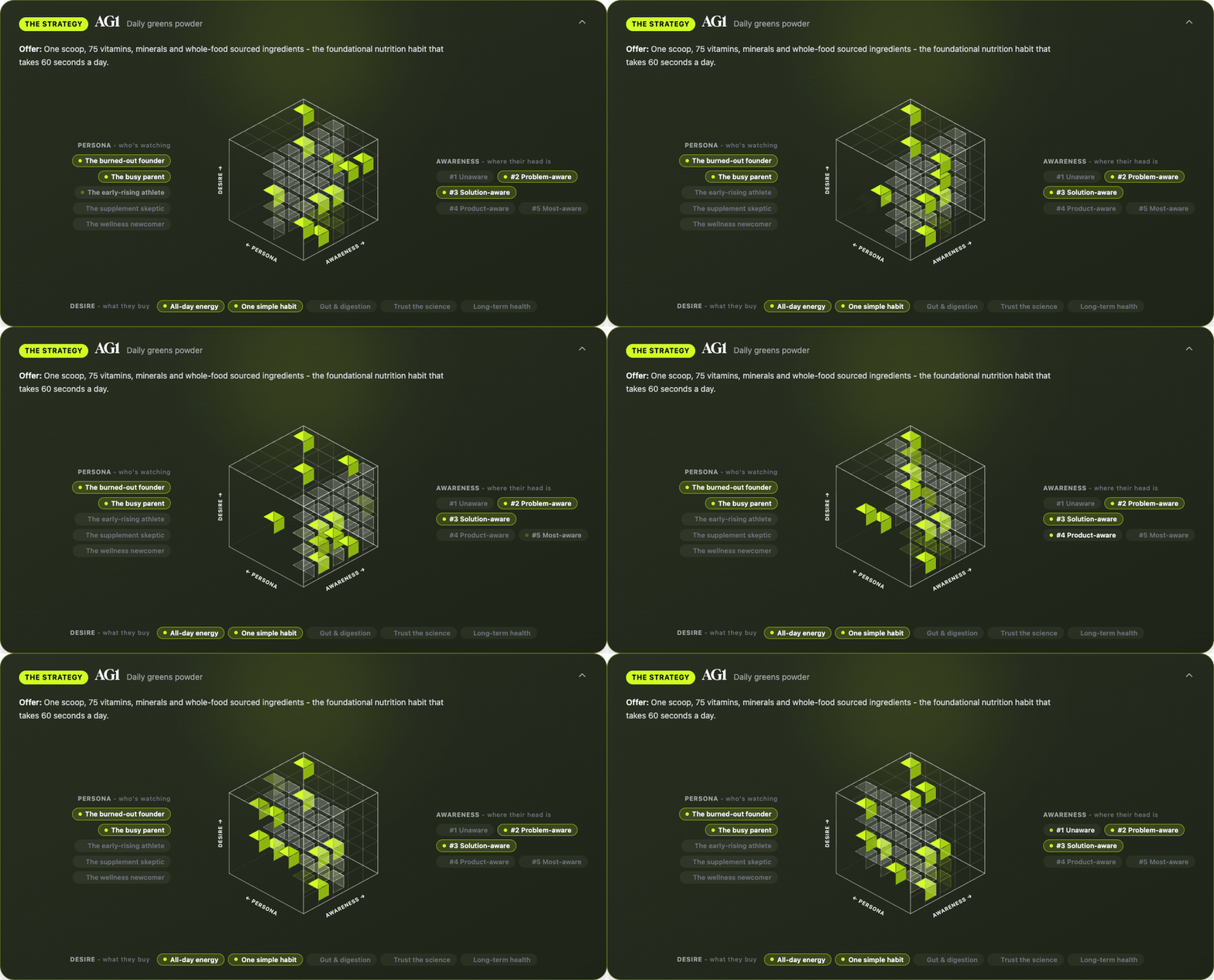
The Hi5 Framework: AG1 walked across the cube - see the full breakdown
Then you need a way to find out which cells actually work. The 3-3-3 Creative Testing Framework, popularised by Pilothouse, turns "test more" into a proper experiment: three concepts, three variations of each, three hooks per variation. You learn what to say first, then how to show it, and only then which opening line wins. Most accounts test in reverse order and end up with a statistically significant headline on a concept nobody wanted.
A framework in performance isn't there to make the deck prettier. It's there so your 27 test ads are 27 different ideas, not 27 colours of one button.
Fix the offer before you fix the ad
Sometimes the creative isn't the problem at all. The Value Equation from Alex Hormozi's $100M Offers breaks perceived value into four levers. The dream outcome and the perceived likelihood of getting it push value up. The time delay and the effort it costs push it down.
Greens gummies are a neat example. Same nutrition promise as a powder, but tearing open a pack beats a shaker and a glass of water, so the effort lever does the selling. A strong offer makes an average ad work. A weak offer makes a brilliant ad look broken, and the team blames the hook.
The anatomy of an ad people finish
Three frameworks deal with the inside of the ad itself. They overlap, so here is the honest difference.
Hook-Story-Offer, from Russell Brunson's DotCom Secrets, is the diagnostic. Every ad is a hook that earns attention, a story that earns belief and an offer that earns the click. When an ad fails, one of the three is broken, and it is usually the hook, because nobody hears an offer they scrolled past.
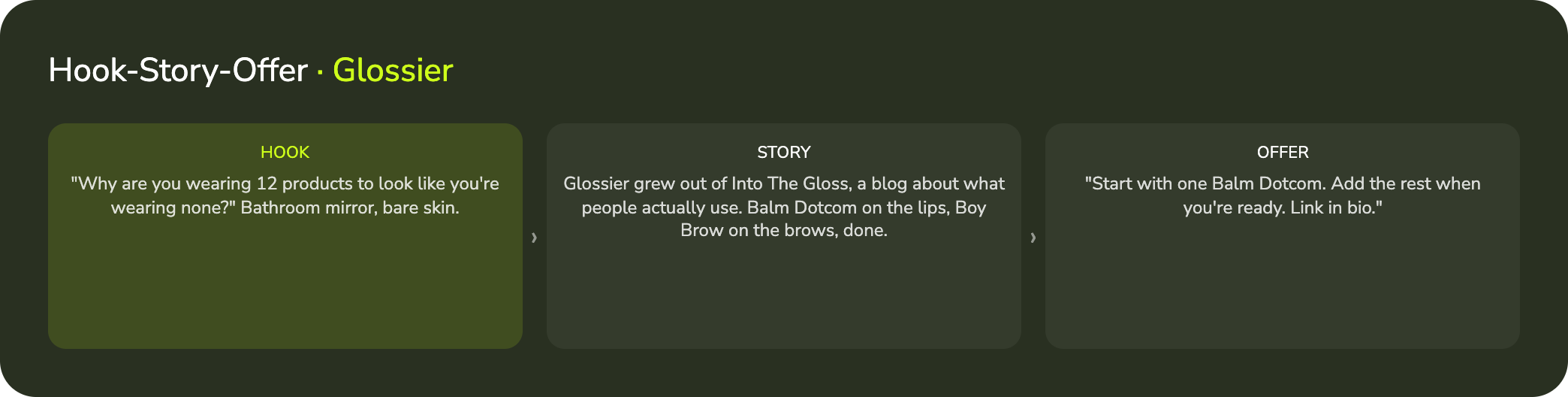
Hook-Story-Offer: Glossier - see the full breakdown
The textbook case is still Dollar Shave Club from 2012. The hook is a founder telling you his blades are great, with a word you can't say on TV. The story is a walk through the warehouse that keeps punching. The offer is a dollar a month. Ninety seconds, three beats, and a category that suddenly looked overpriced.
Watch: Dollar Shave Club: Our Blades Are F***ing Great - see it in our campaigns library
Hook-Retain-Reward is the short-form version, built for feeds where watch time counts as a vote. The hook stops the thumb in the first three seconds, the middle keeps opening small loops of curiosity so nobody bails, and the ending pays off the watch. Hook-Story-Offer tells you what the ad must contain. Hook-Retain-Reward tells you how to keep people around long enough to hear it.
PASTOR is the long-form workhorse for sales pages and video sales letters: Problem, Amplify, Story, Transformation, Offer, Response. Use it when you have two minutes and a skeptical buyer. On a six-second Reel it is a lecture.
Make it spread on its own
Paid reach costs money. Shared reach doesn't. STEPPS, from Jonah Berger's Contagious, lists six reasons people pass things on: Social currency, Triggers, Emotion, Public, Practical value and Stories. Most brand content hits none of the six and then gets a "boost" budget to make up for it.
Duolingo's owl on TikTok hits several at once. Sharing an unhinged owl makes you look in on the joke, and every app notification reminds you of it. The whole thing runs on mild emotional blackmail. Nobody shares a brand. People share what the brand says about them.
Watch: Duolingo: Chaotic Owl on TikTok - see it in our campaigns library
How to actually pick one
Don't know what to say to whom? Start with Customer Awareness Stages and Market Sophistication.
Need many genuinely different ads? Walk the Hi5 Framework, then test the winners with 3-3-3.
Good ads, bad results? Check the offer with the Value Equation before you touch the creative.
Writing the ad itself? Hook-Story-Offer for the structure, Hook-Retain-Reward for short video, PASTOR for long form.
Want reach you don't pay for? Run the idea through STEPPS.
None of these will rescue a product nobody wants, and all of them will happily organise a dull idea into a tidy grid. What they do remove is the excuse that performance creative is a production problem. It is a thinking problem with a deadline.
Every framework here has a live diagram, worked examples on real brands and the sources, in the marketing frameworks library. For the hooks, angles and formats that turn a Hi5 cell into an actual ad, see the social media ad techniques. Pick one cell of the cube for your product tonight and write the ad that only that person would stop for.