STEPPS
People share things for predictable reasons, and Berger reverse-engineered them into six levers. Hit more of them and content spreads further on its own - which is free reach, the most valuable kind on social. Most brand content hits zero of the six and then wonders why nobody shared it.
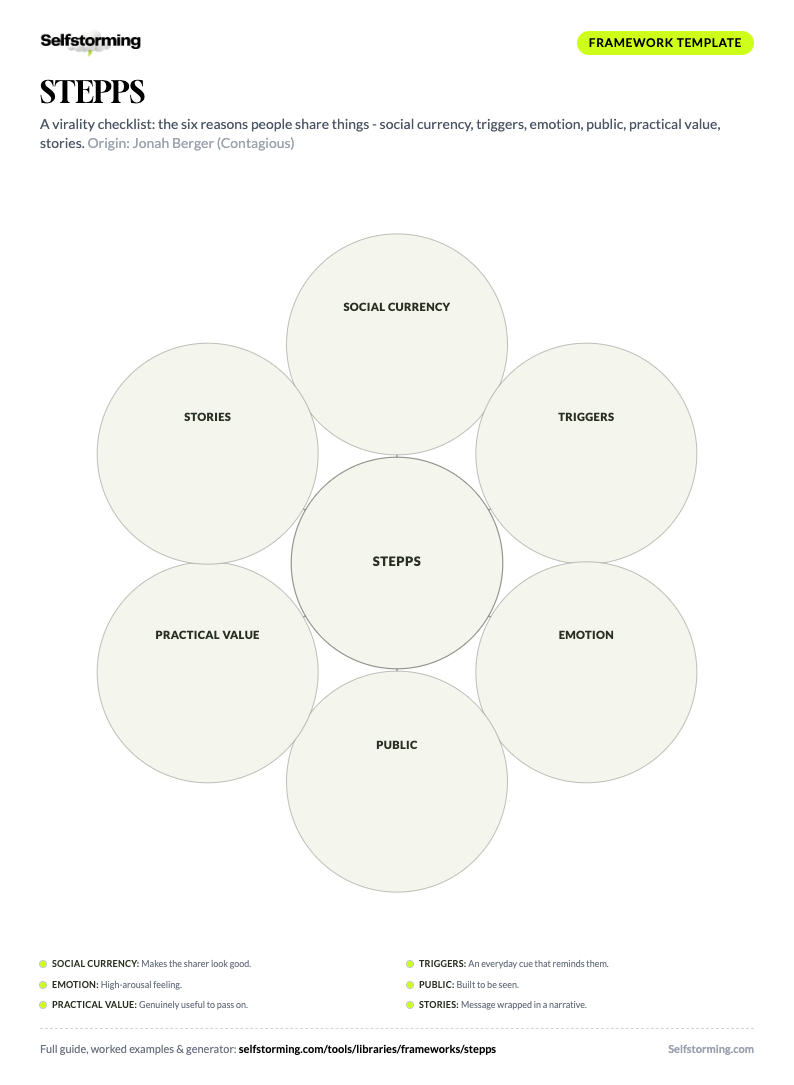
Print it. Fill it in.
The STEPPS as a printable A4 worksheet - write straight into the framework, on paper or in any PDF app.
Download the PDF templateSTEPPS
A virality checklist: the six reasons people share things - social currency, triggers, emotion, public, practical value, stories.
What is STEPPS?
Jonah Berger's six drivers of why things catch on - Social currency, Triggers, Emotion, Public, Practical value, Stories. Virality is not luck; it is engineered by building these levers into the content itself.
Worked Examples
Three real brands. Different categories, different sizes. Same framework, filled in.
A DTC snack brand
FMCG / DTCEngineering a shareable launch instead of a quiet one.
The 6 Layers, One By One
Each one answers a specific question - here is how to fill it in, and how to tell a sharp answer from a lazy one.
1. Social currency
Does sharing this make them look good?
People share things that make them look smart, in-the-know or part of an in-group. Build in something that elevates the sharer's status.
An insider stat or a "did you know" that makes the sharer look clever.
Content that only flatters the brand, giving the sharer no status to gain.
2. Triggers
What everyday cue reminds them of it?
Top of mind, tip of tongue - link the idea to a frequent cue in daily life so something keeps reminding people of it.
Tying a snack to "the afternoon slump" so every 3pm is a trigger.
A clever idea with no everyday hook, so nothing brings it back to mind.
3. Emotion
Does it stir high-arousal feeling?
When we care, we share - especially high-arousal emotions (awe, excitement, anger, humour). Low-arousal feelings like contentment do not travel.
An awe-inspiring transformation or a genuinely funny take.
Aiming for "nice" - low-arousal emotion that nobody bothers to pass on.
4. Public
Is it built to be seen?
Built to show, built to grow - the more visible the behaviour or product, the more it spreads. Make the private public.
A distinctive pack or a shareable result people post without prompting.
A great product whose use is invisible, so nobody sees others using it.
5. Practical value
Is it genuinely useful to pass on?
News people can use - useful, helpful content gets shared because helping others feels good. Make it practically valuable.
A genuinely useful tip or saving that people forward to a friend.
Thin "value" that does not actually help, so nobody passes it on.
6. Stories
Is the message wrapped in a story?
People do not share information, they share stories - so carry your message inside a narrative people want to retell.
A founder origin or customer story that carries the product inside it.
A bare claim with no story, so the message has no vehicle to travel in.
Origin & Lineage
From Jonah Berger's Contagious: Why Things Catch On (2013), based on years of research into what makes ideas, products and content spread.
Critics
It explains sharing after the fact better than it guarantees it before - hitting all six does not promise virality, and chasing shares can pull you away from selling. Some categories are simply less shareable no matter how many levers you pull.
How To Build It
A workshop flow that produces a usable v1 in a day - with the right people in the room, or just you and a Selfstorming strategy session right here.
Score the six
Rate your content idea against each of the six STEPPS drivers.
Add social currency
Give the sharer something that makes them look good.
Build a trigger
Link the idea to a frequent everyday cue.
Raise the emotion
Aim for high-arousal feeling, not pleasant-but-flat.
Make it public and useful
Build it to be seen, and worth passing on.
Wrap it in a story
Carry the message inside a narrative people want to retell.
How This Framework Compares
| Aspect | When It Works | When It Doesn't |
|---|---|---|
| Hook-Retain-Reward | Use HRR to make a single video get watched. | STEPPS is about making content get shared beyond the people you paid to reach. |
| The Hook Model | Use the Hook Model to build habit-forming products. | STEPPS is about content spreading, not in-product retention loops. |
Frequently Asked Questions
What is STEPPS?
STEPPS is Jonah Berger's framework for why things go viral - six drivers of sharing: Social currency, Triggers, Emotion, Public, Practical value and Stories. Build more of them into content and it spreads further on its own.
How do you use STEPPS to make content shareable?
Score your idea against the six drivers and strengthen the weakest - give sharers status, tie it to an everyday trigger, raise the emotion, make it visible and useful, and wrap it in a story people want to retell.
Does STEPPS guarantee virality?
No. It dramatically improves the odds by engineering the drivers of sharing, but virality is never guaranteed and some categories are simply less shareable.
Sources & Further Reading
Related Frameworks
Hi5 Framework
A 5 x 5 x 5 ideation matrix for paid social. Cross three independent axes - Awareness x Persona x Desire - and you get 125 distinct things t
Customer Awareness Stages
Eugene Schwartz's five stages of awareness - Unaware, Problem-Aware, Solution-Aware, Product-Aware, Most-Aware. Where a buyer's head is deci
Hook-Retain-Reward
The retention spine of short-form video. Hook the scroll in the first 3 seconds, retain attention through the middle by paying off curiosity
The 3-3-3 Creative Testing Framework
Test 3 concepts x 3 variations x 3 hooks - a structured 27-asset matrix for finding winning Meta ads fast. Test concepts (genuinely differen