Hook Model
How Products Build Habits in Four Moves
Most products beg for attention. A few never have to ask, because you already opened them before you decided to. That gap - between the product you choose and the product your thumb chooses for you - is what Nir Eyal's Hook Model tries to engineer.
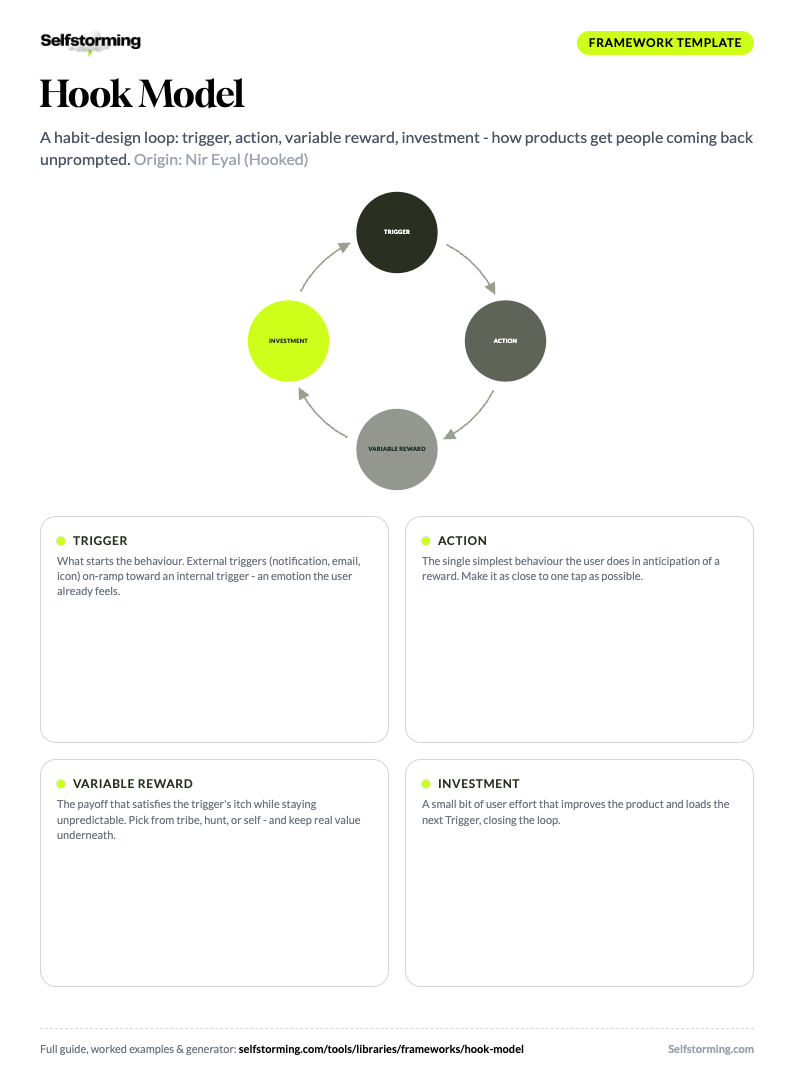
Print it. Fill it in.
The Hook Model as a printable A4 worksheet - write straight into the framework, on paper or in any PDF app.
Download the PDF templateKnowledge Worth Paying For
A working library of brand strategy frameworks - with worked examples on real brands, sources, and decision criteria. Not vibes.
One good deck covers the subscription. The rest is profit.
Four steps in a loop: Trigger (what starts the behaviour, external first then internal), Action (the simplest thing the user does for a reward), Variable Reward (a payoff that surprises, so the brain keeps craving), and Investment (a small bit of work that improves the product and loads the next Trigger). The loop closes because the Investment is what fires the next Trigger - that's how an app stops needing to remind you and starts living in your habits.
BeReal
Photo-sharing app (France, founded 2020)Almost the whole product is one hook loop with nothing bolted on: a single unpredictable daily trigger, a two-minute action, the variable reward of seeing everyone at once, and an investment that quietly makes tomorrow’s trigger matter more.
External: the once-a-day 'Time to BeReal' notification that fires at an unpredictable moment. Internal: the small fear of being late and the itch to see what everyone else is doing right now.
Take the front-and-back photo within two minutes - no filters, no staging, no caption to agonise over. The whole point is that it's too fast to overthink.
Variable and social: you only unlock your friends' posts once you've posted your own, and you never know who'll be doing something funny, awkward, or completely boring. The unpredictability is the reward.
Strava
Fitness tracking and social network for athletes (USA, founded 2009)Shows the loop running on rewards of the tribe more than the hunt. The activity itself happens offline, but the kudos, comments, and segment leaderboards pull people back into the app - and following other athletes is the investment that arms tomorrow's social triggers.
External: a kudos notification, a comment on your run, a friend's posted activity. Internal: the post-workout urge to log the effort and see how it stacks up, and the quiet anxiety of a fitness routine you don't want to fall out of.
Open the app and record an activity, or scroll the feed of friends' workouts. Auto-detection and one-tap start strip the friction from logging the thing you just did.
Variable social validation (you never know how many kudos a run will get), segment leaderboard placement (reward of the hunt - did you take a crown?), and personal-record badges (reward of the self).
Headspace
Meditation and mindfulness app (UK/USA, founded 2010)A gentler, more defensible Hook Model and a useful contrast to the doomscroll loops. The same four steps build a habit users actively want, which is the cleanest answer to the 'is this manipulative?' question - the loop passes Eyal's own test because it measurably improves the user's day.
External: a daily reminder at a chosen time, a 'continue your course' nudge. Internal: stress, racing thoughts before sleep, the overwhelmed feeling that the product explicitly teaches you to associate with opening it.
Press play on a single short session - one tap from the home screen, with a session pre-selected so there's almost nothing to decide.
A genuine shift in state (reward of the self - calmer, more focused), gentle variability in session content and teacher, and a sense of progress through a course you can feel.
BeReal, Strava, Headspace - filled in, line by line. Unlock to read them.
BeReal (Photo-sharing app (France, founded 2020))
Almost the whole product is one hook loop with nothing bolted on: a single unpredictable daily trigger, a two-minute action, the variable reward of seeing everyone at once, and an investment that quietly makes tomorrow’s trigger matter more.
Trigger: External: the once-a-day 'Time to BeReal' notification that fires at an unpredictable moment. Internal: the small fear of being late and the itch to see what everyone else is doing right now.
Action: Take the front-and-back photo within two minutes - no filters, no staging, no caption to agonise over. The whole point is that it's too fast to overthink.
Variable Reward: Variable and social: you only unlock your friends' posts once you've posted your own, and you never know who'll be doing something funny, awkward, or completely boring. The unpredictability is the reward.
Investment: Every post builds your private 'Memories' archive, RealMojis and comments pull friends back, and being late or absent costs you visibility - each day quietly raises the stakes of tomorrow's trigger.
Strava (Fitness tracking and social network for athletes (USA, founded 2009))
Shows the loop running on rewards of the tribe more than the hunt. The activity itself happens offline, but the kudos, comments, and segment leaderboards pull people back into the app - and following other athletes is the investment that arms tomorrow's social triggers.
Trigger: External: a kudos notification, a comment on your run, a friend's posted activity. Internal: the post-workout urge to log the effort and see how it stacks up, and the quiet anxiety of a fitness routine you don't want to fall out of.
Action: Open the app and record an activity, or scroll the feed of friends' workouts. Auto-detection and one-tap start strip the friction from logging the thing you just did.
Variable Reward: Variable social validation (you never know how many kudos a run will get), segment leaderboard placement (reward of the hunt - did you take a crown?), and personal-record badges (reward of the self).
Investment: Following athletes, joining clubs, and building a history of activities. Each follow and each logged run loads the next trigger - more people to give you kudos, more segments to defend, a streak of training you'll feel compelled to continue.
Headspace (Meditation and mindfulness app (UK/USA, founded 2010))
A gentler, more defensible Hook Model and a useful contrast to the doomscroll loops. The same four steps build a habit users actively want, which is the cleanest answer to the 'is this manipulative?' question - the loop passes Eyal's own test because it measurably improves the user's day.
Trigger: External: a daily reminder at a chosen time, a 'continue your course' nudge. Internal: stress, racing thoughts before sleep, the overwhelmed feeling that the product explicitly teaches you to associate with opening it.
Action: Press play on a single short session - one tap from the home screen, with a session pre-selected so there's almost nothing to decide.
Variable Reward: A genuine shift in state (reward of the self - calmer, more focused), gentle variability in session content and teacher, and a sense of progress through a course you can feel.
Investment: Building a meditation streak, completing courses, and setting preferred times trains the app and racks up stored progress. The streak and the learned association between stress and the app become the internal trigger that starts the next loop without a single notification.
1. Trigger
What prompts the user to act - and is it an external nudge or an internal feeling they already have?
The cue that starts the loop. External triggers are explicit and outside the user: a notification, an email, a friend's text, an app icon waiting on the home screen. Internal triggers are the goal - an emotion or routine the user already carries (bored in a queue, anxious about an answer, lonely on a Sunday) that fires the behaviour with no external prompt at all. A habit-forming product spends external triggers like fuel until the behaviour bonds to an internal one.
In practice: The 3pm slump becomes the trigger, not the badge. A meditation app starts by reminding you at 8am. Months in, you open it the moment you feel overwhelmed - no notification required. The internal trigger (stress) does the work the push notification used to.
Common mistake: Spamming external triggers forever. Treating notifications as the strategy instead of the on-ramp. If the behaviour never bonds to an internal trigger, you're renting attention - the day a user mutes you, the loop dies.
2. Action
What is the single simplest behaviour the user does in anticipation of a reward - and can we make it easier?
The behaviour done in expectation of a reward. Per BJ Fogg, an action happens when motivation, ability, and a trigger arrive at the same moment - so the lever you control is ability: make the action stupidly easy. Pull to refresh. Tap to play. Swipe to like. Every extra step is friction between the trigger and the reward, and friction is where habits go to die.
In practice: Press play. That's it. Opening an app and seeing one tappable thing - a single button, a pre-loaded feed, a resume-where-you-left-off card. The action is so light it happens before deliberation does.
Common mistake: Demanding effort before the payoff. A signup wall, a setup wizard, a 'complete your profile' gate standing between the trigger and the first reward. You've added motivation requirements to a step that should cost almost nothing.
3. Variable Reward
Does the payoff satisfy the user's craving while staying unpredictable enough to keep them wanting more?
The reward that resolves the trigger's itch - but with variability baked in, because predictable rewards stop being interesting. Eyal names three flavours: rewards of the tribe (social validation, likes, replies), rewards of the hunt (information, deals, the next scroll), and rewards of the self (mastery, completion, a streak). The surprise is the point: not knowing exactly what you'll get is what keeps the brain leaning in for one more pull.
In practice: You never know which one will land. A feed where most posts are forgettable but one in twenty is genuinely great. The unpredictability is the feature - a perfectly predictable feed would be closed in a week.
Common mistake: Making the reward a sure thing - or a slot machine with no substance. Predictable payoffs bore people; manufactured variability with nothing real underneath (random points, hollow confetti) trains users to feel jerked around. Variability without genuine value erodes trust fast.
4. Investment
What small bit of effort can the user put in now that improves the product and makes the next trigger more likely?
The user does a little work that loads value into the product for next time: adds data, follows accounts, builds a playlist, racks up a streak, trains the algorithm by tapping likes. Two things happen. The product gets better for that specific user (stored value, the IKEA effect of caring about what you helped build), and - this is the loop-closing part - the investment is what loads the next Trigger. Follow someone today and their post triggers you tomorrow. Build a streak and the fear of breaking it becomes an internal trigger. Investment is the hinge that turns four straight steps into a circle that restarts itself.
In practice: Every follow you make becomes tomorrow's notification. Following accounts, saving items, or building a streak quietly arms the next loop - the product now has a reason to trigger you that you handed it yourself.
Common mistake: Asking for investment that benefits you, not them. A 'rate us' popup or a survey right after the reward is extraction, not investment. Real investment leaves the user with something better and gives the product an honest reason to bring them back - skip it and your loop never closes.
Decide your starting point: you don't have to map the loop on a blank whiteboard. Right here on Selfstorming you can find inspiration and patterns from products that already nailed this, or generate a first-draft Hook Model in minutes. Treat that draft as a head start, then pressure-test each step against your real usage data.
Name the internal trigger first, not the notification. Write down the actual emotion your product resolves - bored, anxious, lonely, behind. If you can't name a feeling a user already has, you don't have a habit candidate, you have a tool people open on purpose. That's fine, but it changes the whole strategy.
List your external triggers and rank them by how naturally they hand off to that internal trigger. The job of an external trigger is to make itself redundant. If a notification can't plausibly train someone toward the internal cue, it's just noise you'll eventually have to apologise for.
Strip the action down to one tap. Map every step between trigger and first reward, then delete steps until you can't. Motivation is hard to add and easy to lose; ability is the lever you actually control. Move every possible bit of effort out of the Action step and into the Investment step where it belongs.
Design the reward to satisfy and surprise - and check it's real. Pick which flavour you're offering (tribe, hunt, or self), then build in genuine variability rather than fake randomness. Ask the honest question: if a user saw exactly what they'd get every time, would they still come? If not, find the real variable value.
Engineer the investment to load the next trigger. This is the step most teams botch. After the reward, ask for a small, value-adding action - follow, save, configure, continue a streak - and trace explicitly how that action arms tomorrow's trigger. If you can't draw the line from step four back to step one, your loop is open and your retention will leak.
Run the manipulation test on the whole loop. Eyal's own test: would you, the maker, use this? And does it materially improve the user's life? If the answer is 'it improves our metrics' but not 'it improves their day', you've built a trap, not a habit. Cut it or fix the value.
Instrument the loop and watch where users fall out. Measure trigger response, action completion, reward satisfaction, and return rate after investment. The Hook Model is a hypothesis until the data agrees. Most loops break at the same place twice - usually a reward that stopped being variable, or an investment nobody saw the point of.
Best for: Designing repeat-engagement loops in products people use often by choice - apps, feeds, learning tools, fitness, anything where a daily or weekly habit is the goal. / One-time or low-frequency products (tax filing, insurance claims, major purchases) where forcing a habit is pointless or off-putting. Use a conversion-focused model instead.
Output: A four-step loop diagram - Trigger, Action, Variable Reward, Investment - with a named internal trigger and an explicit arrow from Investment back to Trigger. / A list of features or a notification schedule. The Hook Model is a behavioural loop, not a backlog or a comms calendar.
Time to complete: A first loop map takes an hour or two with the right people; the hard part is validating it against real usage data over weeks, not drawing it. / Don't expect a same-day finished product. A loop on a whiteboard is a hypothesis until the retention numbers agree with it.
vs Fogg Behavior Model: Use the Hook Model when you need the full repeating cycle including reward and investment, not just the moment of a single action. / Use BJ Fogg's B=MAP (Behavior = Motivation, Ability, Prompt) when you're debugging one specific action that isn't happening. Fogg is the engine inside the Hook's Action step; the Hook wraps a loop around it.
vs AARRR: Use the Hook Model to design the behavioural mechanics of how a single user forms a habit inside one product. / Use AARRR (Pirate Metrics - Acquisition, Activation, Retention, Referral, Revenue) when you need a business-level funnel to measure and grow the whole user base. AARRR measures outcomes; the Hook designs the behaviour behind Retention.
vs EAST: Use the Hook Model when the goal is a self-restarting habit loop with a variable reward at its core. / Use EAST (Easy, Attractive, Social, Timely) from the Behavioural Insights Team when you want to prompt a one-off behaviour change (pay a tax, get a vaccine) rather than build a recurring habit. EAST is a nudge checklist; the Hook is a loop architecture.
The Hook Model was developed by Nir Eyal and published in his 2014 book Hooked: How to Build Habit-Forming Products, co-written with Ryan Hoover. Eyal built it on the behavioural work of BJ Fogg at Stanford, whose model (Behavior = Motivation + Ability + Prompt) sits inside the Hook's Action step, and on operant-conditioning research into variable rewards going back to B.F. Skinner. The framework crystallised how Silicon Valley products of the 2010s actually retained users, giving a name and a shape to mechanics that companies were already running by instinct.
The Hook Model has drawn sharp criticism, much of it fair. The central charge is ethical: a loop optimised to make products hard to put down looks a lot like designing for addiction, and the rise of 'time well spent' arguments (Tristan Harris and others) put exactly this kind of mechanic in the dock. Nir Eyal himself responded - first by adding a 'manipulation matrix' and a maker's ethics test to his work, then by writing a whole follow-up book, Indistractable (2019), on how to resist the very loops Hooked taught people to build, which critics read as either an honest course-correction or having it both ways. Beyond ethics, practitioners note the framework over-promises: not every product can or should be habit-forming, manufactured variable rewards can erode user trust rather than build it, and the model says little about whether the habit is good for the person living it. Used honestly it's a powerful design tool; used carelessly it's a recipe for the apps people most want to delete.
What is the Hook Model?
The Hook Model is a four-step loop, created by Nir Eyal in his 2014 book Hooked, for designing habit-forming products. The steps are Trigger (what starts the behaviour), Action (the simplest thing the user does for a reward), Variable Reward (a payoff that satisfies while staying unpredictable), and Investment (a small bit of user effort that improves the product and loads the next Trigger). Run the loop enough times and an external trigger like a notification gets replaced by an internal one like boredom - which is when a habit forms.
Is the Hook Model manipulative?
It can be, and that's the honest answer. The exact same loop builds a language-learning habit or a doomscrolling compulsion - the framework itself doesn't decide which. Nir Eyal took the criticism seriously enough to add a 'manipulation matrix' and a maker's ethics test (would you use it, and does it materially help the user?), and then wrote a follow-up book, Indistractable, on resisting these loops. The Hook Model is a tool. Whether it's manipulative depends entirely on whether you're building a habit people would thank you for or one they'd want to escape.
What are the four steps of the Hook Model?
Trigger, Action, Variable Reward, and Investment - in that order, and in a loop. The Trigger prompts the behaviour. The Action is the simple thing the user does in anticipation of a reward. The Variable Reward satisfies the craving while staying unpredictable. The Investment is a small effort that improves the product and, crucially, loads the next Trigger - which is why the four steps form a circle rather than a one-way funnel.
How is the Hook Model different from the Fogg Behavior Model?
BJ Fogg's model explains a single action: a behaviour happens when Motivation, Ability, and a Prompt arrive together (B=MAP). The Hook Model wraps a full repeating loop around that single moment, adding the Variable Reward and the Investment that make the user come back. In short, Fogg's model is the engine inside the Hook Model's Action step; the Hook Model is the loop built around it.
Why does the reward have to be variable in the Hook Model?
Because predictable rewards stop being interesting. The brain habituates to a known payoff fast, but a variable reward - where you don't know exactly what you'll get - keeps it anticipating and leaning in for one more go. The Hook Model names three flavours of variable reward: rewards of the tribe (social validation), of the hunt (information, resources), and of the self (mastery, completion). The unpredictability is the engine, not a gimmick.
Can the Hook Model be used for good, not just addictive apps?
Yes, and that's arguably its best use. The same loop that powers a doomscroll powers a meditation habit, a fitness routine, or a daily language lesson - products people actively want to keep. The deciding factor is Eyal's own manipulation test: does the loop materially improve the user's life, and would you, the maker, use it? Pass that test and the Hook Model is just good, honest habit design.
Which step of the Hook Model do teams get wrong most often?
The Investment. Most teams nail the Trigger and make the Action easy, then either skip the Investment or turn it into self-serving extraction (a 'rate us' popup). Real investment does two jobs at once: it leaves the user with something better (a tuned feed, a streak, saved work) and it loads the next Trigger. Get the Investment wrong and the loop never closes - which is why so many products that look habit-forming on paper leak users in practice.
Does every product need a Hook Model?
No. The Hook Model is for products meant to be used often, by choice. A one-time purchase, a tax filer, a funeral service - forcing a habit loop onto these is pointless at best and unsettling at worst. If your product solves a problem people meet rarely, you want a conversion-focused approach, not a habit loop. The first honest question is whether a recurring habit is even something your users would want.
A habit-design loop: trigger, action, variable reward, investment - how products get people coming back unprompted.
The Hook Model says habit-forming products run a loop of four steps: a Trigger that starts the behaviour, an Action the user takes in anticipation of a reward, a Variable Reward that satisfies and surprises, and an Investment that quietly makes the next loop more likely. Run the loop enough times and an external nudge (a notification) becomes an internal one (boredom, loneliness, the 3pm slump). That's the whole trick: you stop needing to remind people to come back.
Here's the part everyone skips. The Hook is not a funnel that ends. It's a circle. The Investment at step four is the thing that loads the next Trigger - you follow someone, so now their posts trigger you tomorrow. Read it as a staircase if you must, but it bends back on itself. The honest version of this page tells you that's also exactly why it's the most ethically loaded framework in the marketing canon, and why Eyal spent his next book teaching people how to escape it.
Related Frameworks
EAST
Four levers you apply to any behaviour you want to encourage: Easy (remove friction, use smart defaults, simplify the message), Attractive (
Fogg Behavior Model
Behaviour = Motivation x Ability x Prompt, all converging at one moment. Motivation is how much someone wants to act, Ability is how easy th