EAST
Framework: Make Behaviour Change Easy, Attractive, Social and Timely
Most plans to change behaviour fail for an embarrassingly small reason: they ask people to want the right thing instead of making the right thing the path of least resistance. You write a beautiful campaign about why citizens should pay tax on time, and the tax still arrives late - because the form had a dropdown nobody understood. The intention was never the problem. The friction was.
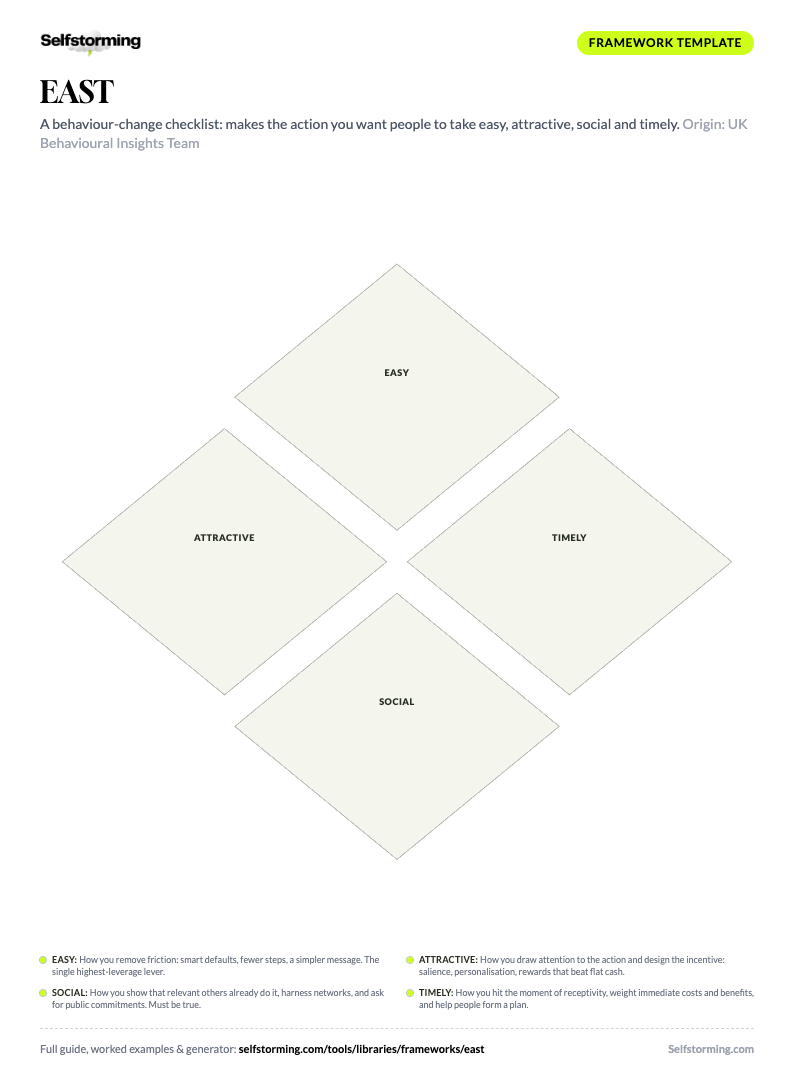
Print it. Fill it in.
The EAST as a printable A4 worksheet - write straight into the framework, on paper or in any PDF app.
Download the PDF templateKnowledge Worth Paying For
A working library of brand strategy frameworks - with worked examples on real brands, sources, and decision criteria. Not vibes.
One good deck covers the subscription. The rest is profit.
Four levers you apply to any behaviour you want to encourage: Easy (remove friction, use smart defaults, simplify the message), Attractive (draw attention and design the incentive so the desired action is the appealing one), Social (show that other people - especially similar people - already do it, and ask for commitments), and Timely (intervene at the moment a person is most able to act, and frame the immediate costs and benefits). It's a pre-flight checklist for nudges, not a theory of mind. Run it before you ship; if a lever is empty, you've found your next improvement.
Duolingo
Language-learning app (USA, founded 2011)A near-perfect EAST machine. Duolingo made learning Easy (bite-size lessons, one tap to start), Attractive (streaks, gems, a cast of characters), Social (leaderboards and friend streaks), and ferociously Timely (the daily reminder, sent at the hour you usually practise). The famous guilt-trip owl is just the Timely lever with a personality.

HMRC tax-reminder letters
UK public-sector behavioural trial (Behavioural Insights Team, 2011 onward)The studies that put EAST on the map. The Nudge Unit rewrote tax-reminder letters using social norms ('most people in your area have already paid') and made the required action clearer and simpler. The redesigned letters lifted on-time payment by measurable percentage points and reportedly pulled forward hundreds of millions in revenue - all from changing the words and the friction, not the tax.
Octopus Energy
UK renewable energy retailer (founded 2015)EAST applied to the genuinely boring act of using less electricity. Octopus's 'Saving Sessions' make reducing demand Easy (you barely change your routine), Attractive (real cash and prize-draw points), Social (collective targets and shared results), and Timely (alerts fired only during the specific high-grid-stress hours when shifting usage actually matters). It's a textbook case of nudging a habit that has no natural emotional pull.
Duolingo, HMRC tax-reminder letters, Octopus Energy - filled in, line by line. Unlock to read them.
Duolingo (Language-learning app (USA, founded 2011))
A near-perfect EAST machine. Duolingo made learning Easy (bite-size lessons, one tap to start), Attractive (streaks, gems, a cast of characters), Social (leaderboards and friend streaks), and ferociously Timely (the daily reminder, sent at the hour you usually practise). The famous guilt-trip owl is just the Timely lever with a personality.
Easy: Lessons shrunk to two-minute bursts you can finish in a lift queue, one tap from the home screen, no decision about where to begin - it picks up exactly where you left off.
Attractive: Streaks, gems, league promotions and animated characters turn a chore into a game. The reward is variable and immediate, which is far stickier than 'you will one day be fluent.'
Social: Leaderboards rank you against real people, friend streaks make a lapse let someone else down, and shared milestones turn solo study into a small social contract.
Timely: The daily reminder lands at the hour you normally practise, and a missed day triggers an escalating nudge - hitting the exact window where forming the habit is still possible.
HMRC tax-reminder letters (UK public-sector behavioural trial (Behavioural Insights Team, 2011 onward))
The studies that put EAST on the map. The Nudge Unit rewrote tax-reminder letters using social norms ('most people in your area have already paid') and made the required action clearer and simpler. The redesigned letters lifted on-time payment by measurable percentage points and reportedly pulled forward hundreds of millions in revenue - all from changing the words and the friction, not the tax.
Easy: The letter was rewritten in plain language with the single required action - pay now - stated clearly up front, removing the confusion that had let people defer without quite deciding to.
Attractive: Key information was made salient and the ask was sharpened, so the consequence of acting (and not acting) was impossible to skim past.
Social: The decisive change: a true social norm - 'the great majority of people in your local area pay their tax on time' - which made the late payer feel like the outlier they didn't want to be.
Timely: The reminder arrived at the decision point, close to the deadline, when the person still had time to act rather than after the window had shut.
Octopus Energy (UK renewable energy retailer (founded 2015))
EAST applied to the genuinely boring act of using less electricity. Octopus's 'Saving Sessions' make reducing demand Easy (you barely change your routine), Attractive (real cash and prize-draw points), Social (collective targets and shared results), and Timely (alerts fired only during the specific high-grid-stress hours when shifting usage actually matters). It's a textbook case of nudging a habit that has no natural emotional pull.
Easy: Opting in is a single tap and 'saving' means doing slightly less for an hour - delaying the dishwasher - rather than learning anything new or installing anything.
Attractive: Participants earn real money and prize-draw entries for the energy they shift, turning an invisible civic good into a visible, immediate, mildly competitive reward.
Social: Sessions are framed as a collective effort with shared targets and published results, so cutting your usage feels like joining a crowd rather than a lonely sacrifice.
Timely: Alerts fire only during the precise hours the grid is under strain and shifting demand genuinely helps - the one window where the behaviour has real value.
1. Easy
If we deleted every step, field, and decision that isn't strictly necessary, what is the smallest possible action we could ask for?
Reduce the friction between intention and action. Harness defaults (people overwhelmingly stick with the pre-selected option), simplify the message, and cut the number of steps. This is the lever that moves the most behaviour for the least cleverness - and the one most teams skip because removing things feels less like work than adding them.
In practice: Auto-enrolment into a workplace pension, with opt-out. The desired behaviour becomes the default and participation jumps from roughly half to nine in ten. Nobody was persuaded; the friction simply changed sides.
Common mistake: A 'quick' signup with eleven fields, a CAPTCHA, and a confirm-your-email-then-set-a-password dance. Every extra step is a silent exit. Teams add friction to 'qualify leads' and then wonder why intention leaks away before the finish line.
2. Attractive
What would make the desired action genuinely catch the eye and feel worth doing right now - not louder, but more appealing?
Draw attention to the action and design the incentive around it. Two halves: attract attention (personalisation, colour, images, a salient message) and design rewards and sanctions for maximum effect (lotteries often beat the same money paid out flat). Attractive is not 'add an exclamation mark' - it's making the right choice the obvious and rewarding one.
In practice: Naming the recipient in the subject line, then making the action a single bright button. Personalised, salient, one obvious next step. Attention goes where the design points it, and here it points at the thing you want done.
Common mistake: A homepage where seven things scream for attention in seven competing colours. When everything is attractive, nothing is. The primary action drowns in a sea of equally-loud secondary ones, and the eye gives up choosing.
3. Social
Who else - especially people like them - is already doing this, and how do we make that honestly visible?
People take cues from what others do, particularly others they identify with. Show that most people already perform the behaviour, use the power of networks, and encourage people to make a public commitment. The social lever is potent and dangerous in equal measure: it only works when the 'others' are real, relevant, and credibly doing the thing.
In practice: Nine out of ten people in your town pay their tax on time. You are currently in the minority. A true, specific, locally relevant norm. People comply because nobody enjoys being the odd one out on their own street.
Common mistake: Join thousands of happy customers! Vague, unverifiable, and probably borrowed. Worse is reverse social proof - 'most people haven't done this yet' - which quietly tells everyone that not doing it is the normal, acceptable choice.
4. Timely
When is this person most able and most willing to act - and are we reaching them in that exact window or long after it shuts?
Behaviour is easiest to shift at moments of change and at the point of decision. Prompt people when they are most receptive, consider the immediate costs and benefits (we over-weight the now), and help them make a plan to bridge intention and action. A great nudge delivered at the wrong moment is just litter.
In practice: Prompting someone to switch energy supplier the week they move house. Habits are already broken, the decision is live, and the friction of changing is at its lowest. The same message six months later hits a closed window.
Common mistake: A 'finish your profile' reminder sent at 3am, eleven days after they last cared. The intention has gone cold and the moment has passed. Timeliness isn't about sending more reminders; it's about sending one at the moment the person can actually do something.
Decide your starting point: You don't have to design a behaviour-change programme from a blank page. Right here on Selfstorming you can pull inspiration, sharpen each lever against your real audience, or generate a first-draft EAST plan in minutes. Treat the draft as a head start, not a verdict, then run it through the steps below to strip real friction, find an honest social norm, and pick the moment that actually converts. Workshop-from-scratch and AI-draft-then-pressure-test are both valid; most teams move faster from a draft.
Define the single behaviour, in the person's terms: Write down the one specific action you want one specific person to take - 'renew the policy before it lapses,' not 'increase engagement.' If you can't name the action and the actor, you're optimising a metric, not changing a behaviour.
Map the friction before you add anything: Walk the current journey step by step and count every field, click, decision, and moment of doubt. Most teams find three steps they could delete today. Removing friction is the highest-leverage move in EAST and the one everyone skips.
Attack Easy first, hard: Set the desired action as the default where it's ethical to do so. Simplify the message to one idea. Cut steps until removing one more would break the task. Only once Easy is exhausted should you reach for the other three levers.
Make the right action the attractive one: Direct attention with personalisation, salience, and a single obvious primary action - then design the incentive. Remember a lottery or a small immediate reward often beats a larger delayed one. Don't make it louder; make it more clearly worth doing.
Find a true, relevant social norm: Look for a real statistic about what people like your target already do, and make it specific and local. If most people don't yet do the thing, do NOT advertise that - find a different, honest comparison, or skip the lever. Never invent the crowd.
Pick the moment, then build the plan: Identify the window where the person is most able to act - a life change, a renewal date, the point of decision - and intervene there. Help them form an implementation intention ('when X happens, I'll do Y'), which is what turns a good intention into a done thing.
Run it, measure it, and prefer a test to an argument: EAST nudges are cheap to ship and their effects are small and sometimes don't replicate, so don't trust your intuition about which lever won. A/B test the change against the old version, keep what moves the behaviour, and bin what doesn't.
Best for: Encouraging a specific, simple behaviour - signing up, paying on time, switching, completing a form. Quick audits of an existing journey to find and remove friction. / Building motivation from zero, shifting deeply entrenched habits, or designing the underlying offer. EAST optimises a behaviour; it doesn't manufacture the desire for it.
Output: A short, action-ready list: one improvement per lever (Easy, Attractive, Social, Timely) that you can ship and test this week. / A psychological model of why the behaviour exists or a long-term motivation strategy. EAST gives you levers to pull, not an explanation of the machine.
Time to complete: Minutes to an hour to audit a journey or a single asset against the four levers. Fast enough to run in a standup. / Weeks of ethnographic research or behaviour-mapping. If you need that depth, EAST is the wrong altitude of tool.
vs Fogg Behavior Model: EAST is a practical, ship-it checklist for designing a nudge. Reach for it when you need an action plan, not an explanation. / Fogg (B=MAP: Motivation, Ability, Prompt) is a diagnostic model of why a behaviour does or doesn't happen. Use Fogg to diagnose; use EAST to design the fix.
vs Hook Model: EAST works on one-off and repeated behaviours alike and is comfortable in public-sector and one-time-action contexts. / The Hook Model (Eyal: Trigger, Action, Variable Reward, Investment) is built specifically for forming habitual product loops. Use Hook when the goal is daily-return retention, EAST when the goal is a clean single conversion.
vs AIDA: EAST is behaviour-first and friction-obsessed - it cares whether the person can act, not just whether they're persuaded. / AIDA (Attention, Interest, Desire, Action) is a persuasion and attention funnel for crafting a message. Use AIDA to write the ad; use EAST to make sure the action it points to is actually doable.
EAST was published in 2014 by the UK's Behavioural Insights Team - the unit set up inside David Cameron's Cabinet Office in 2010 and universally known as the Nudge Unit. Its report, EAST: Four simple ways to apply behavioural insights, distilled a sprawling academic literature into four words a civil servant could actually use on a Monday. The intellectual lineage runs straight back to Richard Thaler and Cass Sunstein's 2008 book Nudge, which popularised 'libertarian paternalism' and 'choice architecture,' and behind that to Daniel Kahneman and Amos Tversky's work on heuristics and biases. The Behavioural Insights Team began as a seven-person government team and later spun out as a global social-purpose company, exporting EAST to governments and organisations worldwide. The framework spread because, unlike most of behavioural economics, it was deliberately built to be remembered and applied by non-specialists.
The honest case against EAST is worth stating plainly. First, nudges are small - they shift behaviour by single-digit percentage points, and several celebrated findings have failed to replicate in the wider replication crisis, so any one famous result deserves suspicion. Second, EAST is a checklist, not a theory: it tells you what to try but not why a behaviour persists, which makes it useless for the deep, stubborn problems where motivation, not friction, is the barrier. Third, there's an ethics problem baked in - the same four levers power dark patterns and manipulation, and EAST itself draws no line between a respectful nudge and a sludgey trick. Finally, the field has been accused of over-claiming on the back of a handful of vivid wins (the tax-letter studies above all). The defensible way to use EAST is as a cheap, testable starting point you validate with your own data - never as proof that behavioural science has the answer.
What does EAST stand for?
EAST stands for Easy, Attractive, Social, Timely - the four levers the UK Behavioural Insights Team recommends applying to any behaviour you want to encourage. Make the desired action easier (less friction, smart defaults), more attractive (salient and well-incentivised), more social (others like them already do it), and more timely (delivered at the moment they can act). It's a checklist you run a nudge through before you ship it.
Who created the EAST framework?
EAST was created by the UK's Behavioural Insights Team, the government 'Nudge Unit' founded in 2010, and published in their 2014 report 'EAST: Four simple ways to apply behavioural insights.' It builds directly on Richard Thaler and Cass Sunstein's 2008 book 'Nudge' and on the heuristics-and-biases research of Daniel Kahneman and Amos Tversky.
Is EAST the same as the Fogg Behavior Model?
No. The Fogg Behavior Model (B=MAP: Behavior happens when Motivation, Ability, and a Prompt converge) is a diagnostic - it explains why a behaviour does or doesn't occur. EAST is a design checklist - it gives you four concrete levers to pull once you've decided what to encourage. Many teams use Fogg to diagnose the blockage and EAST to design the fix.
Does EAST actually work, or is it overhyped?
Both, honestly. EAST nudges produce real but small effects - often single-digit percentage shifts - and behavioural science has had genuine replication problems, so some celebrated results don't hold up. The pragmatic stance: EAST is a cheap, fast source of testable ideas. Treat every nudge as a hypothesis, A/B test it against the original, and keep only what your own data confirms. Don't trust the famous case studies to transfer to your context unexamined.
Is using EAST manipulative?
It can be, which is the uncomfortable part. The same four levers that power an honest nudge also power dark patterns - fake scarcity timers, invented social proof, sludge that makes cancelling hard. The line is simple to state and easy to cross: a respectful nudge is one you'd happily explain to the person's face, that serves their interest as well as yours, and that uses only true social proof. If you'd be embarrassed to disclose it, you've left EAST and entered manipulation.
When should I NOT use EAST?
When the barrier is motivation rather than friction. EAST assumes some latent willingness it can lower the cost of acting on - it's brilliant for 'they sort of want to but the form is painful' and useless for 'they fundamentally don't care.' For deeply entrenched habits, addiction, or building desire from zero, reach for a richer model like COM-B or the Fogg Behavior Model, and fix the underlying offer before you optimise the journey.
How is EAST different from AIDA?
AIDA (Attention, Interest, Desire, Action) is a persuasion funnel for crafting a message - it's about moving someone's mind. EAST is behaviour-first and friction-obsessed - it's about whether someone can and will actually act. AIDA helps you write the ad; EAST makes sure the action that ad points to is easy, attractive, social, and timely enough that the persuasion doesn't leak away at the last step. They're complementary, not competing.
Can EAST work for B2B and SaaS, not just government campaigns?
Yes - it's quietly everywhere in good SaaS. Smart defaults and shorter onboarding are Easy; in-product personalisation and well-designed upgrade incentives are Attractive; '4,000 teams at companies like yours use this' (when true) is Social; and triggering a prompt at the moment of value - right after a user hits a limit, not a random Tuesday - is Timely. The public-sector origin obscures how directly EAST maps onto activation, conversion, and retention work.
A behaviour-change checklist: makes the action you want people to take easy, attractive, social and timely.
EAST is the Behavioural Insights Team's answer to that, and it is gloriously unglamorous. Four words - Easy, Attractive, Social, Timely - that you run any nudge through before you ship it. Make it Easy (strip the friction). Make it Attractive (catch the eye, sharpen the incentive). Make it Social (show that others are doing it). Make it Timely (hit them at the moment they can actually act). It is a checklist, not a grand theory of the human mind, and that is exactly why it works on a Tuesday afternoon when you have a landing page to fix and no budget for a behavioural economist.
Done badly, EAST becomes a fig leaf for manipulation - dark patterns dressed up as 'choice architecture,' fake scarcity timers, made-up social proof. The honest version respects the person you're nudging and is happy to be explained to their face. This page walks each of the four levers, the question that unlocks it, and how to tell a real nudge from a cheap trick.
Related Frameworks
Fogg Behavior Model
Behaviour = Motivation x Ability x Prompt, all converging at one moment. Motivation is how much someone wants to act, Ability is how easy th
Hook Model
Four steps in a loop: Trigger (what starts the behaviour, external first then internal), Action (the simplest thing the user does for a rewa