Fogg Behavior Model
Why People Do (or Skip) the Thing You Want
Most teams treat behaviour like a motivation problem. The user didn't sign up, didn't finish the form, didn't come back on day two - so the fix must be a more inspiring headline, a punchier email, one more exclamation mark. BJ Fogg spent two decades at Stanford watching that assumption fail. His conclusion is almost rude in its simplicity: B=MAP. Behavior happens when Motivation, Ability, and a Prompt all show up at the same moment. Miss one and nothing happens, no matter how good the other two are.
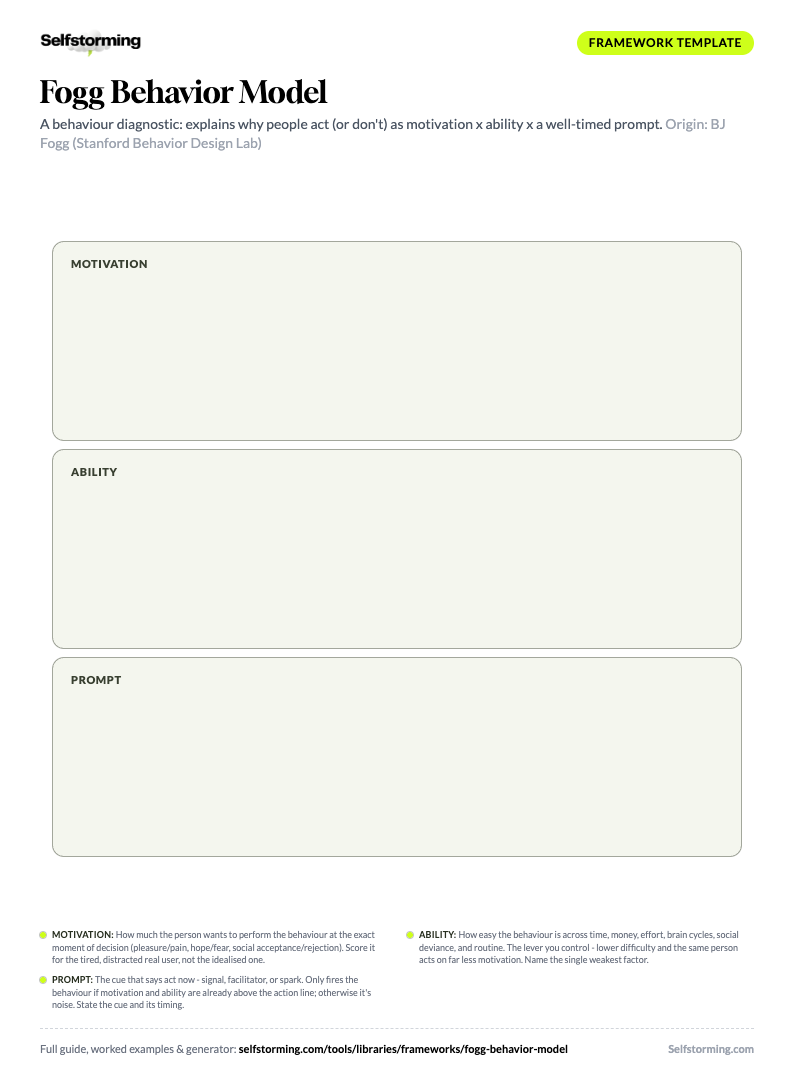
Print it. Fill it in.
The Fogg Behavior Model as a printable A4 worksheet - write straight into the framework, on paper or in any PDF app.
Download the PDF templateKnowledge Worth Paying For
A working library of brand strategy frameworks - with worked examples on real brands, sources, and decision criteria. Not vibes.
One good deck covers the subscription. The rest is profit.
Behaviour = Motivation x Ability x Prompt, all converging at one moment. Motivation is how much someone wants to act, Ability is how easy the action is, and a Prompt is the cue that says do it now. The rule that does the heavy lifting: when a behaviour fails, make it easier before you try to make people want it more - ability is cheaper and more reliable than motivation. And a prompt with no motivation or no ability behind it is just an annoying notification.
Duolingo
Language-learning app (USA, founded 2011)The clearest case of ability beating motivation. Duolingo didn't out-inspire its rivals - it shrank the daily behaviour until a barely-motivated, half-asleep user still does it, then prompted that micro-action at a moment the user already cared. B=MAP in one green owl.

Monzo
Digital bank / fintech app (UK, founded 2015)Monzo rides motivation spikes it can predict instead of manufacturing new ones. Payday and instant spend notifications hit at the rare moments people actually want to think about money, when the action is a single tap - then prompts the behaviour exactly there.
Headspace
Meditation and sleep app (UK/USA, founded 2010)A category where motivation is famously unreliable - everyone wants to be calmer, almost nobody remembers to meditate. Headspace solves it on the ability and prompt axes: tiny sessions, gentle cues at moments calm is already wanted.
Duolingo, Monzo, Headspace - filled in, line by line. Unlock to read them.
Duolingo (Language-learning app (USA, founded 2011))
The clearest case of ability beating motivation. Duolingo didn't out-inspire its rivals - it shrank the daily behaviour until a barely-motivated, half-asleep user still does it, then prompted that micro-action at a moment the user already cared. B=MAP in one green owl.
Motivation: Mild but real: a learner wants to 'know Spanish someday' and feels guilty skipping. Crucially, Duolingo never relies on this being high - it engineers a streak so loss-aversion (fear of breaking it) does the motivating once motivation alone would fail.
Ability: Engineered to the floor. One lesson is a few taps over ninety seconds, no typing required, picks up where you left off. The behaviour is so easy it survives near-zero motivation - the deliberate point.
Prompt: A daily reminder timed to the user's habitual lesson window, plus streak-risk and friend-activity nudges. The cue lands when ability is already high and a sliver of motivation (don't lose the streak) is present - a spark, not a nag.
Monzo (Digital bank / fintech app (UK, founded 2015))
Monzo rides motivation spikes it can predict instead of manufacturing new ones. Payday and instant spend notifications hit at the rare moments people actually want to think about money, when the action is a single tap - then prompts the behaviour exactly there.
Motivation: Naturally spikes at two moments: payday (feeling flush, slightly responsible) and the instant a payment leaves (mild sting, fresh awareness). Monzo times its asks to these spikes rather than trying to make budgeting feel exciting on a random Tuesday.
Ability: Round-ups, Pots, and instant balance updates make saving and tracking a one-tap, near-zero-effort behaviour - no spreadsheet, no transfer ritual. The friction that kills budgeting elsewhere is designed out.
Prompt: Real-time spend notifications and payday nudges that arrive precisely when motivation is up and the action is easy. The push to move money into a Pot is a facilitator dropped into the exact window where both lines are above zero.
Headspace (Meditation and sleep app (UK/USA, founded 2010))
A category where motivation is famously unreliable - everyone wants to be calmer, almost nobody remembers to meditate. Headspace solves it on the ability and prompt axes: tiny sessions, gentle cues at moments calm is already wanted.
Motivation: Genuine but flaky - people want to be less stressed and sleep better, but that wanting evaporates the moment life gets busy. Headspace assumes motivation will be low at the decision moment and designs around it rather than depending on it.
Ability: Sessions start at three minutes, one tap to play, no setup, soothing rather than demanding. The behaviour is small enough to do on a commute or in bed - difficulty engineered down so low motivation still clears the bar.
Prompt: A reminder timed to wind-down moments (bedtime, end of workday) when the desire for calm naturally rises and the action is a single tap. A signal placed in the gap where motivation and ability briefly coincide - not a random midday ping.
1. Motivation
At this exact moment, how much does this person actually want to do the thing - and is that wanting reliable enough to build on?
How much someone wants to perform the behaviour right now. Fogg groups it into pleasure/pain, hope/fear, and social acceptance/rejection. The trap is treating motivation as the main lever: it's the one you control least and it swings wildly within a single day. Motivation buys you the right to ask for harder behaviours - but it's a loan that gets called in fast.
In practice: Monzo's payday "you got paid" notification hits at the one moment motivation to budget is naturally high - money just arrived, the user feels flush and slightly guilty - so the nudge to set a savings pot lands on a real spike instead of manufacturing one.
Common mistake: Cranking the copy to 11 and calling it strategy. Adding "Transform your life today!" to a six-field form doesn't raise real motivation - it raises suspicion. You can't headline your way past a behaviour that's simply too hard to do.
2. Ability
What is the single hardest part of doing this, and could we make it so easy that a barely-interested person would still do it?
How easy the behaviour is to perform - measured in time, money, physical effort, brain cycles, social weirdness, and how far it breaks from routine. Ability is the lever you actually control, and the model's central bet: lower the difficulty and the same person will act on far less motivation. Find the weakest link (usually one of those six factors) and attack that, not all of them at once.
In practice: Duolingo's one-tap daily lesson. The behaviour was shrunk until "do your language practice" became "tap a green owl for ninety seconds" - so low-effort that a streak survives on near-zero motivation, which is exactly the point.
Common mistake: Answering low completion with a motivation campaign. Teams run a re-engagement email blast when the real problem is an eleven-step setup. Ability beats motivation here every time: make it easier rather than trying harder to make people care.
3. Prompt
At the moment this person is both willing and able, what cue tells them to do it right now - and is it actually arriving then?
The cue that says act now. Fogg splits prompts into signals (work when motivation and ability are already high), facilitators (help when motivation is high but ability is low), and sparks (help when ability is high but motivation is low). The catch: a prompt only fires the behaviour if motivation and ability are already above the action line. No timing fixes a behaviour the person can't or won't do - the prompt just becomes noise.
In practice: Headspace's bedtime reminder arrives when the user is winding down (motivation present) and the action is a single tap to play (ability present) - the cue lands in the gap where both are already true, so it triggers instead of nagging.
Common mistake: Carpet-bombing notifications and hoping. Firing a prompt at someone with zero motivation and high friction doesn't create behaviour - it creates an uninstall. A prompt with nothing behind it is the fastest way to teach people to mute you.
Decide your starting point: You don't have to map a behaviour from a blank page. Right here on Selfstorming you can find inspiration and directions, or generate a first-draft Fogg Behavior Model in minutes. Treat that draft as a head start, then run it through the steps below to refine it and pressure-test it against how your users really behave. Both routes work - most teams move faster starting from a draft.
Name one specific behaviour, not a vibe: "Be more engaged" is not a behaviour - it's a hope. Write down the single, observable action you want, at the level of "open the app and log one expense" or "complete the first lesson." If you can't watch it happen, you can't model it.
Score the moment, not the average user: For that exact behaviour, estimate motivation and ability at the real moment of decision - tired, distracted, mid-commute, not the idealised version in your persona deck. The honest score is almost always lower than you'd like.
Find the weakest link in ability: Run the six factors - time, money, physical effort, brain cycles, social deviance, routine. One of them is the real bottleneck. Most teams blur all six; the win comes from naming the single hardest one and demolishing it.
Make it easier before you make them want it: This is the move people skip. Try every ability fix first - fewer steps, pre-filled fields, smaller commitment - because lowering difficulty is cheaper and more reliable than raising motivation. Only chase motivation once the action is genuinely easy.
Place the prompt where both lines are already above zero: Map when motivation and ability naturally coincide, then put your cue exactly there. A prompt outside that window isn't a trigger - it's an annoyance that trains people to ignore the next one.
Match the prompt type to the gap: If ability's the problem, use a facilitator (make the action smaller in the cue itself). If motivation's the problem, use a spark (hope/fear/social baked into the cue). If both are already high, a plain signal is enough - don't over-design it.
Test, watch the moment, and adjust the cheap lever first: Ship it, then watch whether the behaviour actually fires. When it doesn't, resist the motivation-campaign reflex - re-check ability and prompt timing first, because they're the levers you control.
Best for: Diagnosing why a single, specific behaviour isn't happening and deciding which lever - motivation, ability, or prompt - to pull at the moment of action. / Long-term loyalty, brand meaning, or identity-level change. The Fogg Behavior Model is a moment-of-action tool, not a life-story tool.
Output: A clear read on each B=MAP factor for one behaviour, plus a prioritised fix (usually 'make it easier here', 'move the prompt to there'). / A funnel-wide dashboard or a multi-month retention model. B=MAP explains the tap, not the cohort curve.
Time to complete: Under an hour for one behaviour - name it, score motivation and ability, place the prompt, ship a test. The simplicity is the speed. / Weeks of behavioural research with diary studies and longitudinal tracking. Different deliverable, different rigour.
vs Hook Model (Nir Eyal): B=MAP diagnoses a single behaviour at one moment and tells you which factor is failing. Sharper for fixing one stuck action. / The Hook Model (Trigger → Action → Variable Reward → Investment) is a loop for building repeat habits over time. Use Hook when you need the cycle, not the single moment.
vs EAST (Behavioural Insights Team): B=MAP gives you the multiplication logic and the motivation-vs-ability trade-off - good when you need to know which lever to pull. / EAST (Easy, Attractive, Social, Timely) is a checklist for nudge design. Use EAST when you want quick design heuristics rather than a diagnostic model.
vs AARRR (Pirate Metrics): B=MAP explains why users fail a specific step - the behavioural mechanics behind a drop-off. / AARRR (Acquisition, Activation, Retention, Referral, Revenue) is a funnel measurement framework. Use AARRR to find where the leak is, then B=MAP to understand why it leaks.
The Fogg Behavior Model comes from BJ Fogg, the Stanford researcher who founded what is now the Stanford Behavior Design Lab (originally the Persuasive Technology Lab) in the late 1990s. He formalised the model in his 2009 paper A Behavior Model for Persuasive Design as B=MAT (Behavior = Motivation x Ability x Triggers), later refining it to B=MAP - swapping 'Triggers' for the friendlier 'Prompt' - to stress that all three must converge at a single moment for behaviour to occur. The thinking reached a wide audience through his 2019 book Tiny Habits: The Small Changes That Change Everything, which reframed the model into a practical method built on shrinking behaviours and celebrating tiny wins.
The Fogg Behavior Model draws steady criticism for oversimplifying human behaviour into three tidy variables, when real action is tangled up with identity, culture, habit, and social context the model flattens. Practitioners also note that motivation and ability resist clean measurement, so the multiplication looks more precise than it is. The sharpest critique is ethical: B=MAP is value-neutral and works just as well for building compulsive, attention-extracting products as for building healthy habits - and Fogg, having taught many of Silicon Valley's growth-hackers, is sometimes held partly responsible for the persuasive-tech playbook. Finally, the model deliberately describes the moment of action, not long-term behaviour or meaning - it explains why someone tapped, not whether the habit will last or matter.
What is the Fogg Behavior Model?
The Fogg Behavior Model is a behavioural design framework from Stanford's BJ Fogg, summarised as B=MAP: a behaviour happens only when Motivation, Ability, and a Prompt converge at the same moment. It's used to diagnose why a specific action isn't happening and to decide which of the three levers to pull - usually ability, because making the thing easier is cheaper and more reliable than making people want it more.
What does B=MAP mean?
B=MAP stands for Behavior = Motivation x Ability x Prompt. The key is the multiplication: if any one factor is near zero, the behaviour is near zero, no matter how strong the other two are. Motivation is how much someone wants to act, Ability is how easy the action is, and a Prompt is the cue to act now. An earlier version of the model used B=MAT, with 'Triggers' instead of 'Prompt'.
Should I focus on motivation or ability in the Fogg Behavior Model?
Ability, almost always. The most useful insight in the model is that ability often beats motivation - making the behaviour easier is cheaper, faster, and more in your control than trying to make people care more. Motivation fluctuates by the hour and you don't own it. So when a behaviour stalls, demolish the hardest part of doing it before you write a single inspiring email.
Why does a prompt sometimes fail in the Fogg Behavior Model?
Because a prompt only fires a behaviour if motivation and ability are already above the action line. Send a cue to someone who doesn't want to act or can't easily act, and it isn't a trigger - it's an annoyance. Worse, mistimed prompts train people to ignore the next one. The fix is to map the window where motivation and ability naturally coincide, and prompt only there.
Is the Fogg Behavior Model the same as the Hook Model?
No. B=MAP diagnoses a single behaviour at one moment and tells you which factor - motivation, ability, or prompt - is failing. Nir Eyal's Hook Model (Trigger → Action → Variable Reward → Investment) is a loop for building repeat habits over time. They're complementary: use B=MAP to fix a stuck action, and the Hook Model to turn that action into a returning habit.
Does the Fogg Behavior Model work for B2B products?
Yes, and it's badly underused there. B2B teams over-invest in motivation - demos, decks, ROI calculators - while the real bottleneck is usually ability: a setup that takes three meetings, a form that needs IT, a workflow that breaks routine. B=MAP forces you to score the action at the moment a busy buyer actually decides, which is almost always lower-motivation and higher-friction than the persona deck admits.
How is the Fogg Behavior Model used in product onboarding?
Onboarding is where B=MAP earns its keep. You name one observable activation behaviour, score motivation and ability for a distracted first-time user, and shrink the action until it clears the bar on low motivation. Then you place the prompt at the moment both lines are above zero. Duolingo's one-tap daily lesson and Monzo's payday nudge are textbook examples of designing onboarding around ability and timing rather than hype.
What are the criticisms of the Fogg Behavior Model?
Three main ones. It oversimplifies - real behaviour involves identity, culture, and habit the model flattens into three variables. Motivation and ability are hard to measure cleanly, so the maths feels more precise than it is. And the ethical one: B=MAP is value-neutral, so the same mechanics that build a meditation streak build a doomscroll, which is why Fogg, who taught many growth-hackers, is sometimes tied to the persuasive-tech playbook. It also describes the moment of action, not long-term behaviour or meaning.
A behaviour diagnostic: explains why people act (or don't) as motivation x ability x a well-timed prompt.
The counterintuitive part - the part that makes this worth your afternoon - is the relationship between motivation and ability. We instinctively reach for motivation because it feels like the noble lever: inspire people, change their hearts, win them over. But motivation is expensive, it fluctuates by the hour, and you don't control it. Ability you do control. You can make the thing easier. And a behaviour that's easy enough needs almost no motivation to fire. The whole model is really an argument for laziness as strategy: stop trying to make people care more, and start making the thing they should do absurdly easy to do right now.
Related Frameworks
EAST
Four levers you apply to any behaviour you want to encourage: Easy (remove friction, use smart defaults, simplify the message), Attractive (
Hook Model
Four steps in a loop: Trigger (what starts the behaviour, external first then internal), Action (the simplest thing the user does for a rewa