Customer Awareness Stages
The single most useful idea in direct response, and the chassis the Hi5 Framework runs on. People do not arrive at your ad in the same state: some have never heard of the problem, some are comparing you to two rivals in a browser tab. Schwartz's insight is that the same claim that converts a Most-Aware buyer is wasted on an Unaware one - and vice versa. Diagnose the stage first, then write.
CUSTOMER AWARENESS STAGES
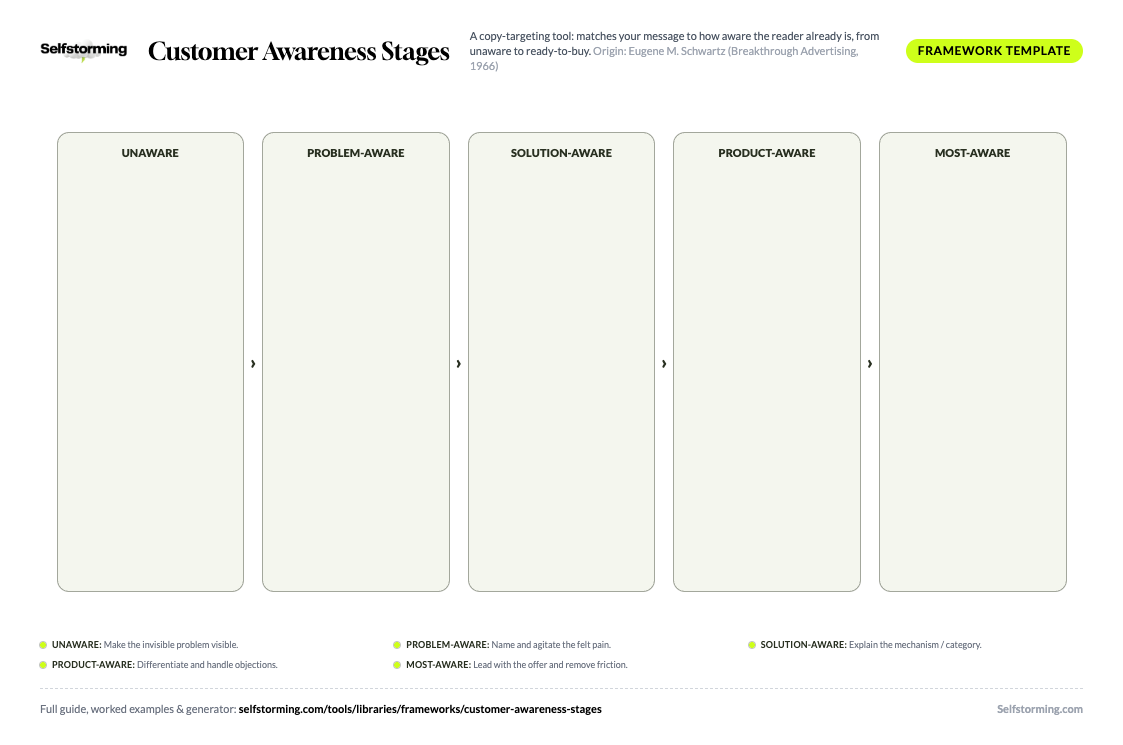
“The five stages a buyer moves through - from not knowing they have a problem to being ready to buy - each one demanding a different message.”
What is Customer Awareness Stages?
Eugene Schwartz's five stages of awareness - Unaware, Problem-Aware, Solution-Aware, Product-Aware, Most-Aware. Where a buyer's head is decides what an ad is allowed to say. Match the message to the stage and it lands; mismatch it and you either confuse a cold buyer or bore a hot one.
Worked Examples
Three real brands. Different categories, different sizes. Same framework, filled in.
LIVA (electrolytes)
DTC supplementOne product, a message written for each of the five stages.
The 5 Layers, One By One
Each one answers a specific question - here is how to fill it in, and how to tell a sharp answer from a lazy one.
1. Unaware
Do they even know the problem exists?
No problem in mind, no solution, no you. The coldest stage. You cannot sell - you can only make an invisible problem visible, usually through a story, a stat or a pattern interrupt.
A posture brand opening on "the average person spends 7 hours hunched over a screen" - naming a problem the viewer never framed as one.
Leading with the product or an offer. To someone Unaware, that is an answer to a question they have not asked.
2. Problem-Aware
Do they feel the pain but not know there is a fix?
They feel the symptom and may be resigned to it, but do not know a solution exists. Name and agitate the problem, then reveal that a fix is possible (PAS lives here).
A sleep brand: "Still tired after eight hours? It is probably not how long you sleep." Agitates the felt pain, opens the door to a solution.
Jumping straight to product features before the viewer accepts the problem is solvable.
3. Solution-Aware
Do they know the type of solution, but not your product?
They know solutions exist and are weighing categories (pills vs. powders vs. apps). Win by explaining your mechanism and why your kind of solution is the right one.
A hydration brand: "Why electrolytes beat plain water" - educating on the category before naming the product.
Assuming they know you. They know the category, not your brand - skipping the mechanism loses them.
4. Product-Aware
Do they know you and are comparing you to rivals?
They know your product and are deciding between you and two alternatives. Differentiate on the one thing that matters and dismantle the last objection.
A DTC brand: "Yes, we cost more - here is the one thing the cheap ones can not do." Differentiation plus objection-handling.
Re-explaining the problem they already accept, instead of giving them a reason to pick you.
5. Most-Aware
Are they ready, just waiting for a reason to act now?
They know and want it; all that is left is a nudge. Lead with the offer, add real scarcity, remove friction. The least clever stage and often the most profitable.
"Free shipping ends tonight - your cart is still open." Pure offer and urgency to someone already sold.
Wasting the first three seconds re-selling the problem to someone who is reaching for their wallet.
Origin & Lineage
From Eugene Schwartz's Breakthrough Advertising (1966), still the sharpest model of buyer readiness ever written. Largely unchanged in 60 years because it describes how attention works, not a tactic that dates.
Critics
Real audiences are mixed - a single ad set contains all five stages at once, so treating awareness as a clean linear funnel to silo by is a mistake. It is a lens for writing the message, not a campaign structure. Under Meta's Andromeda the smarter move is to run a spread of awareness levels inside one diverse pool and let the algorithm match.
How To Build It
A workshop flow that produces a usable v1 in a day - with the right people in the room, or just you and a Selfstorming strategy session right here.
Step 1
Diagnose which stage the audience (or segment) is actually in before writing a word.
Match the message to the stage
visibility for Unaware, agitation for Problem-Aware, mechanism for Solution-Aware, differentiation for Product-Aware, offer for Most-Aware.
Step 3
Run a spread of stages inside one ad set rather than siloing them into rigid funnel campaigns.
Step 4
Read which stages convert for your product and weight creative production toward them.
How This Framework Compares
| Aspect | When It Works | When It Doesn't |
|---|---|---|
| AIDA / the funnel | Use to map one journey from attention to action. | Awareness Stages diagnoses message-readiness, not funnel volume. |
| Hi5 Framework | Use Hi5 to generate many angles across awareness, persona and desire. | Awareness alone is one axis - use it when you only need to fix the message-to-stage match. |
Frequently Asked Questions
Is this a funnel?
No. A funnel maps volume moving through stages; awareness stages describe what a buyer is ready to hear. One ad set contains all five at once.
How does it relate to the Hi5 Framework?
Awareness is one of the three Hi5 axes. Hi5 crosses it with persona and desire to generate 125 distinct angles.
Sources & Further Reading
Related Frameworks
Brand Onion
Five concentric layers from outer to inner: Attributes (provable product facts), Benefits (functional + emotional outcomes), Personality (ho
Brand Archetypes
Twelve characters drawn from Jungian psychology, grouped into four families by core human motivation: Independence & Fulfillment (Innocent,
Brand Key
Eight sections, built outside-in: Root strengths (your heritage and core competence), Competitive environment (the real alternatives), Targe
Brand Identity Prism
Six facets on a prism, two per axis. Physique (tangible features and look) and Personality (character, as if a person) form the picture-of-s