Hi5 Framework
Under Meta's Andromeda shift, creative is the targeting. The algorithm wants a wide, diverse pool of ads and figures out who each one is for - so the bottleneck stops being media and becomes ideas. The Hi5 Framework is a systematic way to make that volume without making 25 variations of the same thought. Three independent axes, each capped at five values, give you a 5 x 5 x 5 grid where every cell is a genuinely different brief: a different person, in a different state of awareness, chasing a different desire.
- 1Unaware
- 2Problem-aware
- 3Solution-aware
- 4Product-aware
- 5Most-aware
- 1Budget-conscious
- 2Quality-focused
- 3Status-driven
- 4Convenience-seeker
- 5Skeptic
- 1Money
- 2Time
- 3Health
- 4Status
- 5Security
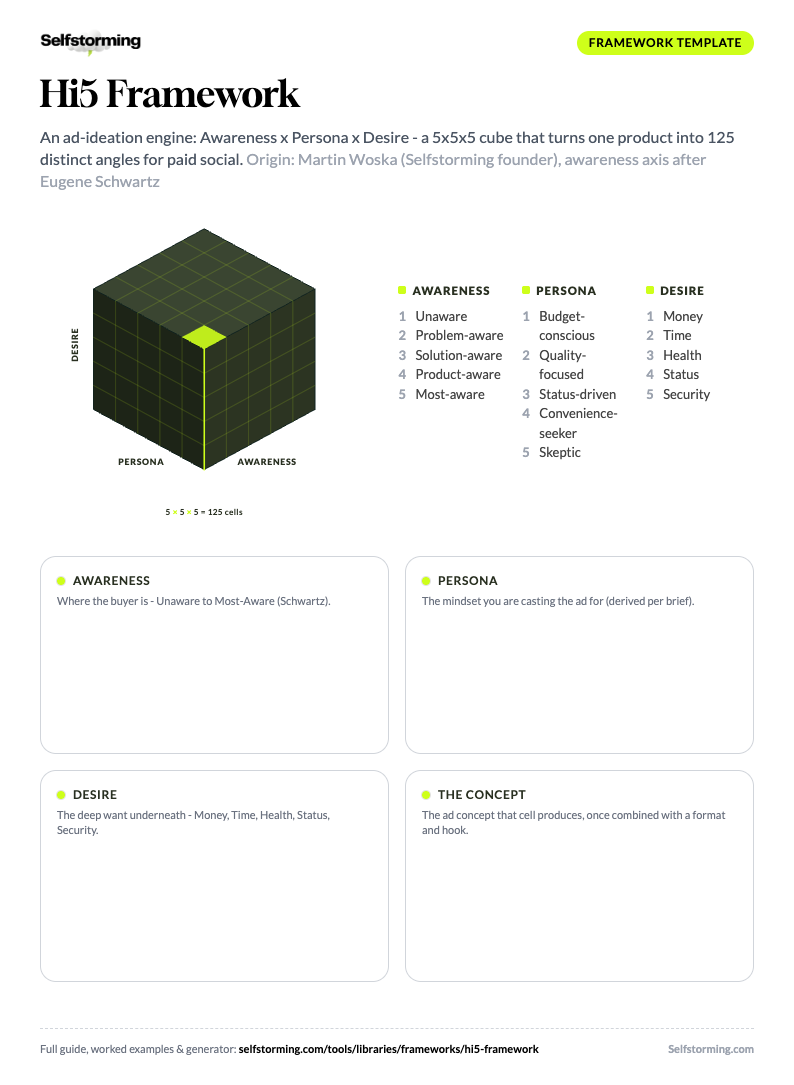
HI5 FRAMEWORK
“The Hi5 Framework is a 5 x 5 x 5 ideation cube - Awareness x Persona x Desire - that turns one product into 125 distinct creative angles for paid social.”
What is Hi5 Framework?
A 5 x 5 x 5 ideation matrix for paid social. Cross three independent axes - Awareness x Persona x Desire - and you get 125 distinct things to say about a single product. Walk the cube and you produce the volume and diversity of creative that Meta's Andromeda algorithm now rewards, without repeating yourself.
Worked Examples
Three real brands. Different categories, different sizes. Same framework, filled in.
LIVA (electrolytes)
DTC supplementOne sugar-free electrolyte drink, walked across three cells of the cube - same product, three completely different ads.
Problem-Aware
The skeptic (burned by supplements before)
Health
Founder-to-camera: "You are not hungover, you are dehydrated." Names the 3pm headache, blames missing electrolytes, ends on a 60-day money-back guarantee to disarm the skeptic.
A project-management SaaS
B2B softwareThe same tool, two cells apart, reads as two different products.
Solution-Aware
The convenience-seeker (drowning in tools)
Time
Split-screen: six tabs and a broken spreadsheet vs. one board. "The month-end that used to take a day now takes an hour." Time as the payoff, not features.
A premium skincare serum
Beauty DTCMost-aware buyer, status desire - a different cell again.
Most-Aware
The quality obsessive
Status
Press / as-seen-in static: clipped magazine headline over the bottle. "The one the dermatologists actually keep on their own shelf." Authority and status, leading with the offer.
The 3 Layers, One By One
Each one answers a specific question - here is how to fill it in, and how to tell a sharp answer from a lazy one.
1. Awareness
Where is this person in their journey - do they even know they have the problem, or are they ready to buy?
The first axis and the hinge of the whole framework - Eugene Schwartz's five stages of customer awareness, which decide what an ad is even allowed to say. Unaware: no problem in mind, so you can only make it visible. Problem-Aware: feels the pain but does not know a fix exists, so you name and agitate it. Solution-Aware: knows solutions exist but not yours, so you explain your mechanism. Product-Aware: knows you and is comparing options, so you differentiate and handle the objection. Most-Aware: ready to buy and just needs a nudge, so you lead with the offer. Awareness is also the only axis tied to a stored tag on each angle, which is how the cube connects to the angles library.
A sleep brand running five awareness variants of one product: a Problem-Aware ad naming the 3pm crash, a Solution-Aware ad on why magnesium beats melatonin, and a Most-Aware ad that just leads with the deal and free shipping.
Treating awareness as a funnel stage to silo into separate ad sets. Under Andromeda you want the awareness spread inside one diverse pool, not split into rigid TOFU/MOFU/BOFU campaigns.
2. Persona
Who is this for - which kind of buyer, with which worldview, would react to this differently?
The second axis: five buyer personas, derived per brief rather than pulled from a fixed library - mindsets, not demographics. A generic set to start from: Budget-conscious (price is the lens they judge through), Quality-focused (wants the best version and will pay for it), Status-driven (wants to be seen with it), Convenience-seeker (wants it effortless), and Skeptic (has been burned before and needs proof). The same product, chasing the same desire, lands completely differently depending on who you cast the ad for - which is why deriving these from the ICP, reviews and sales calls is what keeps the output specific instead of generic 'busy mum' filler.
For an electrolyte drink: the same hydration benefit pitched to a marathon runner (performance), a hungover 25-year-old (recovery), and a nurse on a double shift (endurance) - three personas, three different ads.
Reaching for demographic labels instead of mindsets. "Women 25-34" is not a persona; "the skeptic who has been burned by supplements before" is.
3. Desire
What deep want is really driving the purchase underneath the feature?
The third axis: the core human desire the product actually serves, because nobody buys the feature - they buy what it gets them. Five durable desires cover most categories: Money (save it or make it), Time (get it back), Health (feel or look better), Status (be admired for it), and Security (remove a worry). The same blender is 'save money on smoothies' (Money), 'breakfast in 30 seconds' (Time), 'more greens every day' (Health) or 'the kitchen that looks like the magazine' (Status). Crossing Desire with Persona and Awareness is what makes two ads for one product feel like ads for two different products.
A password manager sold four ways: never lose access again (Security), stop resetting passwords all day (Time), one tool instead of five (Money), the setup serious people use (Status).
Defaulting every ad to the same desire (usually the rational one the product team cares about) and leaving the more emotional desires - Status, Security - on the table.
Origin & Lineage
The cube and its 5 x 5 x 5 combinatorics are ours, built for the Andromeda era of paid social. Only one axis is borrowed: Awareness rides on Eugene Schwartz's five stages of customer awareness from Breakthrough Advertising (1966), still the sharpest model of where a buyer's head is. Persona and Desire are derived per brief rather than pulled from a fixed library, which is what keeps the output specific instead of generic.
Critics
It is a divergence tool, not a quality filter - the cube will happily generate 125 mediocre ideas if you feed it a weak product or lazy axes. It also assumes the three axes are genuinely independent; if your Persona always implies one Desire, you are really running a 5 x 5, not a 5 x 5 x 5. And like any matrix, it can seduce you into completeness for its own sake. You rarely need all 125 - you need the dozen cells that fit the brief, executed well.
How To Build It
A workshop flow that produces a usable v1 in a day - with the right people in the room, or just you and a Selfstorming strategy session right here.
Lock the offer
The cube generates angles, not value - a weak offer just produces 125 weak ideas, so fix the product and offer first.
Derive the personas
Pull five buyer mindsets from the ICP, reviews and sales calls. Mindsets, not demographics.
Set the desires
Confirm five core desires (Money, Time, Health, Status, Security) that are genuinely distinct, not the same benefit reworded.
Add the awareness axis
Use Schwartz's five stages as the third axis - they are fixed, so you only derive two of the three.
Pick your cells
You rarely need all 125 - choose the cells that fit the brief and spread them across awareness and desire for diversity.
Write and combine
For each chosen cell, write the message, then build it out with the Ad Angles, Ad Formats and Hooks libraries.
Ship and read by cell
Put a diverse batch into one ad set, let the algorithm match each creative, then iterate the winning cell.
How This Framework Compares
| Aspect | When It Works | When It Doesn't |
|---|---|---|
| AIDA / the funnel | Use when you want to map one buyer journey from attention to action. | Hi5 is the opposite job - generate many parallel angles, not sequence one path. |
| Customer personas alone | Use when you only need to understand who you are talking to. | Hi5 crosses persona with awareness and desire to produce briefs, not just audience profiles. |
| Awareness stages (Schwartz) | Use when the question is purely how aware the buyer is. | Hi5 uses awareness as one of three axes, so the output is creative volume, not a single message. |
Frequently Asked Questions
What is the Hi5 Framework?
The Hi5 Framework is a 5 x 5 x 5 ideation cube for paid social - Awareness x Persona x Desire. Crossing three independent axes of five values each turns one product into 125 distinct creative angles, so you can produce the volume and diversity Meta's Andromeda algorithm rewards without repeating yourself.
How do you create social ads at scale with Hi5?
Lock the product and offer, derive five personas and five desires for the brief, and use Schwartz's five awareness stages as the third axis. Pick the cells that fit, spread them for diversity, write the message for each, then turn each into a finished ad with the angle, format and hook libraries. Ship a diverse batch into one ad set and let the algorithm match each creative to its audience.
Is the Hi5 Framework just personas?
No. Personas are one of three axes. The power is the crossing: the same persona, at a different awareness stage, chasing a different desire, is a completely different ad. That combinatorial step is what personas alone do not give you.
How does the Hi5 Framework relate to angles, formats and hooks?
The cube decides what to say (the cell). The Ad Angles, Ad Formats and Hooks libraries decide how to say it. A finished concept is a Hi5 cell, executed through an angle, a format and a hook.
Sources & Further Reading
Related Frameworks
Customer Awareness Stages
Eugene Schwartz's five stages of awareness - Unaware, Problem-Aware, Solution-Aware, Product-Aware, Most-Aware. Where a buyer's head is deci
Hook-Retain-Reward
The retention spine of short-form video. Hook the scroll in the first 3 seconds, retain attention through the middle by paying off curiosity
The 3-3-3 Creative Testing Framework
Test 3 concepts x 3 variations x 3 hooks - a structured 27-asset matrix for finding winning Meta ads fast. Test concepts (genuinely differen
The Value Equation
Alex Hormozi's formula for why an offer converts: Dream Outcome x Perceived Likelihood of Achievement, divided by Time Delay x Effort & Sacr