The Value Equation
Most ad accounts try to fix a weak offer with better creative. The Value Equation says the offer is the lever. It breaks perceived value into four variables you can actually pull: the two on top raise value (a bigger dream, more belief it will happen), the two on the bottom destroy it (the longer it takes and the more effort it costs). A great offer makes even average creative work; a weak offer makes great creative struggle.
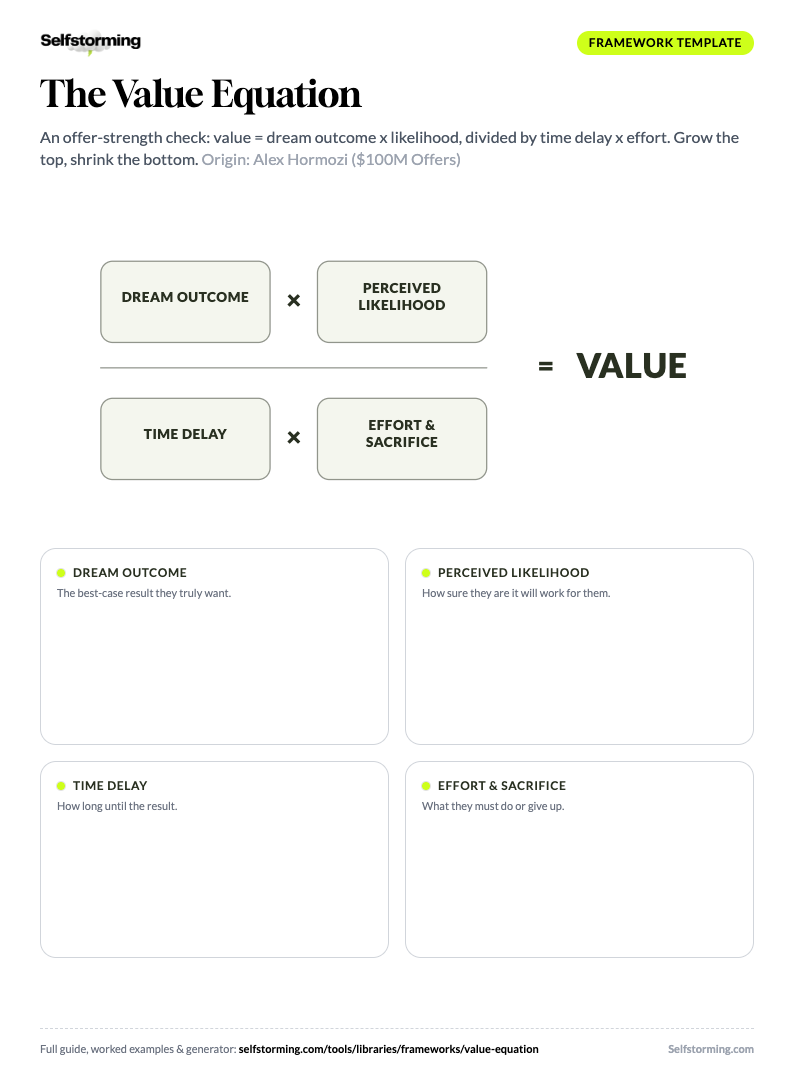
THE VALUE EQUATION
“Value = (Dream Outcome x Perceived Likelihood) / (Time Delay x Effort & Sacrifice). Maximise the numerator, minimise the denominator.”
What is The Value Equation?
Alex Hormozi's formula for why an offer converts: Dream Outcome x Perceived Likelihood of Achievement, divided by Time Delay x Effort & Sacrifice. Raise the top, shrink the bottom, and you make an offer so good people feel stupid saying no - which is what actually moves paid-social numbers.
Worked Examples
Three real brands. Different categories, different sizes. Same framework, filled in.
LIVA (electrolytes)
DTC supplementThe same product, run through all four variables.
The afternoon energy to finish your day strong - no 3pm crash.
60-day money-back guarantee and thousands of reviews.
Headache gone in about twenty minutes.
One sachet stirred into a glass of water.
A project-management SaaS
B2B softwareReframing a feature-heavy product as an offer.
A month-end close that takes an hour, not a lost day.
Used by 200 finance teams, white-glove migration included.
Set up in an afternoon, first clean close next month.
We import your data and build the board for you.
The 4 Layers, One By One
Each one answers a specific question - here is how to fill it in, and how to tell a sharp answer from a lazy one.
1. Dream Outcome
What is the best-case result they truly want?
The transformation the buyer is really after - vivid, specific, emotional. The bigger and clearer the dream, the higher the value. Sell the destination, not the vehicle.
Not "an electrolyte drink" but "the afternoon energy to actually finish your day strong".
Selling the feature (the ingredient) instead of the dream (the outcome).
2. Perceived Likelihood
How sure are they it will work for them?
Belief that they specifically will get the result. Proof, guarantees, mechanism and specificity all raise it. A huge dream with low belief still has low value.
A 60-day money-back guarantee plus 47,000 reviews makes the dream feel safe to chase.
A bold claim with no proof - the dream stays a fantasy, so perceived value collapses.
3. Time Delay
How long until they get the result?
The gap between buying and the payoff. The longer the wait, the lower the value - so shorten it, or show fast early wins along the way.
"Headache gone in twenty minutes" beats "noticeable results in 8-12 weeks".
Burying a long time-to-value, so the buyer discounts the whole offer.
4. Effort & Sacrifice
How much do they have to do or give up?
Everything they must do, learn, or give up to get the result. The more effort, the lower the value - so remove steps, do it for them, make it effortless.
"One sachet in water" beats "follow this 6-step daily protocol".
Adding friction (complex onboarding, lifestyle overhaul) that quietly kills perceived value.
Origin & Lineage
From Alex Hormozi's $100M Offers (2021). It distilled a century of direct-response intuition about offers into one teachable formula, and has become the default mental model for offer design in DTC and info-products.
Critics
It quantifies things that are really perceptions, so it is a thinking tool, not a calculator - you cannot literally multiply "dream outcome". It also says nothing about whether you can deliver; an irresistible offer you cannot fulfil is just a faster route to refunds.
How To Build It
A workshop flow that produces a usable v1 in a day - with the right people in the room, or just you and a Selfstorming strategy session right here.
Name the dream
Write the real, vivid outcome the buyer wants - the destination, not the product.
Raise belief
Stack proof, guarantees and a clear mechanism so they believe it will work for them.
Cut the wait
Shorten time-to-value, or surface a fast early win to bridge a long payoff.
Remove the effort
Strip steps, do-it-for-them, and kill every bit of friction and sacrifice.
Lead with it
Build the ad and landing page around the strongest variable, not the feature list.
How This Framework Compares
| Aspect | When It Works | When It Doesn't |
|---|---|---|
| Hook-Story-Offer | Use HSO to structure the ad around the offer. | The Value Equation designs the offer itself, before you write the ad. |
| Value Proposition Canvas | Use the VPC to map fit between product and customer jobs. | The Value Equation is sharper for tuning a direct-response offer to convert. |
Frequently Asked Questions
What is the Value Equation?
It is Alex Hormozi's formula for perceived value: Dream Outcome times Perceived Likelihood of Achievement, divided by Time Delay times Effort and Sacrifice. Raise the top two, shrink the bottom two, and the offer becomes hard to refuse.
How do you use the Value Equation in ads?
Score your offer on all four variables, fix the weakest, and lead the ad with the strongest - sell the dream outcome, prove it is likely, show fast results, and make it effortless.
Is the Value Equation a real calculation?
No. It is a thinking model - you cannot literally multiply a dream outcome. Its power is forcing you to look at four levers most marketers ignore.
Sources & Further Reading
Related Frameworks
Brand Onion
Five concentric layers from outer to inner: Attributes (provable product facts), Benefits (functional + emotional outcomes), Personality (ho
Brand Archetypes
Twelve characters drawn from Jungian psychology, grouped into four families by core human motivation: Independence & Fulfillment (Innocent,
Brand Key
Eight sections, built outside-in: Root strengths (your heritage and core competence), Competitive environment (the real alternatives), Targe
Brand Identity Prism
Six facets on a prism, two per axis. Physique (tangible features and look) and Personality (character, as if a person) form the picture-of-s