The 3-3-3 Creative Testing Framework

    Post-Andromeda, creative is 50-60% of the auction, so creative testing is the most important operational discipline in paid social. The 3-3-3 framework (popularised by Pilothouse) turns "make more ads" into a clean experiment: three distinct concepts, three variations of each, three hooks per variation. You learn what concept resonates, then what execution, then what opening line - in that order - instead of guessing.
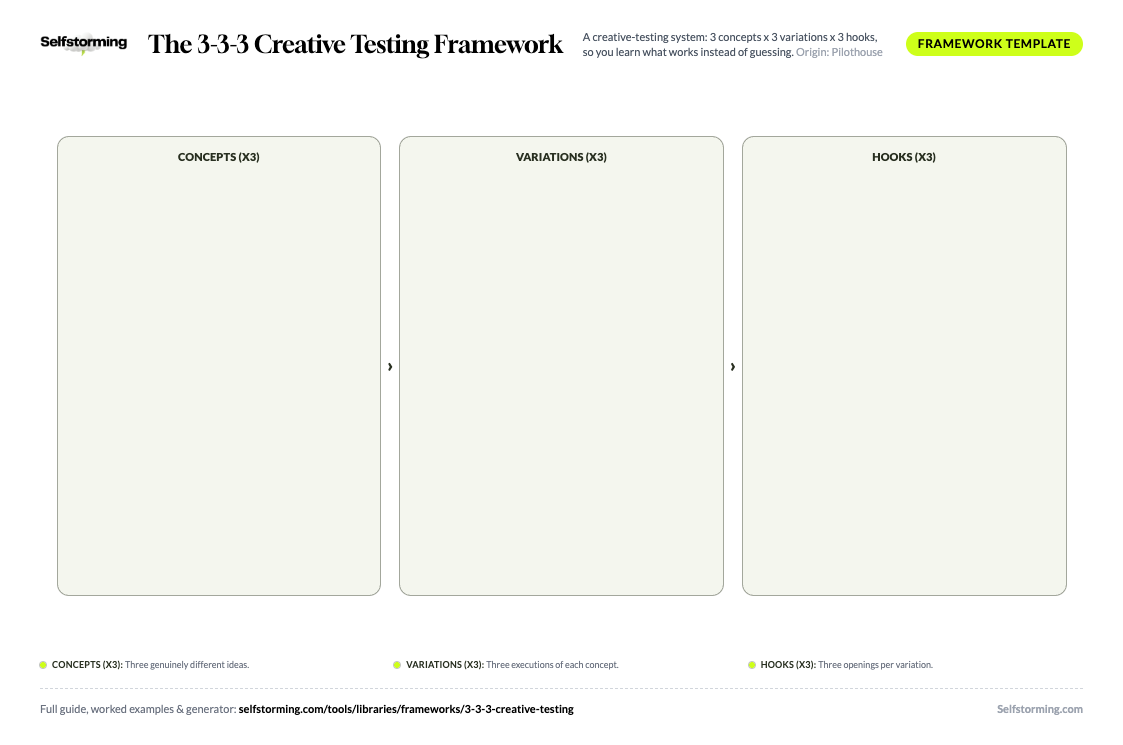
    Concepts (x3)
    Variations (x3)
    Hooks (x3)

    THE 3-3-3 CREATIVE TESTING FRAMEWORK

    “A structured creative test - 3 concepts, 3 variations each, 3 hooks each - that isolates what actually moves performance.”

    What is The 3-3-3 Creative Testing Framework?

    Test 3 concepts x 3 variations x 3 hooks - a structured 27-asset matrix for finding winning Meta ads fast. Test concepts (genuinely different ideas), not just colours, isolate one variable at a time, and let the data crown the winner before you scale it.

    Worked Examples

    Three real brands. Different categories, different sizes. Same framework, filled in.

    Example 1

    A sleep-supplement DTC

    DTC supplement

    One round of 3-3-3, walked across the three tiers.

    Concepts (x3)
    Problem-agitation (the 3pm crash), founder origin story, and a side-by-side vs. melatonin.
    Variations (x3)
    Each shot as lo-fi UGC, as a podcast clip, and as kinetic typography.
    Hooks (x3)
    "You are not tired, you are under-recovered." / "I tracked my sleep for 30 days." / "47,000 people switched this year."
    Example 2

    A B2B scheduling SaaS

    B2B software

    Concept-led testing to escape feature-list fatigue.

    Concepts (x3)
    Cost-of-chaos, a 30-second demo, and a customer-quote montage.
    Variations (x3)
    Screen-record, AI-avatar explainer, and split-screen old-way-vs-new.
    Hooks (x3)
    "Your month-end takes a day. It should take an hour." / "Watch this in 20 seconds." / "Read what 200 teams said."

    The 3 Layers, One By One

    Each one answers a specific question - here is how to fill it in, and how to tell a sharp answer from a lazy one.

    1. Concepts (x3)

    What are three genuinely different ideas?

    Three radically different angles, tones or archetypes - a problem-agitation, a social-proof, a demo, say. Concept is the big lever; this is where most of the performance difference lives.

    Good answer

    A skincare brand testing: a dermatologist explainer, a 30-day transformation, and an ugly-ad price comparison.

    Wrong answer

    Three near-identical concepts (the trap). Andromeda rewards variation, not iteration.

    2. Variations (x3)

    What are three executions of each concept?

    For each winning-candidate concept, three different executions - format, talent, edit - holding the idea constant. This isolates how to make the idea, separate from the idea itself.

    Good answer

    The transformation concept shot as UGC, as a split-screen, and as a kinetic-text version.

    Wrong answer

    Changing the concept while calling it a variation - now you cannot tell what won.

    3. Hooks (x3)

    What are three openings for each variation?

    Three first-3-second hooks per variation, tested last - because nobody watches the body of an ad they did not stop scrolling for. Hooks are the cheapest, highest-leverage variable.

    Good answer

    The same UGC ad opened with a negative hook, a curiosity hook, and a social-proof hook.

    Wrong answer

    Testing hooks first on an untested concept, or never isolating the hook at all.

    Origin & Lineage

    A practitioner framework popularised by the agency Pilothouse and now standard across post-Andromeda media buying. The principle is older than the platforms: isolate one variable, test enough to read a clean signal, double down on the winner.

    Critics

    It is an optimisation engine, not an idea engine - feed it weak concepts and it just finds the least-bad one. The matrix can also tempt teams into testing trivial variations (the same idea nine times) instead of genuinely different concepts, which is the trap Andromeda specifically punishes.

    How To Build It

    A workshop flow that produces a usable v1 in a day - with the right people in the room, or just you and a Selfstorming strategy session right here.

    1

    Pick the concepts

    Choose three genuinely different ideas, not three shades of one. Concept is the biggest lever.

    2

    Build the variations

    Produce three executions of each concept, holding the idea constant.

    3

    Write the hooks

    Draft three openings per variation and test those last - hooks are cheap and decisive.

    4

    Isolate the variable

    Change one thing at a time so the winning signal is clean and actionable.

    5

    Read in order

    Concept first, then execution, then hook. Give each enough budget and time for a real read.

    6

    Scale the winner

    Pour budget into the winning cell, then start the next 3-3-3 round to refresh the pipeline.

    How This Framework Compares

    AspectWhen It WorksWhen It Doesn't
    Hi5 FrameworkUse Hi5 to generate the diverse concepts to test.3-3-3 is the testing system that finds the winner among them.
    A/B testingUse a plain A/B test for one isolated variable.3-3-3 structures a whole concept-to-hook hierarchy, not a single split.

    Frequently Asked Questions

    What is the 3-3-3 Creative Testing Framework?

    It is a structured Meta-ads creative test - three distinct concepts, three variations of each, and three hooks per variation, giving a 27-asset matrix - that isolates what actually drives performance so you can find and scale winners fast.

    How do you run a 3-3-3 test?

    Pick three genuinely different concepts, build three executions of each, and write three hooks per variation. Test one variable at a time, read concept first then execution then hook, give each cell enough budget for a real signal, and scale the winner.

    How is 3-3-3 different from the Hi5 Framework?

    Hi5 generates the diverse concepts; 3-3-3 is the testing system that finds the winner among them. Use Hi5 to ideate, 3-3-3 to validate.