Half of Coke buyers buy once or twice a year. Angela Voss on light buyers, frequency, the real cost of CTV and measuring TV with ten models instead of one.
Half of all Coca-Cola buyers buy just one or two cans or bottles a year (you all know that ofc). One of the most famous brands on the planet is built, to a surprising degree, on people who barely buy it.
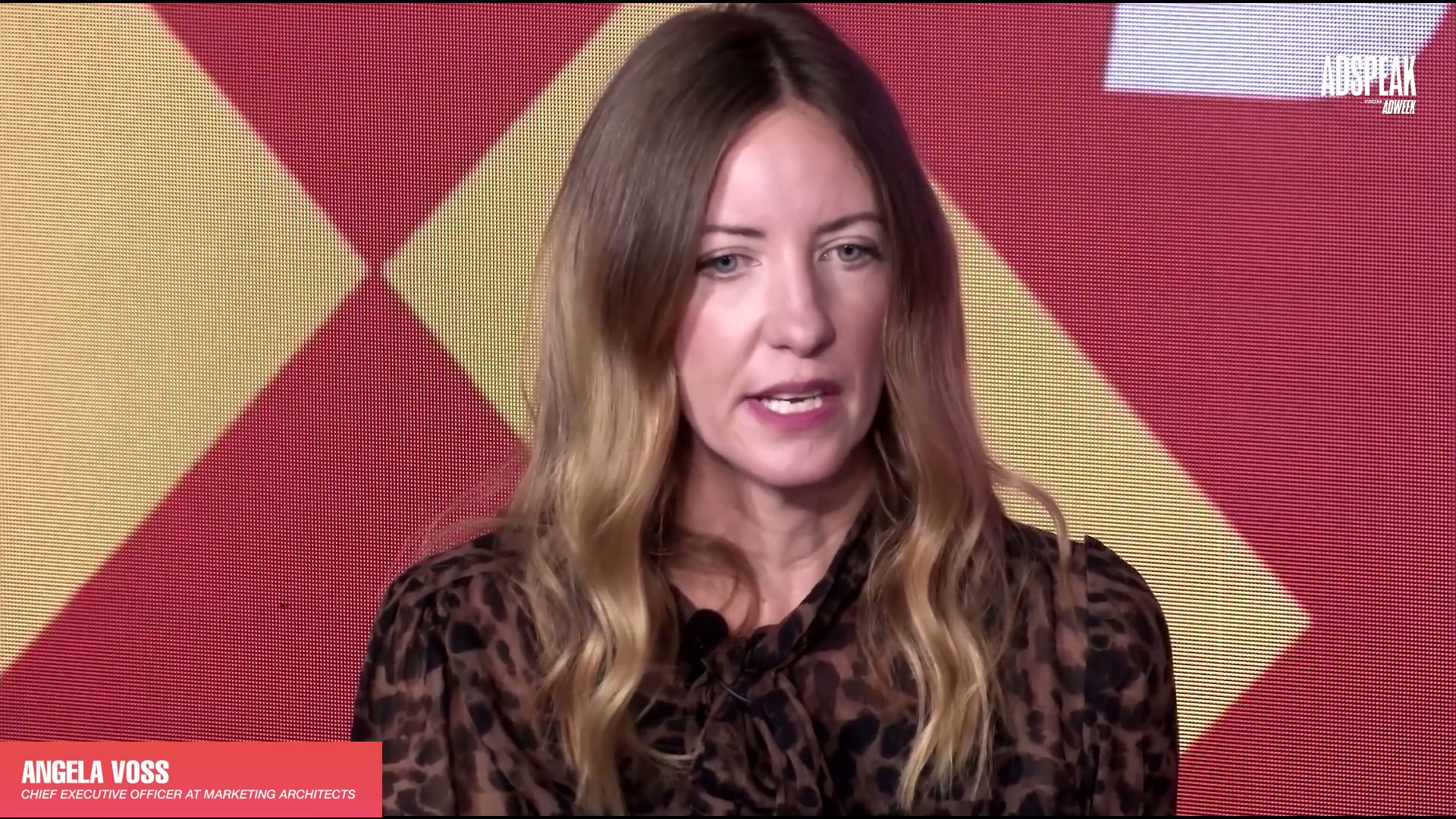
Angela Voss, CEO of the TV-only agency Marketing Architects, used that number at Adweek's Brandweek (in a session with Dale Harrison, now an episode of the Adspeak podcast) to make a point about targeting. If you have read Byron Sharp, nothing in her half of the talk is news. Light buyers, broad reach, diminishing returns on frequency - it is the Ehrenberg-Bass canon, applied to TV. But I do not see that as a weakness. It is one more confirmation from someone who buys media for a living, and the industry still behaves as if it never read the book.
Still, I find it totally funny that there'a an TV only agency calles Marketing Architects :DDD. One would expect complex marketing from marketing architects but that's not the point now.
Performance habits walk into the TV studio
Voss describes a pattern I see with clients too. A brand grows on digital, runs out of runway there, and moves into TV or connected TV. It brings its habits along: tight audience segments, lookalikes built from the best customers, everything measured against a narrow bullseye.
Connected TV makes this very tempting, because it looks like digital. You can target it like digital. So people do. The result, in Voss's words, is that brands end up "mindfully avoiding reaching potential customers because they're too narrowly targeted."
"Hyper targeting is agreeing to pay more to ignore your future customer set." - Angela Voss
That is the best line of the session, and it works because both halves are true. You pay a premium for the targeting, and the premium buys you a smaller audience.
Light buyers are where growth lives
The Coca-Cola stat is a textbook example of what Ehrenberg-Bass calls the law of buyer graphs: most of a brand's buyers are light buyers, and growth comes mainly from getting more of them, not from squeezing heavy buyers harder. Voss's point is that many brands' buyers buy only once or twice a year, and yet marketing teams obsess over finding heavy buyers and cloning them.
Heavy buyers are lovely. They are also already buying. The growth sits in the long tail of people who think of you occasionally, and in the people who do not think of you yet.
B2B has its own version. Voss cites the familiar figure that six to ten people are involved in a typical B2B buying decision. Targeting "the buyer" with one tidy persona means the finance director, the IT lead and the colleague who will actually use the thing never hear of you. Then the decision gets made in a meeting you were never mentioned in.
Reach everyone once, then worry about twice
The frequency debate goes the same way. Is it better to hit a small group many times or a big group once or twice? Voss's answer follows the evidence: response drops with every additional exposure, so ideally you would reach everyone once.
Nobody can do that, of course. But the direction matters. Anyone who has watched the same CTV ad four times in one evening (and started to resent a brand they previously had no opinion about) has felt the opposite strategy. Voss calls that over-frequency "evidence of marketers not following empirical data." Hard to argue with. Every extra impression on the same person is an impression you did not give to a new one.
This connects directly to Harrison's half of the session, which I wrote up separately: reach has far more headroom than creative, and memory decays fast. Spending budget on the fifth exposure is spending it against both of those facts.
CTV is not the cheap TV
The usual objection to broad reach is budget, and Voss takes it on. Linear TV has a reputation as the expensive channel, and the Super Bowl does not help (a 30-second spot averaged around $8 million in 2025). CTV feels like the affordable alternative.
In absolute spend, it often is. Per thousand people actually reached, Voss argues it is frequently more expensive, because the base inventory price gets stacked with middleman fees, tech fees, ad distribution fees and premium targeting costs. You spend less in total and pay more for each viewer.
Her fixes: buy across the full range of networks instead of a few favourite publishers ("agreeing to pay more to reach an audience you could otherwise reach for less"), buy by audience rather than by programme, and accept that the market is now too fragmented for humans to buy efficiently. Marketing Architects claims its own AI buying platform gets inventory at a fifth of the scatter-market cost.
A fair note here. Voss runs a TV agency with its own buying technology, so the CTV-cost argument and the one-fifth figure are vendor claims. The direction makes sense to me - layered fees are real, and most of them are invisible to the client. Ask for the effective cost per thousand real viewers, after all fees, before you call any channel cheap.
Measure with more than one model
The last objection to reach is accountability. If you are talking about impressions and reach, how do you prove sales? Voss does not pretend this is easy. In a Marketing Architects survey of more than 300 marketers, linear TV ranked as the hardest channel to measure and CTV as the third hardest.
Her answer is triangulation. The agency runs at least ten measurement approaches per client - spot-based attribution, ACR data, foot traffic, marketing mix modelling, geo holdouts - and treats platform-reported ROAS with suspicion. "All models are wrong," she says, borrowing the old statistician's line, which only makes the case for using several of them.
That is the healthiest part of the talk. Broad reach and accountability are not opposites. You just cannot get the answer from a single dashboard that the media seller built.
What to take from it
If you have read How Brands Grow, you knew all of this. Now look at your own media plan and check whether it shows. Three questions:
Who is outside your targeting today who could buy from you at least once a year? That group is probably bigger than your bullseye.
What is your average frequency, and how many new people could the last two exposures have reached instead?
What does your CTV actually cost per thousand real viewers once every fee is in?
The evidence for broad reach has been confirmed so many times that confirmation itself has stopped being interesting. Acting on it, apparently, is still rare. If you want the findings behind these laws in one place, they live in the Marketing Wisdom library, each with its source.