New Contagious x FleishmanHillard data on 1,000 marketing leaders: cautious brands get backlash at the same rate as bold ones (20% vs 21%), bold work waits 7 days for sign-off vs 3, and 85% of leaders admit delayed decisions beat imperfect ones. Safe work is the costly kind.
Every marketing approval process has a ghost in it: the campaign that died in review because someone asked "but what if people get upset?" Nobody measures the cost of that question. Contagious and FleishmanHillard just did, and the answer should be laminated and taped to every CMO's monitor.
In The Chaos Advantage (October 2026), they surveyed 1,000 senior marketing and communications leaders and analysed four years of Cannes Lions effectiveness winners. The setup is familiar: 86% of leaders say the environment is more unpredictable than three years ago, 78% expect it to stay that way, and two-thirds of marketers report feeling overwhelmed. The punchline is not. Caution, the thing organizations reach for when the world shakes, turns out to be the expensive option - and the report puts three separate price tags on it.
Tax one: the false-safety paradox
The whole logic of playing it safe rests on one assumption: if we stay quiet, nothing bad happens to us. The data says otherwise. Cautious and less cautious organizations attract public backlash at near-identical rates - 20% versus 21%.
One percentage point. That is the entire protection premium that silence buys. Meanwhile 58% of leaders say missing opportunities through caution happens more often than suffering negative outcomes from boldness. You are paying for insurance that does not insure, with opportunities you will never see itemized on any invoice.
Tax two: the wait-and-see tax
Human instinct under threat is to pause and let the danger pass. In marketing, the danger does not pass anymore - the report's foreword calls chaos "the norm du jour" - so pausing is just slowly leaving.
The leaders know it, too: 61% say waiting too long is the bigger risk, 47% have personally watched a market opportunity expire while their organization deliberated, and 85% agree that delayed decisions can be more damaging than imperfect ones. Read that one again. The people running the approval gauntlets believe an imperfect campaign beats a late one, and then their own processes choose late, every time.
Tax three: the machinery of caution
And those processes have a measured speed. Bold work takes seven days to sign off; safe work takes three. The system literally charges you four days of cultural relevance as an entry fee for ambition. 66% of leaders say risk management blocks action more than it enables it, and when uncertainty rises, the first things organizations slow down are creative approval (38%) and campaign launches (37%) - precisely the two levers the moment demands.
So the machine works like this: chaos creates an opening, the opening requires speed, and the org responds by doubling the queue in front of the only work that could use it.
What the bold ones get for their trouble
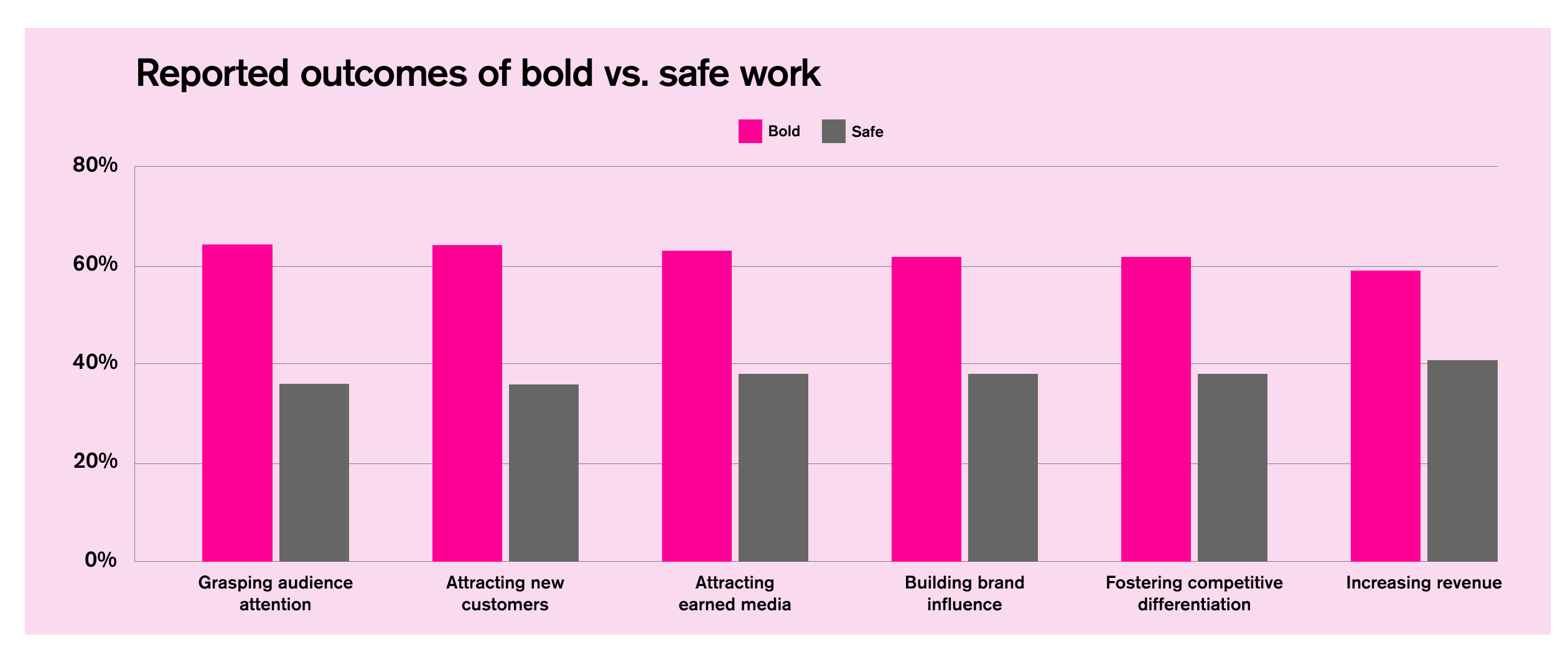
Across every outcome in the survey, bold work beats safe work by roughly 25 points - grasping attention (around 64% vs 36%), attracting new customers, earning media, building brand influence, even increasing revenue.
Source: Contagious x FleishmanHillard, The Chaos Advantage (2026)
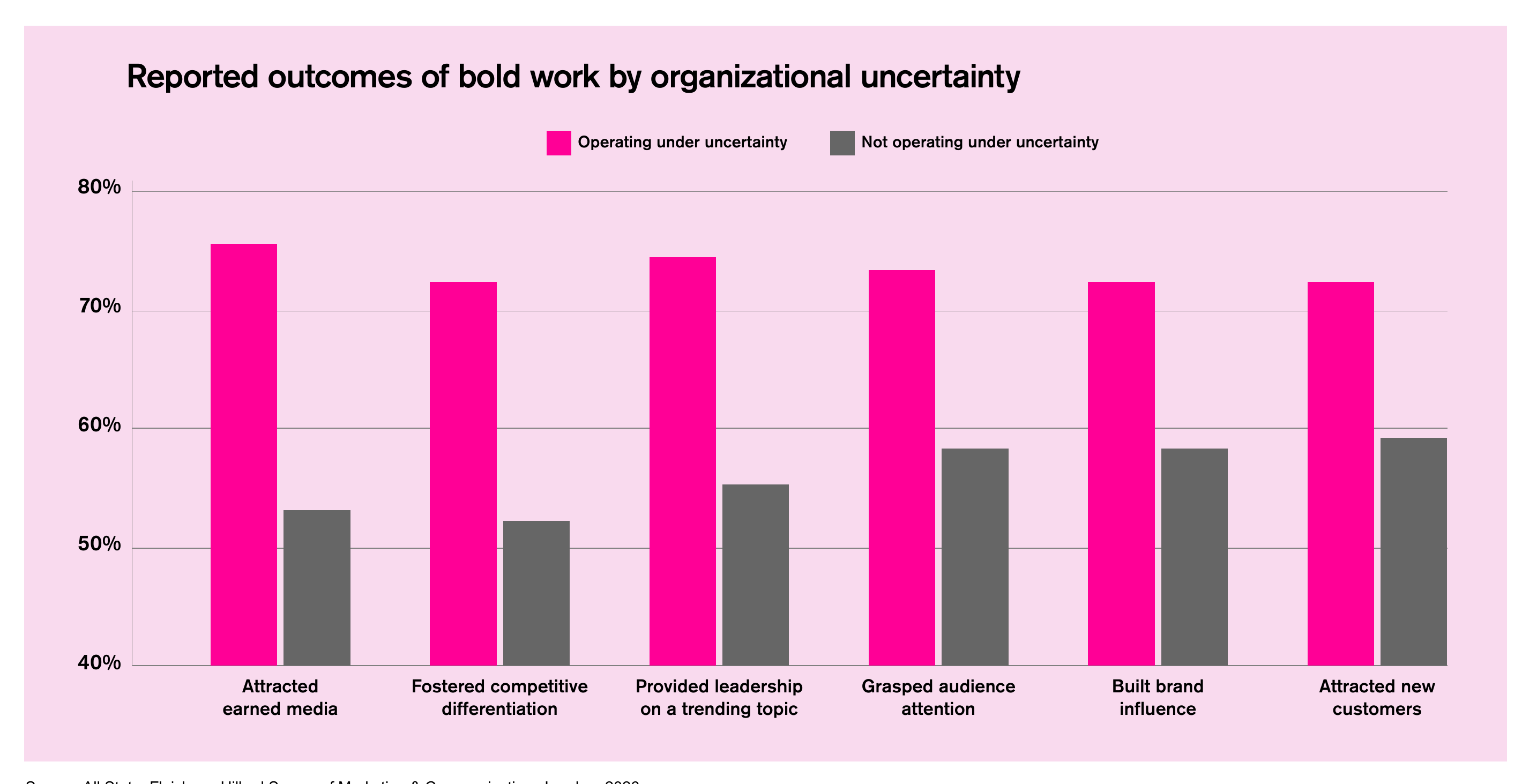
And the gap widens exactly where you'd least expect: the more uncertainty leaders operate under, the more they report bold work paying off. Leaders in chaotic environments rate its outcomes 15-20 points higher than their calm-water colleagues - on earned media it's roughly 76% versus 53%.
Source: Contagious x FleishmanHillard, The Chaos Advantage (2026)
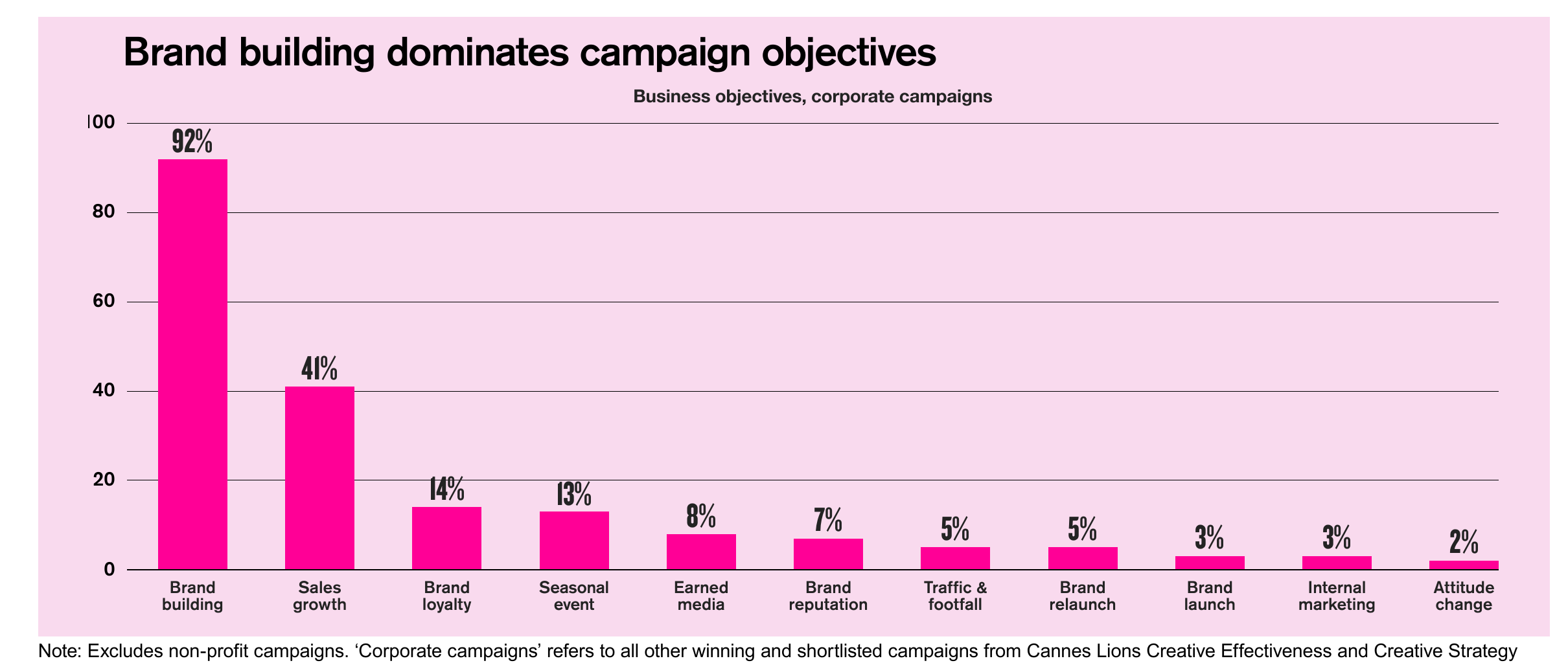
This lines up with the wider effectiveness literature the report leans on: dull work needs an estimated $189bn of extra US media spend to match the effect of non-dull work (System1, the IPA, Adam Morgan and Peter Field's Extraordinary Cost of Dull), and dull media channels cost -37% in conversion and -14% in ROI. Boring is not a style choice. It is a budget line.
The real problem was never conviction
Here is the part I find genuinely funny, in the way only organizational behaviour can be. 88% of leaders believe bold work is more effective in uncertain times. 87% believe uncertainty creates share-of-voice opportunities. Belief is nearly unanimous - and most of these organizations still ship mostly safe work. The bottleneck is not conviction. It is the three taxes above, quietly collected between the brief and the launch.
Which means the fix is not a braver moodboard. It is structural: evidence that bold work drives commercial results (the number one unlock leaders named), clearer risk guardrails agreed before the moment, and faster paths from idea to approval. We built Selfstorming around a version of the same belief - that the scary part of bold work shrinks when the thinking behind it is solid, which is why our ideation sessions anchor ideas in evidence and our Wisdom library keeps the receipts.
Run the audit on your own shop: how many days does bold work wait at your sign-off desk, and what did the last delay cost you? If you cannot answer, that is the tax working as designed - invisibly.
Safe work still feels safe. That feeling is the most expensive thing your marketing buys.