Menlo Ventures' 2026 consumer AI report: paying flipped from 3% to 55% of users in a year, the top 14% of spenders carry 60% of a $40B market, and AI-labelled content takes a 2:1 engagement penalty. What to do about each.
For two years, the AI business model was a running joke: two billion users, three paying customers, all of them venture funds. That joke just died.
According to Menlo Ventures' 2026 State of Consumer AI (run with Morning Consult on 5,067 US adults this July), 55% of AI users now pay for at least one AI product. A year ago it was 3%. I have read a lot of adoption studies, and I cannot remember any consumer behaviour flipping from "basically nobody" to "most people" in twelve months. Streaming took a decade to teach people that content costs money. AI did it between two summers.
Source: Menlo Ventures, 2026: The State of Consumer AI
The money moved faster than the people
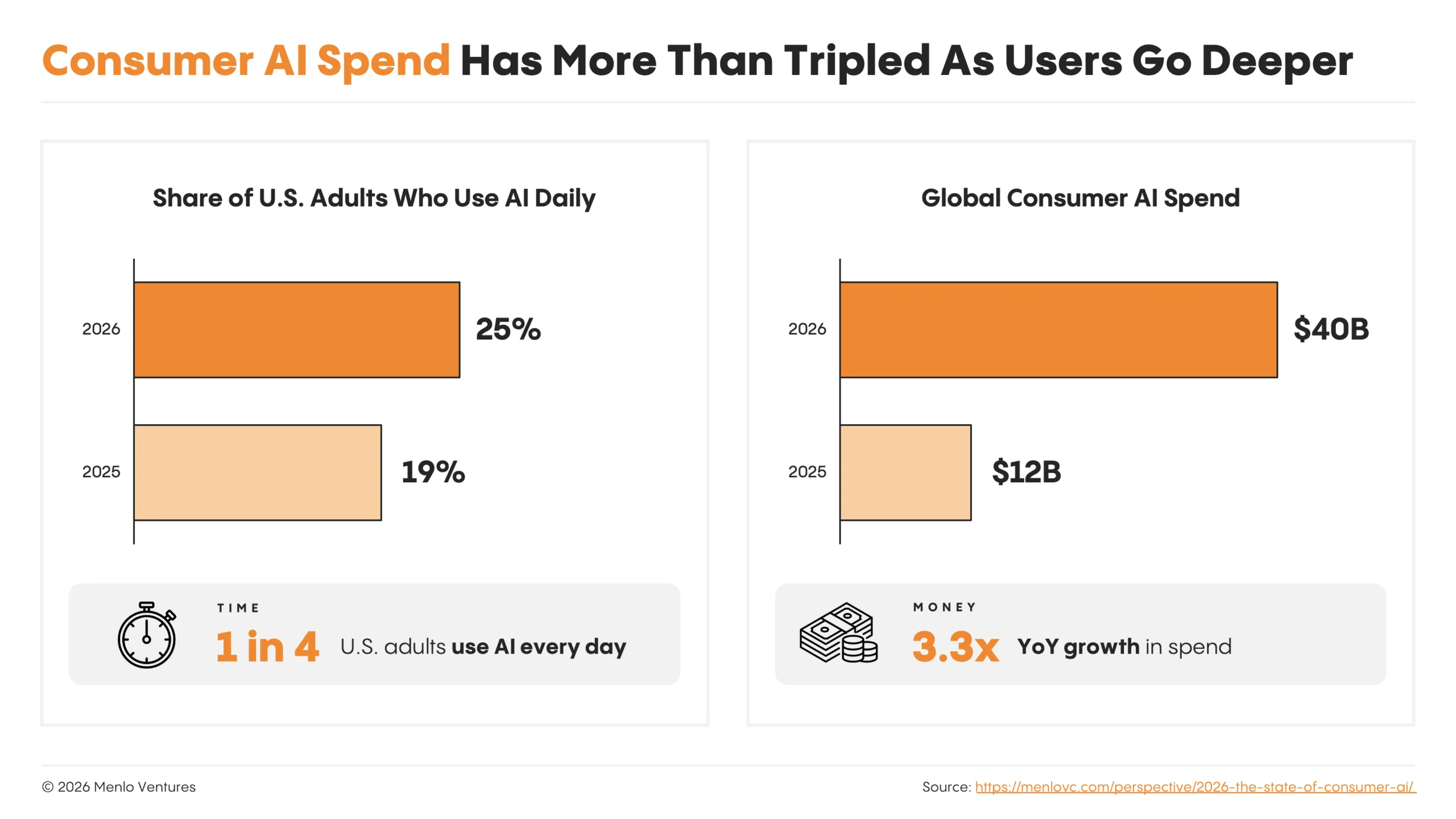
The headline pair from the report: global consumer AI spending more than tripled, from USD 12 billion to USD 40 billion, while the number of users grew just 11%, from 1.8 to 2.0 billion. Adoption is flattening. Wallets are not.
And the wallet is concentrated in a way that should look familiar to anyone who has run a subscription business: the top 14% of spenders, those paying USD 100 or more a month, account for 60% of all consumer AI spending. The typical payer sits at USD 20-49 a month. So the market is not two billion people paying a little. It is a small tribe of dependents funding the whole show, with a long tail of dabblers behind them - 29% of users spend less than 15 minutes a day with AI.
Building Selfstorming, I see the same curve in miniature. The people who pay are not the ones who tried the most features. They are the ones whose Tuesday broke when an AI provider had an outage.
Reliance predicts payment, agents predict reliance
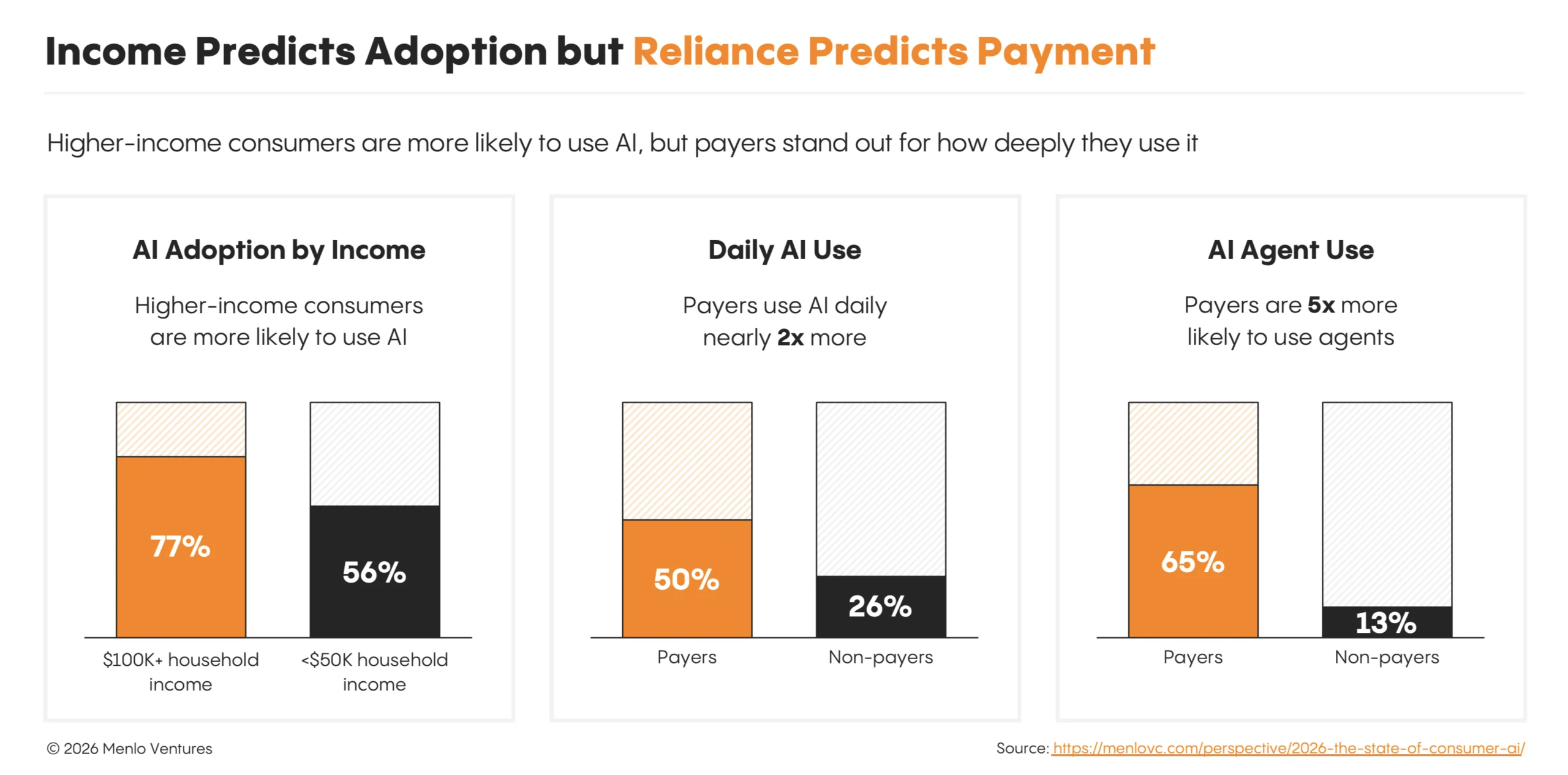
The report's sharpest finding hides in the agent data. 41% of AI users have tried agents and 24% use them regularly - fine, early-adopter numbers. But 92% of agent users pay for AI, 65% of payers use agents versus 13% of non-payers, and 32% have already let an AI act on their behalf without final approval.
Read that last one again. A third of agent users let software finish the job without checking. Booking, buying, replying. That is not a chat habit. That is delegation, and delegation is the thing people have always paid real money for - it used to be called an assistant, an agency, or a travel agent.
Source: Menlo Ventures, 2026: The State of Consumer AI
Menlo's first prediction for 2027 follows directly: agentic purchases drive USD 100 billion in online sales. Their third prediction should worry media planners more: AI becomes a critical advertising channel. If an agent shortlists three espresso machines before a human ever sees a brand name, the discovery battle happens inside the model. Which is why we track Share of Model as a serious metric, not a conference gag.
Meanwhile, daily AI beat food delivery
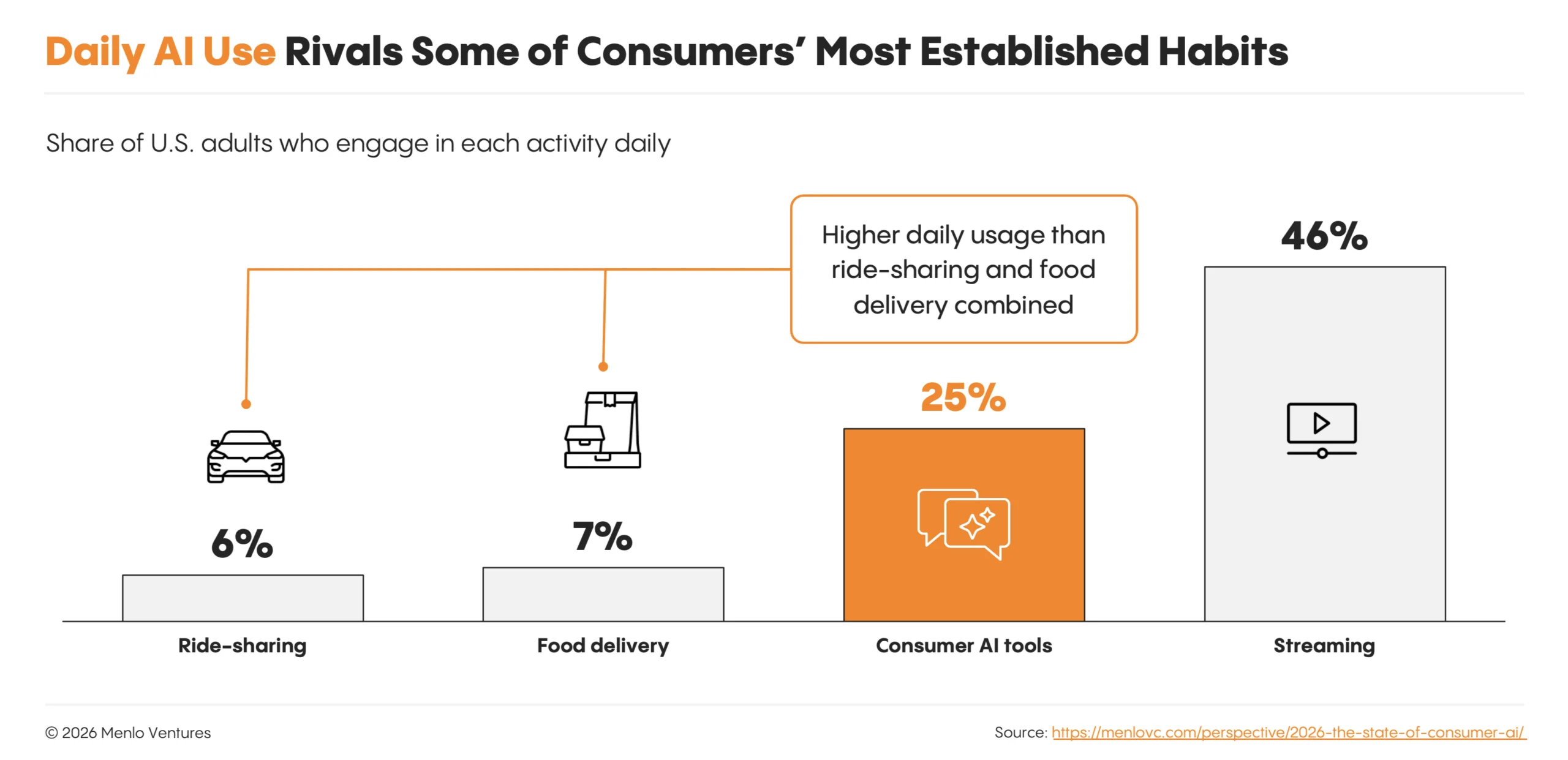
A quarter of US adults now use AI every day, up from 19%. General AI assistants get daily use from 22% of consumers - more than ride-sharing (6%) and food delivery (7%) combined. The average AI user runs 3.0 assistants side by side, up from 2.2, which means the "one assistant to rule them all" thesis is losing to the same behaviour we know from streaming: people subscribe to a stack and resent it monthly.
Source: Menlo Ventures, 2026: The State of Consumer AI
The part marketers keep skipping
Here is the number I would pin above every creative department's door: 36% of consumers say they are less likely to engage with content they know is AI-generated. Only 14% are more interested. That is an engagement penalty of better than two to one, attached not to the quality of the work but to the label.
It gets steeper where the stakes rise. For medical diagnosis, people prefer a human 63% to 19%. Mental health support, 61% to 19%. Legal advice, 59% to 21%. Even for learning a new skill, humans lead 44% to 28%. Consumers are happy to let AI draft their emails and increasingly happy to let it buy their flights - and still, the moment something matters, they want a person.
So the strategy is not "hide the AI", and it is definitely not "flood the feed". The winners in this report's world use AI where consumers reward it (speed, admin, delegation) and keep visible humanity where consumers pay for it (judgment, taste, accountability). The lazy middle - obviously machine-made content pretending to be human - collects the 36% penalty and feeds the slop pile.
What I would actually do with this
Three moves, in order of regret if skipped.
1. Price for dependents, not dabblers. If 14% of payers carry 60% of the market, your pricing page is the filter. Find the users whose week breaks without you and build an expensive tier for them.
2. Get your brand legible to agents. Structured data, quotable claims, sourced numbers. When a third of agent users stop reviewing the output, being the answer beats being the ad.
3. Decide where you are proudly human. Pick the moments where a person visibly owns the judgment, and say so. The data says consumers will pay a premium for it precisely because everyone else is automating it away.
The report's quiet punchline: 52% of Americans say AI has not meaningfully changed their lives. Two billion users, forty billion dollars, and half the country shrugs. Which means the story is not finished - it means the products that made people pay are the ones that stopped feeling like AI and started feeling like help.