Branded web mentions correlate 0.664 with AI Overview visibility. Backlinks: 0.218. Here are the five factors Ahrefs found, the robots.txt check that makes them moot, and why there is no single AI search strategy.
For about fifteen years, the answer to "how do we rank" has been some version of: get links. Better links. More links. An entire industry grew up around that sentence.
Then Ahrefs ran the numbers on AI search across roughly 75,000 brands and 25 million AI Overviews, and links came seventh.
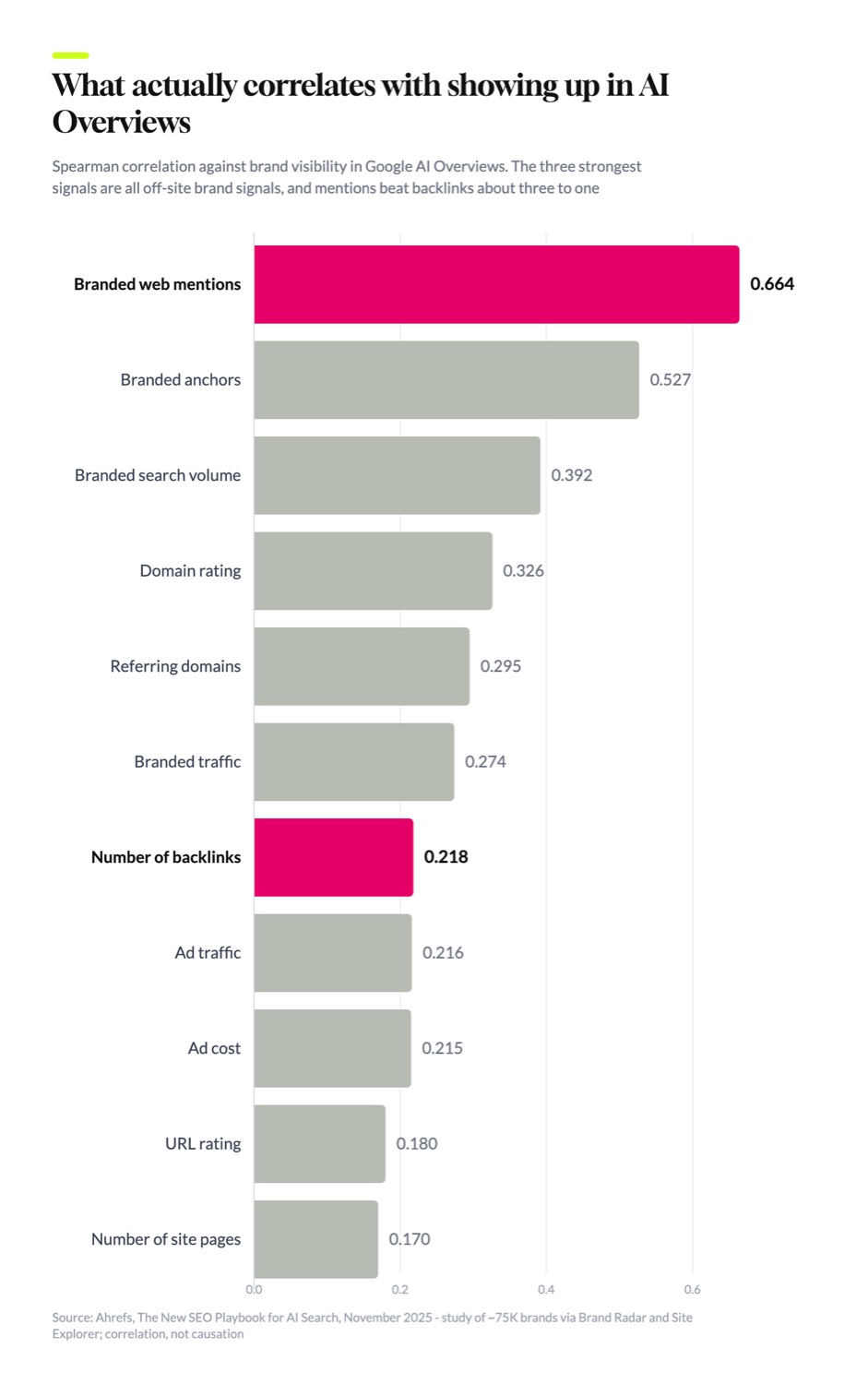
Mentions beat links, about three to one
Source: chart redrawn by Selfstorming from Ahrefs, The New SEO Playbook for AI Search, November 2025
Branded web mentions correlate at 0.664. Number of backlinks: 0.218. Roughly three times the correlation, from the thing most SEO budgets treat as a nice-to-have.
Look at what sits above backlinks. Branded anchors, 0.527. Branded search volume, 0.392. Domain rating, 0.326. The top three are all off-site brand signals. Not things you do to your website. Things that happen to your name elsewhere.
The mechanism Ahrefs offers is simple enough to be uncomfortable: models learn by reading the web, so every appearance of your brand on a credible site is another training example. See "Red Bull" next to "extreme sports" enough times and the association hardens. That is not optimisation. That is being talked about.
Two things before anyone rewrites their strategy deck. This is correlation, stated as correlation, and Ahrefs does not claim otherwise. And it is Ahrefs research that concludes you should buy Ahrefs Brand Radar, which gets a walkthrough twice in nine minutes. Both true. Use the numbers, name the source.
Long-tail stopped being about coverage
In classic SEO, long-tail was a numbers game. Rank for more queries, get found more ways.
In AI search it does a different job. Ask an assistant to "plan me a five day trip to Japan in November" and it does not go looking for one page. It fans that prompt into dozens of smaller sub-queries, pulls from several sources, and stitches one answer. Rank for the narrow, specific questions and you get pulled into the assembly.
Which reframes content clusters from an SEO tactic into a retrieval strategy. You are not covering a topic to catch searchers. You are covering it so that whichever fragment the model breaks the question into, you are what it finds.
Your page is not read. It is chopped up.
This is the part most content teams have not internalised.
Google AI is described as walking a page's semantic HTML from top to bottom, and both Google and ChatGPT chunk a page rather than reading it whole, then decide which chunks are worth keeping. Your article is not evaluated as an article. It is evaluated as a pile of pieces.
The obvious conclusion is wrong, and Ahrefs says so explicitly: this does not mean writing in short choppy blurbs or turning everything into an FAQ. It means grouping related thoughts and keeping each section on a single takeaway, so each piece makes sense alone while still connecting to the next.
If your best point is buried in paragraph nine of a rambling section, the chunk containing it may not survive the cut. Not because it is wrong. Because it arrived tangled.
Freshness became a retrieval signal, not a ranking one
Source: chart redrawn by Selfstorming from Ahrefs, The New SEO Playbook for AI Search, November 2025
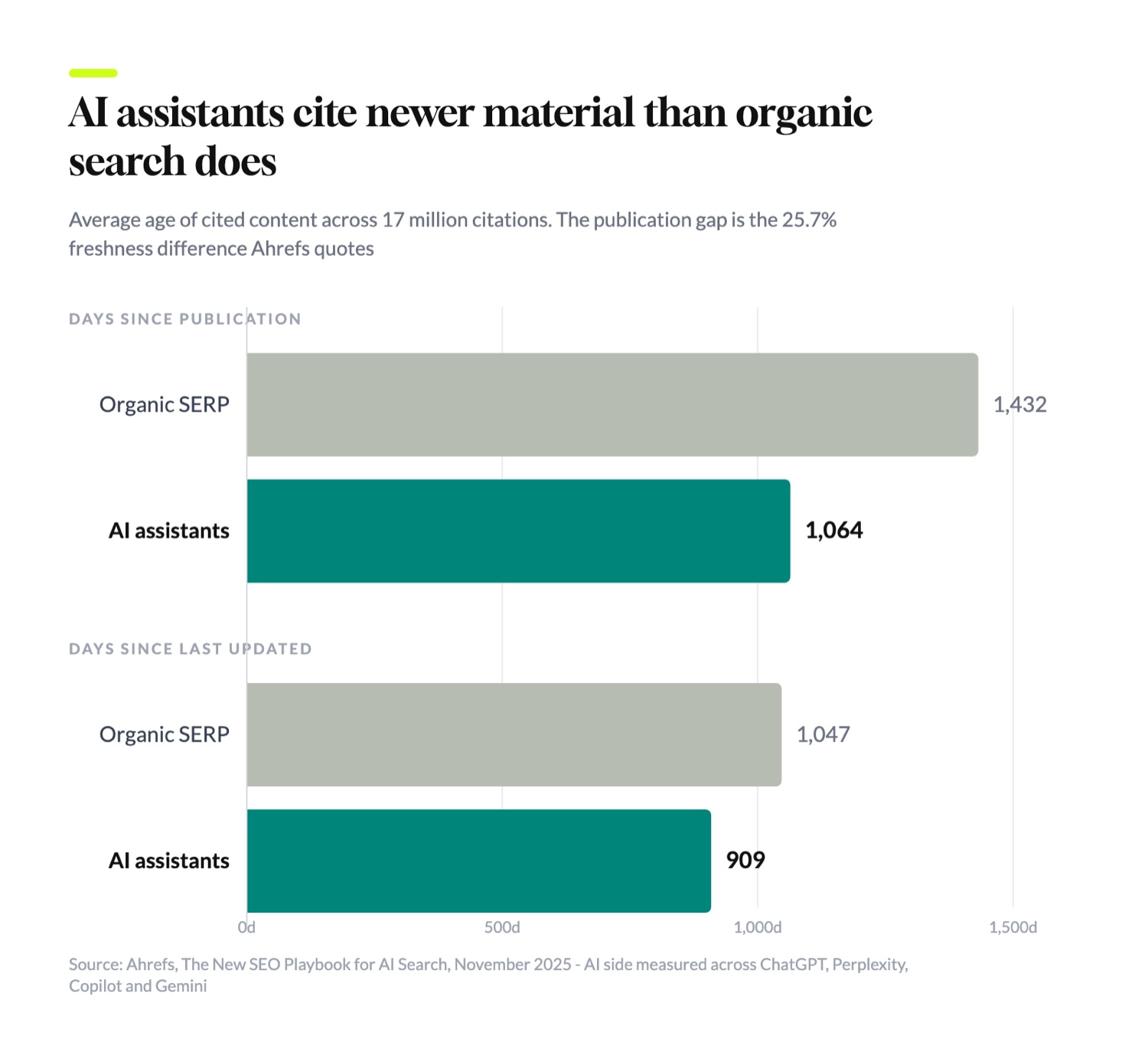
Across 17 million citations: content cited by AI assistants averages 1,064 days since publication against 1,432 for organic search results. That gap is the 25.7% freshness difference. On last-updated it is 909 days against 1,047.
The why matters more than the number. Assistants use retrieval augmented generation, which means a model that already knows an answer from training does not search at all. Retrieval only fires when the topic is new or moving. So recency is not a tiebreaker applied to everything. It is the condition under which anything gets fetched in the first place.
HubSpot's worked example: they updated their Small Business Ideas article in April. Organic traffic spiked, which nobody would find surprising. AI mentions to that page spiked at the same moment, over 1,100 new ones.
Which turns a refresh cycle from housekeeping into a retrieval play. Update the facts, add the newer numbers, cut what expired, and redate it when the redate is honest.
The check that makes all of this moot
Ahrefs studied 140 million websites and found about 5.9% were blocking OpenAI's GPTBot alone. Roughly one site in seventeen.
Go to yourdomain.com/robots.txt. It takes seconds, and everything above is wasted effort if the answer is bad.
There is no single AI search strategy
This is the finding with the most planning consequence, and the least airtime.
Source: Ahrefs, The New SEO Playbook for AI Search, November 2025
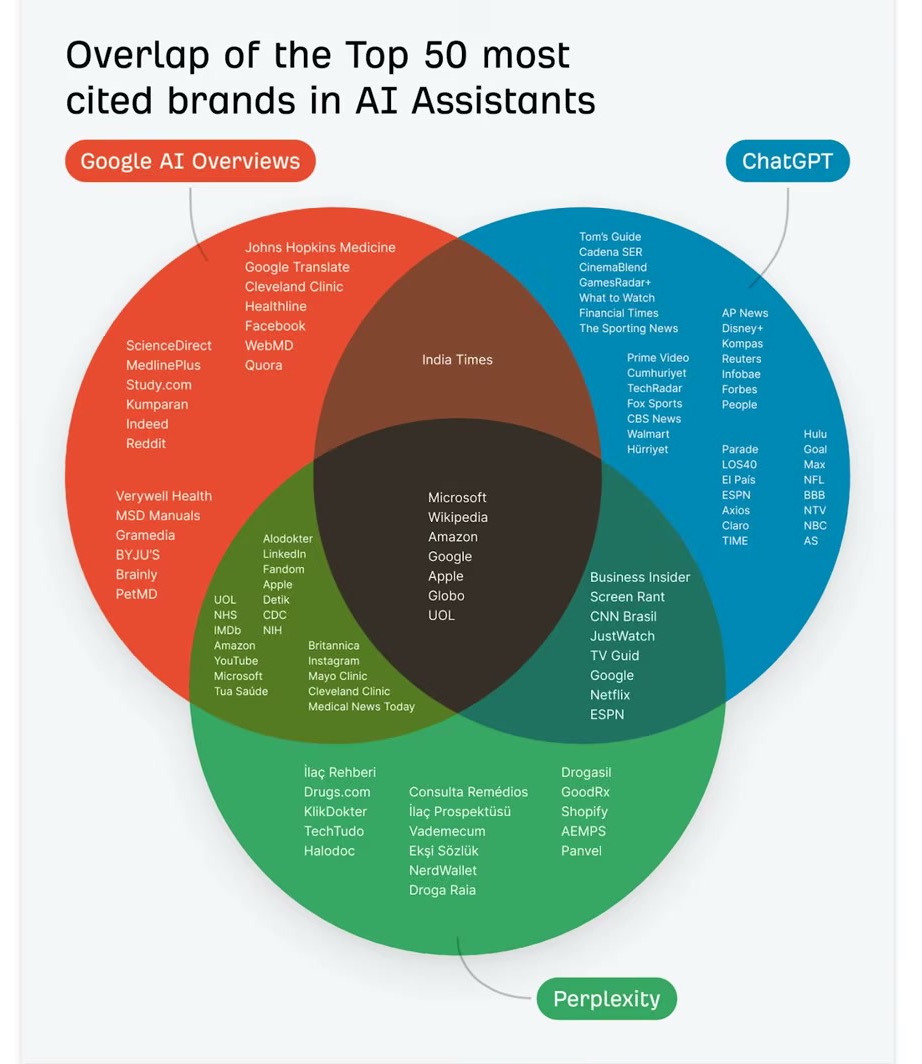
Ahrefs compared the top 50 most-mentioned domains across Google AI Overviews, ChatGPT and Perplexity. Only 14% were shared across all three. Seven domains out of fifty.
And look at which seven sit in that centre: Microsoft, Wikipedia, Amazon, Google, Apple, Globo, UOL. Five of the largest properties on the internet plus two Brazilian portals. That is not a club you join by publishing better.
Outside the centre, the assistants pull from visibly different worlds. Google AI Overviews leans on YouTube, Reddit and Quora. ChatGPT prefers publishers and wires, Reuters and the Associated Press. Perplexity reaches for niche and regional sites in health, finance and local blogs.
The practical read: dominating one assistant tells you almost nothing about the others, and where you chase mentions should differ by platform. Ahrefs' own split is highly linked-to pages for Google AI Overviews, high-traffic pages for ChatGPT and Perplexity.
The most useful sentence in the video
It comes at the end, and it is Ahrefs undercutting their own playbook:
"No one actually knows how to definitively optimize for AI search yet. It's still too early. For now, all we have is the data we've analyzed."
That is the right posture, and it is worth borrowing. GEO, AEO, LLMO are still just SEO done broader. Not content and links, but being present wherever your audience already is, in a form a machine can pick up in pieces.
One caveat we would add on top of theirs: this video is from November 2025, on a subject that moves monthly. Treat the direction as sound and the specific numbers as a snapshot.
If you want the adjacent evidence, the piece on long-term brand effects and the Cannes write-up on creators both land on the same conclusion from different directions: the thing that makes you visible is the brand, not the tactic.