AI slop starts before the first word: a model with no brief writes the average of the internet. Brief ZERO is the brand context your AI reads first, so the output finally sounds like you.
Ask any AI for a billboard line for a language app and you get "Learn languages simply and fun, right on your phone." The grammar is fine. The line is invisible. It is the sentence that would win if the whole internet voted, and a sentence the whole internet would vote for belongs to nobody.
That is AI slop. Most of the advice about it is about tidier sentences. I think the fix starts one step earlier, with what the model knows before it writes a word.
What slop actually is
Google's own AI Overview defines AI slop as "low-quality, mass-produced digital content created using generative artificial intelligence with little human effort, meaning, or care." Fair, and a little ironic coming from the machine.
The better definition came from Patreon founder
Jack Conte at SXSW 2026: slop is "that lazy phase after the introduction of a new medium where we're all just trying to reproduce existing things that are honestly just better if the people do them."
The word that matters is phase. Early film parked the camera where the front row of a theatre would sit. Slop is what a new medium makes while it still imitates the old one.
In marketing I would add one practical line. Slop is what a model writes when it knows nothing about you. It has read everything, so with no brief it falls back on the average of everything.
Two layers of slop
The first layer is the tics. Long dashes everywhere, three adjectives where one would do, "not only a drink but a lifestyle", the over-eager assistant tone, the closing line that sounds like a horoscope. You learn to spot them in a week and you can clean them out of any draft.
The second layer is harder to see. A perfectly clean sentence with no brand in it is still slop, only better groomed. "Duolingo helps millions of people learn languages" has no tics at all. It also has no Duolingo in it.
After 17 years at TRIAD, most of them spent reading briefs, I would put it this way. The brief always did most of the work. AI just made a bad brief visible faster, and at scale. A junior copywriter with an empty brief asks questions. A model with an empty brief answers them for you, confidently, with the internet's opinion.
Brief ZERO: the brief before every brief
So we built the layer that comes before the task. Brief ZERO is one brand context your AI reads before it writes, ideates or plans. You write it once and attach it to everything.
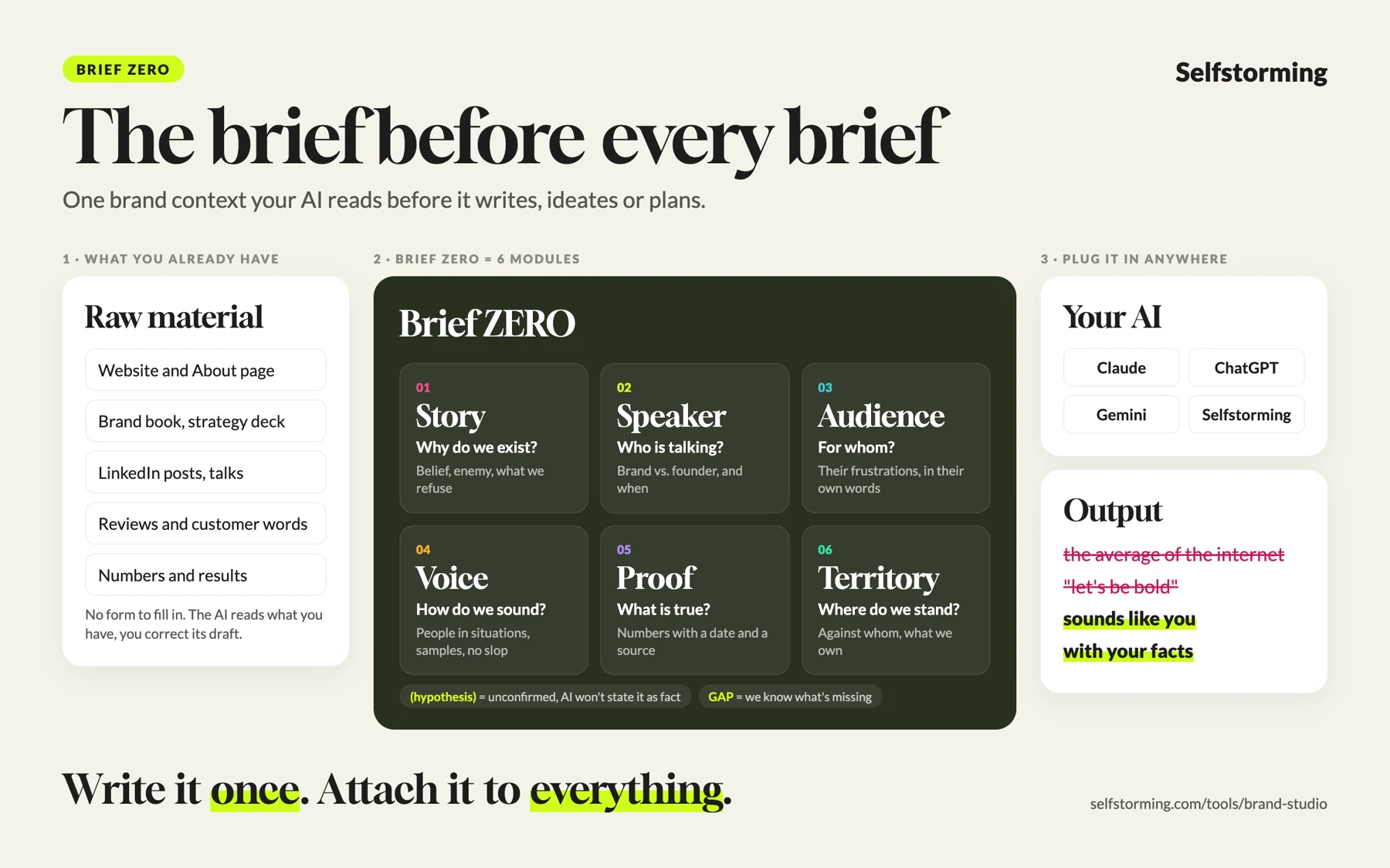
It has six modules, each answering one question a good account director would ask on day one.
Story - why do we exist? The belief, the enemy, what we refuse to do.
Speaker - who is talking? The brand, the founder, or a character, and when each one speaks.
Audience - for whom? Their frustrations in their own words, the phrases they actually use.
Voice - how do we sound? People in situations and real samples, with no list of adjectives.
Proof - what is true? Numbers with a date and a source.
Territory - where do we stand? Who we compete with and what we own.
You don't fill in a form. You hand over what you already have (website, brand book, a strategy deck, reviews) and the AI drafts the modules. You correct the draft. Anything nobody has confirmed gets marked as a hypothesis, so the model won't state your guesses as facts. Gaps are marked as gaps, which is more honesty than most brand books manage.
Same task, two answers
The fastest way to see the difference is to run the same task twice. We used Duolingo, because its brand is loud enough that you notice when it goes missing.
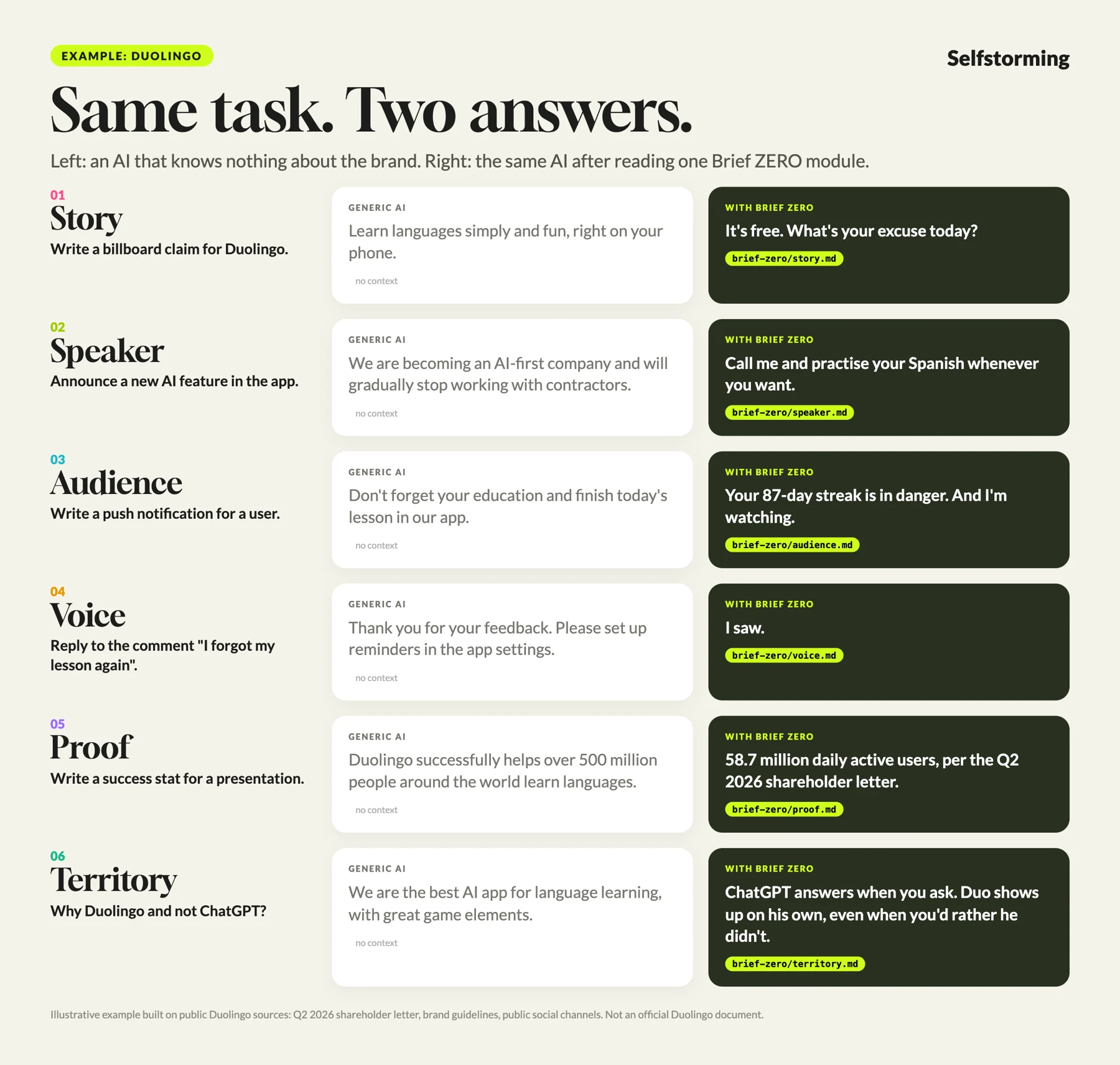
Illustrative example built on public Duolingo sources. Not an official Duolingo document.
Look at the push notification. The generic version reminds you to "finish today's lesson in our app", which is the voice of a dentist's receptionist. With the Audience module loaded, the model knows its users treat the streak as sacred and the owl as a mild threat. "Your 87-day streak is in danger. And I'm watching."
Or the reply to a user who wrote "I forgot my lesson again". The generic AI thanks them for their feedback and points them to the settings. The Voice module produces two words. "I saw." Short, slightly menacing, unmistakably Duo.
The Proof row is the one strategists should care about most. Without context, the model reaches for the round number it has seen most often online. With the Proof module, it quotes 58.7 million daily active users from the Q2 2026 shareholder letter, with a date and a source. One of those goes into a client deck. The other goes into a correction email.
None of the generic answers is wrong. They just belong to every language app at once.
How it works in Selfstorming
Brief ZERO lives in Selfstorming. Paste your website or upload a brief or brand book, and it fills in the first draft, charts and tables included. Add colors, logos and product shots if you want the visual side covered too.
Then you attach the brand with one click in the Ideation Session, Hooks, Research or the Strategy Session, the same way you would add a document, except it is always there and you never retype it. If you work in Claude, ChatGPT or Cursor, the MCP connector lets your own AI load the same brief before it writes. Not sure what goes in? See how Selfstorming describes itself.
Brief ZERO is part of The Storm plan. A subscription includes two brands, which covers your own brand and the client that keeps you up at night.
The fix is boring, and that is the point
Better prompts help a bit. Cleaner sentences help a bit more. The model was never the bottleneck. The empty page you handed it was.
Open Brief ZERO, paste your website, and spend twenty minutes correcting what the AI got wrong about your brand. Those twenty minutes are the most human part of the job, and every draft you generate afterwards inherits them.