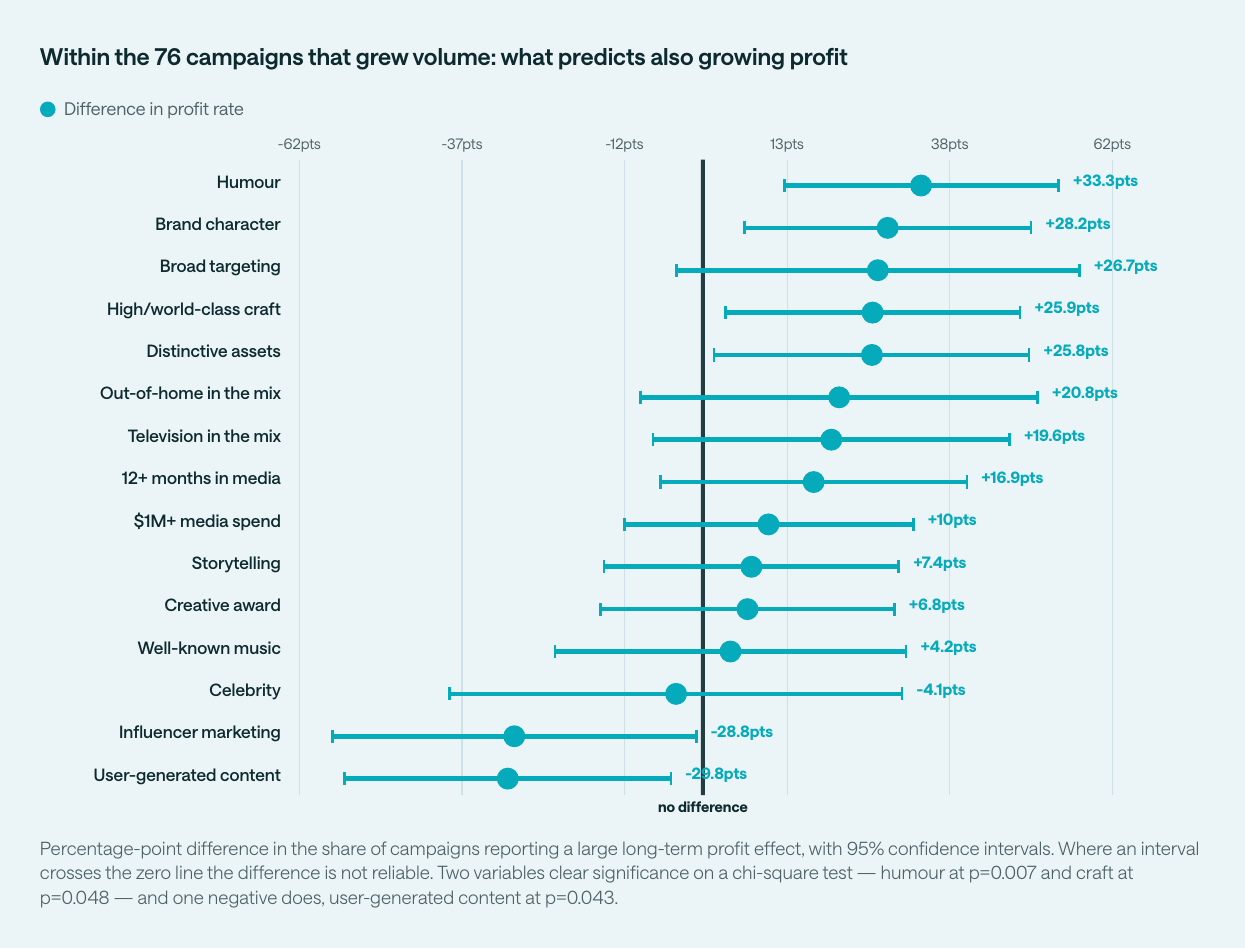
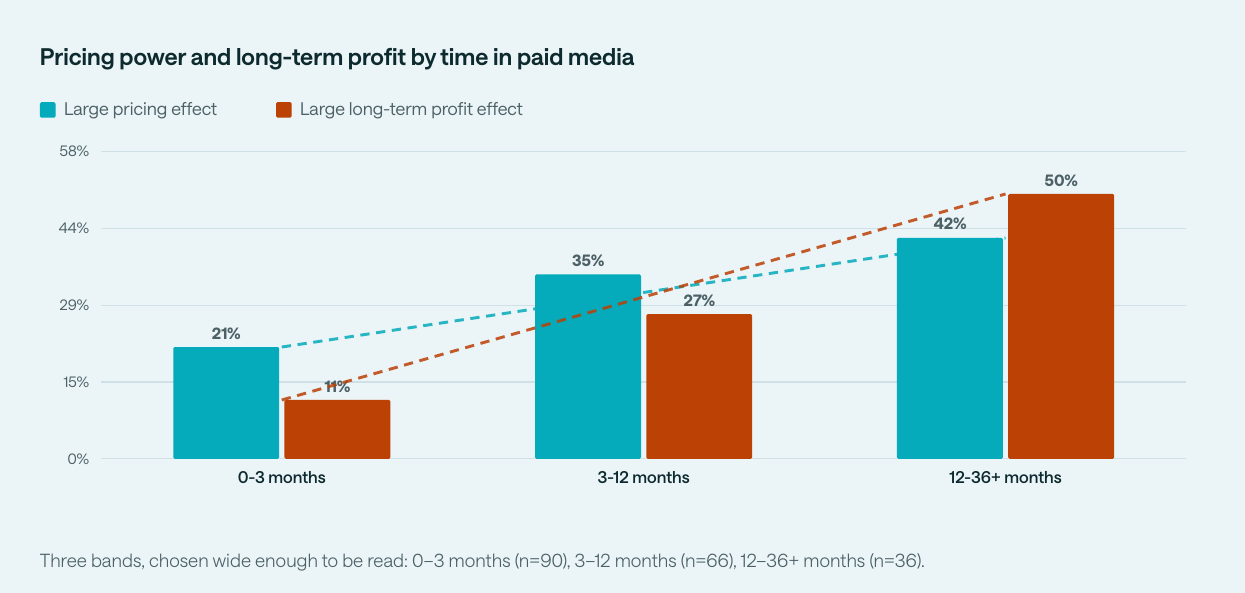
The most consistent brands report very large profit growth almost six times as often. But the coherence that pays lives in voice and action, not in the logo rules.
Consistency has a branding problem. Say the word in a creative meeting and people hear "do the same ad again". Say it to a brand manager and they hear "use the right shade of blue".
Both are missing the part that pays. FutureBrand's report From Artefact to Infinite pulls together the evidence on what kind of consistency actually moves business results, and the answer isn't the kind most brand manuals police.
The numbers on consistency
System1 and the IPA scored 80 UK brands between 2017 and 2024 on thirteen measures of consistency. The most consistent brands had more than twice as many major business wins per campaign as the least consistent: 3.0 against 1.3. Brands with the strongest culture of consistency were almost six times as likely to report very large profit growth (38.5% against 6.7%).
Effie and System1 then applied the same framework to 139 US and UK brands. The most consistent quarter earned 4.2 times the advertising return of the least consistent and were 2.9 times as likely to report profit growth.
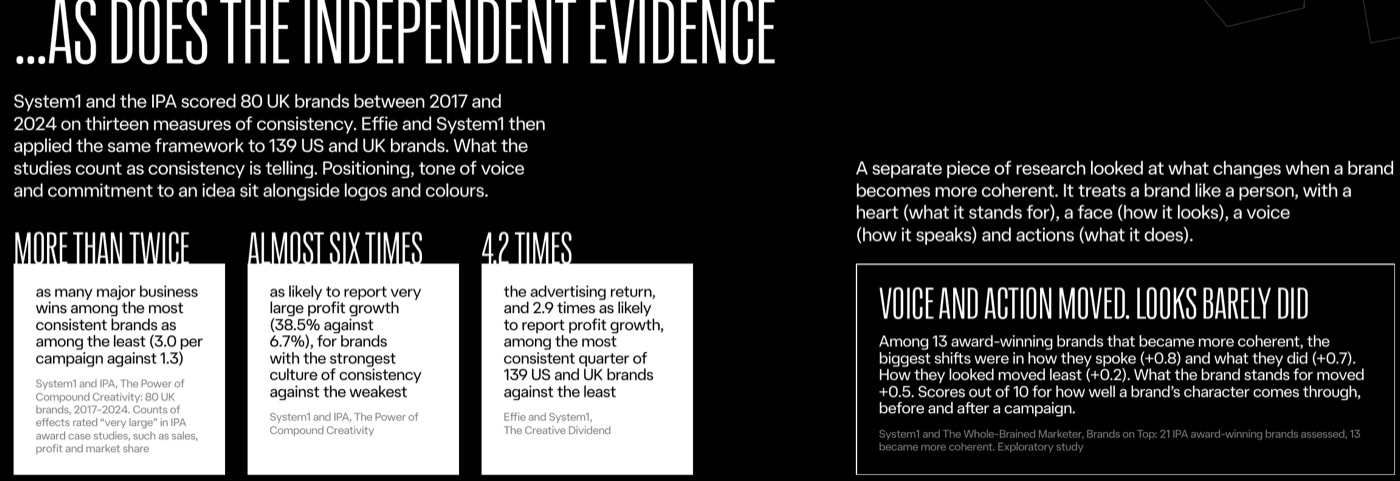
Source: FutureBrand, From Artefact to Infinite (2026), p. 37, citing System1 and IPA, The Power of Compound Creativity; Effie and System1, The Creative Dividend.
Look at what those studies count as consistency, though. Positioning, tone of voice and commitment to an idea sit right next to logos and colours. It was never only about the visual system.
Voice and action moved. Looks barely did.
This is the finding I'd put on a slide. A System1 study treated brands like people, with a heart (what they stand for), a face (how they look), a voice (how they speak) and actions (what they do). Among 13 IPA award-winning brands that became more coherent, the biggest shifts were in voice (+0.8 out of 10) and action (+0.7). What the brand stands for moved +0.5. How the brand looked moved least of all, +0.2.
So the brands that got more coherent didn't get there by tightening the logo rules. They got there by talking and acting more like themselves. It's an exploratory study and a small sample, and the report says so. It still matches what I see from the agency side: clients rarely lose coherence in the identity. They lose it in what they say and do between campaigns.
The Index: the field got better at behaving
FutureBrand adds its own data. Its Index has asked more than 30,000 professionals in 17 countries how they see the world's 100 most valuable companies, on eighteen attributes. None of the eighteen asks what a company looks like. Every one describes how it behaves.
Between 2015 and 2025, all eighteen rose by nine to twelve points, and the average went from 26% to 37%. That has an awkward consequence for anyone standing still. Apple scored 45% in 2015 and 44% in 2025, still above average on every attribute, and dropped from 2nd to 14th. Its Individuality lead collapsed from +31 to +4, while the leads built on conduct repeated over years (Personality, Indispensability) held.
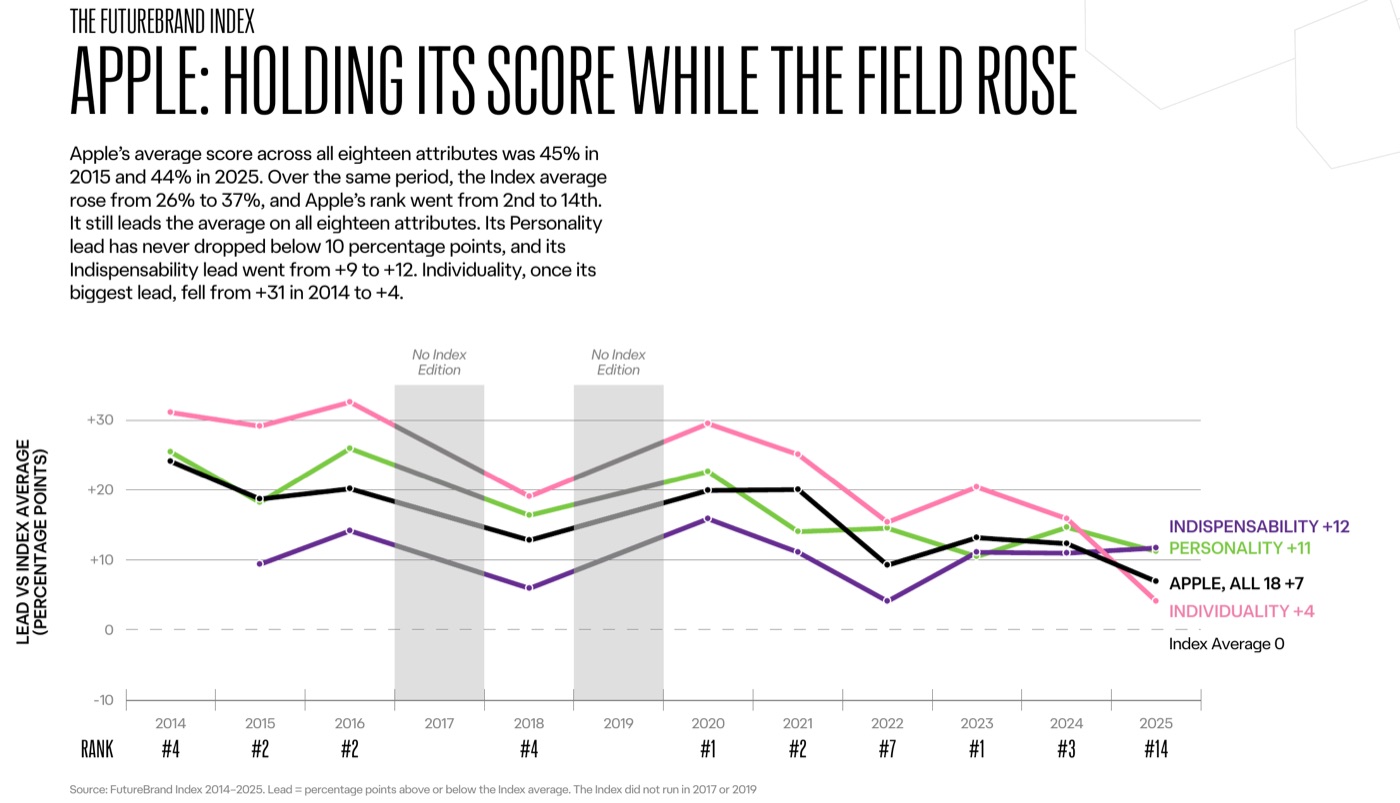
Source: FutureBrand, From Artefact to Infinite (2026), p. 21, FutureBrand Index 2014-2025.
Coca-Cola shows the same shape: above average on Story, Personality and Consistency in every edition for eleven years. Amazon got a Personality lead without a defining campaign or a mascot. FutureBrand's reading is that conduct produces personality, and that a score like that is hard to buy with a campaign.
Coherence has a price tag
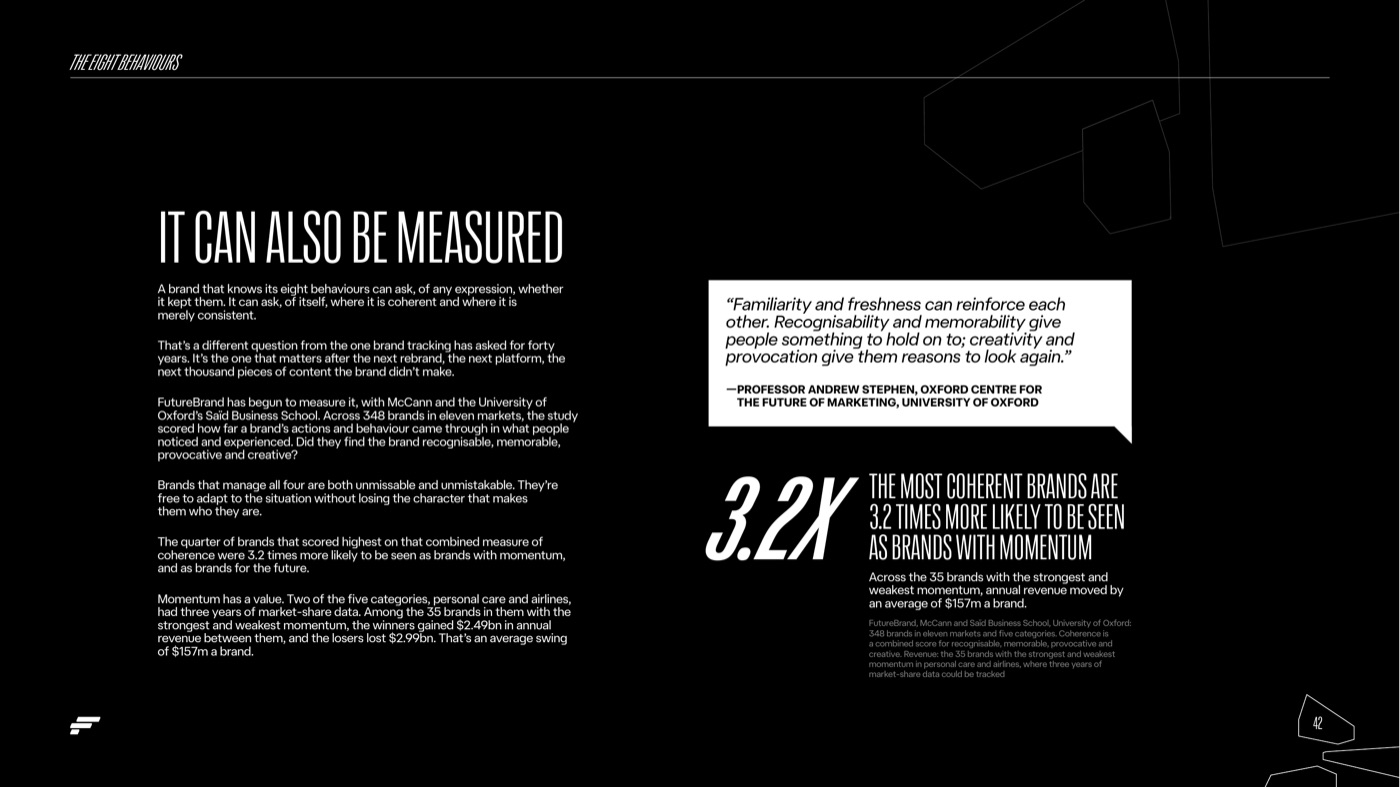
The newest data in the report comes from a study FutureBrand ran with McCann and Oxford's Saïd Business School across 348 brands in eleven markets. It scored coherence as four things together: recognisable, memorable, provocative and creative.
The most coherent quarter were 3.2 times more likely to be seen as brands with momentum. In personal care and airlines, where three years of market-share data existed, the 35 brands with the strongest and weakest momentum moved revenue by an average of 57m each: the winners gained .49bn between them, the losers lost .99bn.
Source: FutureBrand, McCann and Saïd Business School, University of Oxford, via From Artefact to Infinite (2026), p. 42.
Professor Andrew Stephen's comment on it is worth quoting: "Familiarity and freshness can reinforce each other." Recognisable and memorable give people something to hold on to. Creative and provocative give them a reason to look again. Consistency isn't the opposite of creativity here. It's what lets creativity get noticed.
This lines up with James Hurman's 12 effectiveness principles that hold across markets, which I recently turned into a drum machine.
"Duration and consistency compound; short-termism destroys value"
is one of them, supported in every market where it has been tested. FutureBrand's contribution is to say where that consistency should live.
A caveat and a to-do
Most of these studies draw on award-winning case studies where the results are reported by the entrants, and FutureBrand published the report alongside its own repositioning. Read it as a well-argued thesis with good evidence, not as a law of physics.
The to-do is simple. Next time someone asks for "more consistency", ask which layer they mean. If the answer is the logo, check the voice and the behaviour first. That's where the money moved.