44% of big brands' paid creative is made by outside creators and AI assistants now describe brands to shoppers. FutureBrand's report shows why the brand manual has to describe behaviour, not logos.
Every brand manual I have ever signed off was thick enough to stop a door. I have a fair idea how many people read one cover to cover: the designer who made it, and the person who had to approve it.
That used to be fine. The people who made the brand's stuff were few, trained, and sitting two desks away. FutureBrand's new report, From Artefact to Infinite, argues that this world is gone, and it brings the numbers to prove it.
Who actually makes your brand now
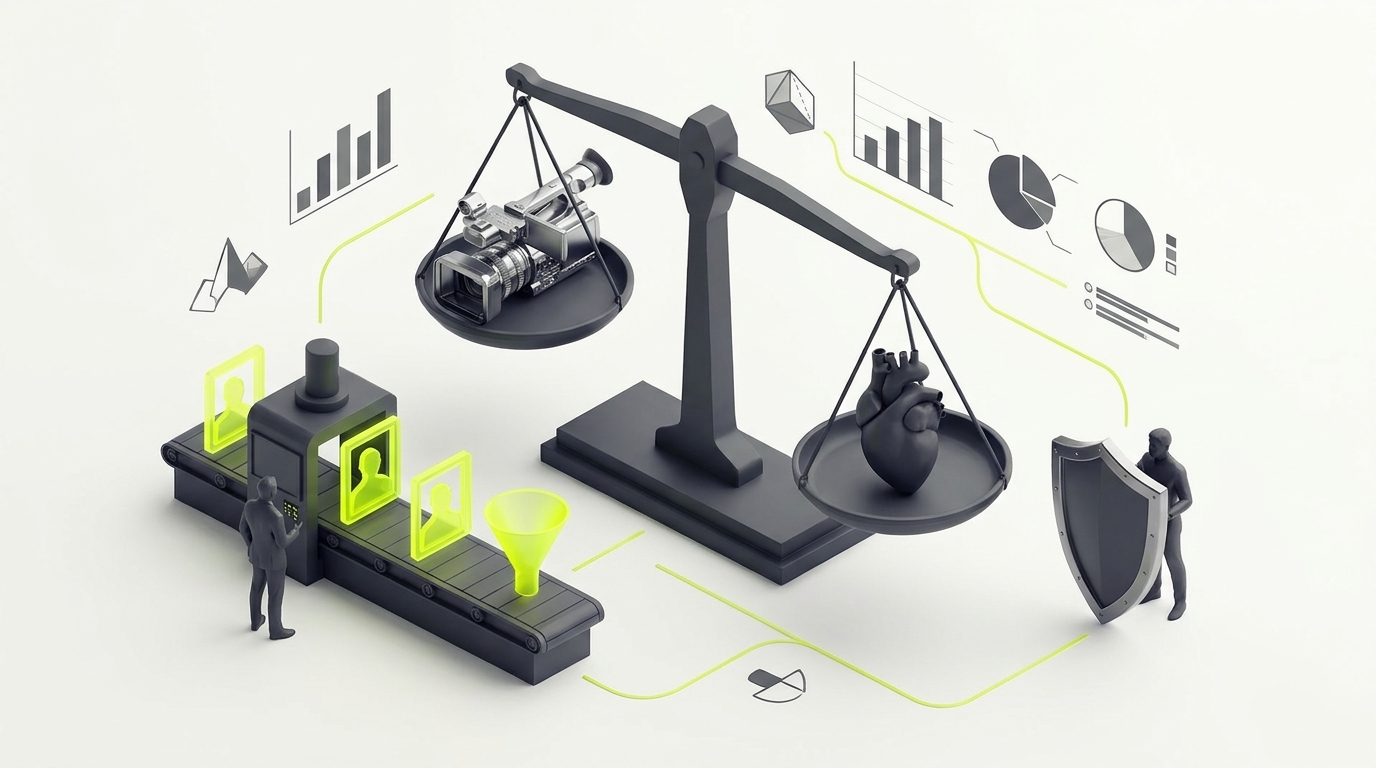
According to the figures FutureBrand collects, 44% of a large brand's paid advertising creative is now made by creators outside the company (CreatorIQ, May 2026). 96% of the world's largest advertisers use generative AI in their marketing, eight in ten use it to make content (WFA), and six in ten companies say they already deal with off-brand content: work made by someone who never read the book.
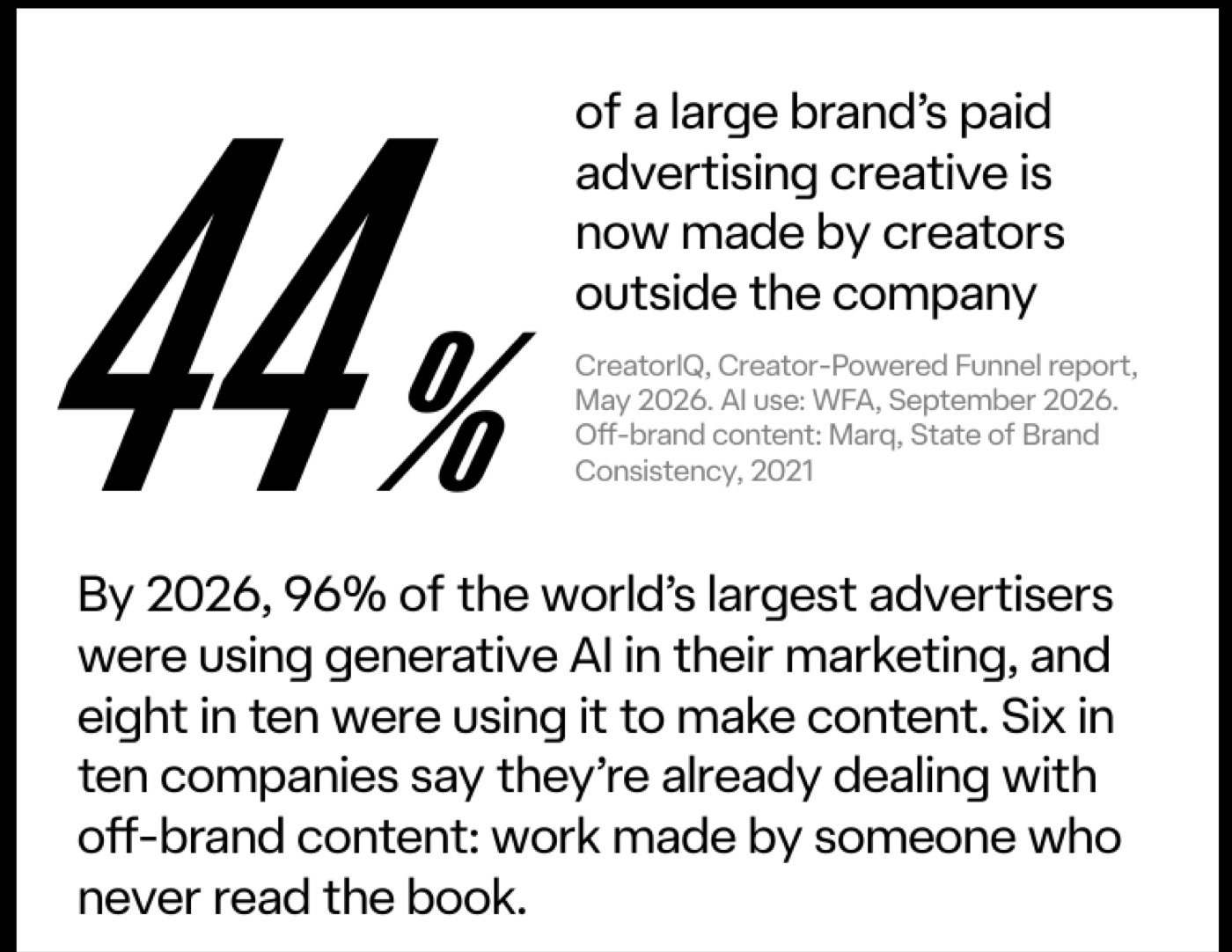
Source: FutureBrand, From Artefact to Infinite (2026), p. 5.
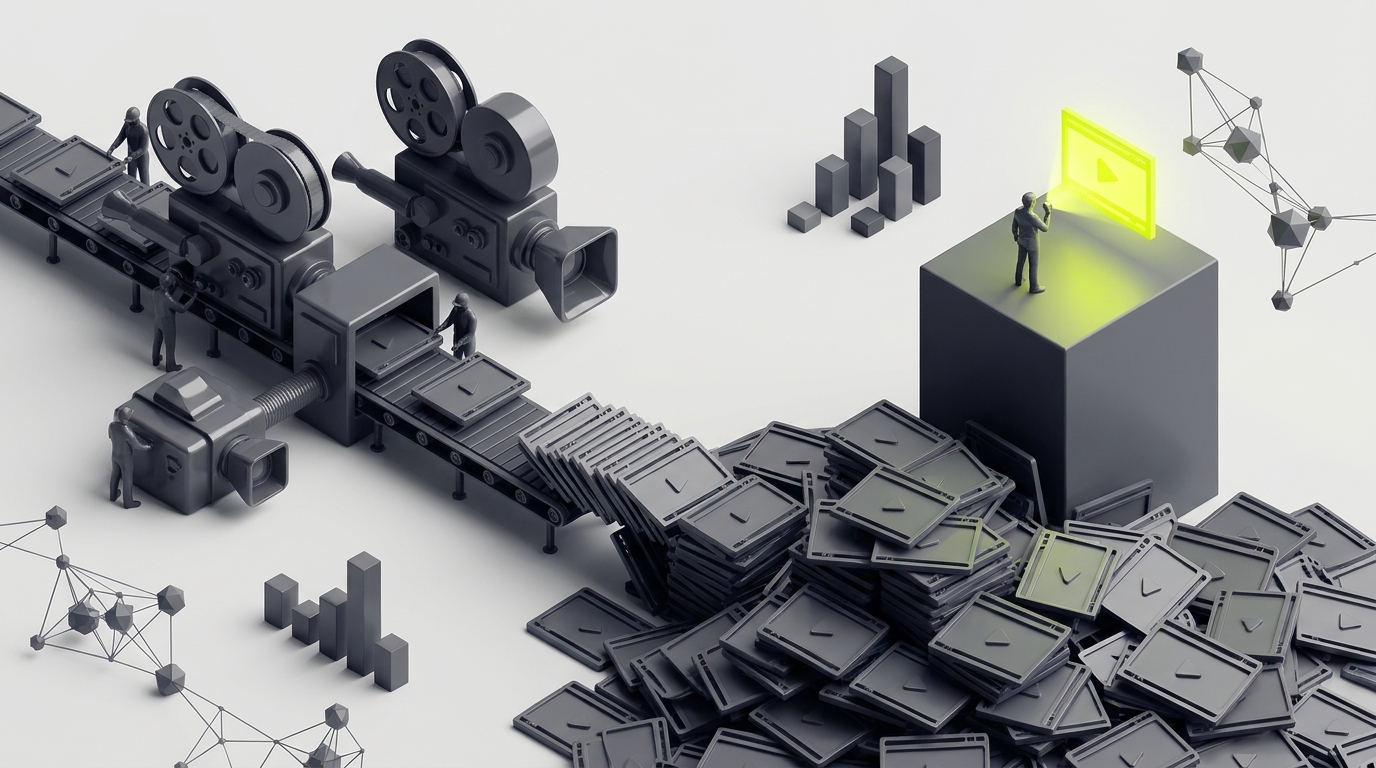
Add the content volume. 62% of marketers say demand for content grew five-fold or more in two years, and 71% expect it to happen again by 2027 (Adobe). Nobody approves that much work page by page. The person who used to say "that's off-brand" has, in FutureBrand's words, either left the building, multiplied into nine hundred people, or turned into a model.
And who reads it
This is the half most brand teams haven't priced in yet. The first reader of your brand is increasingly not a human.
AI assistants sent 393% more traffic to US retail sites in a year. Amazon's shopping assistant Rufus had 250 million users in 2025, and those who used it were 60% more likely to buy. And 57% of people who use AI chatbots have decided not to buy something because of what the chatbot told them (Semrush, July 2026). The same share bought something on its recommendation.
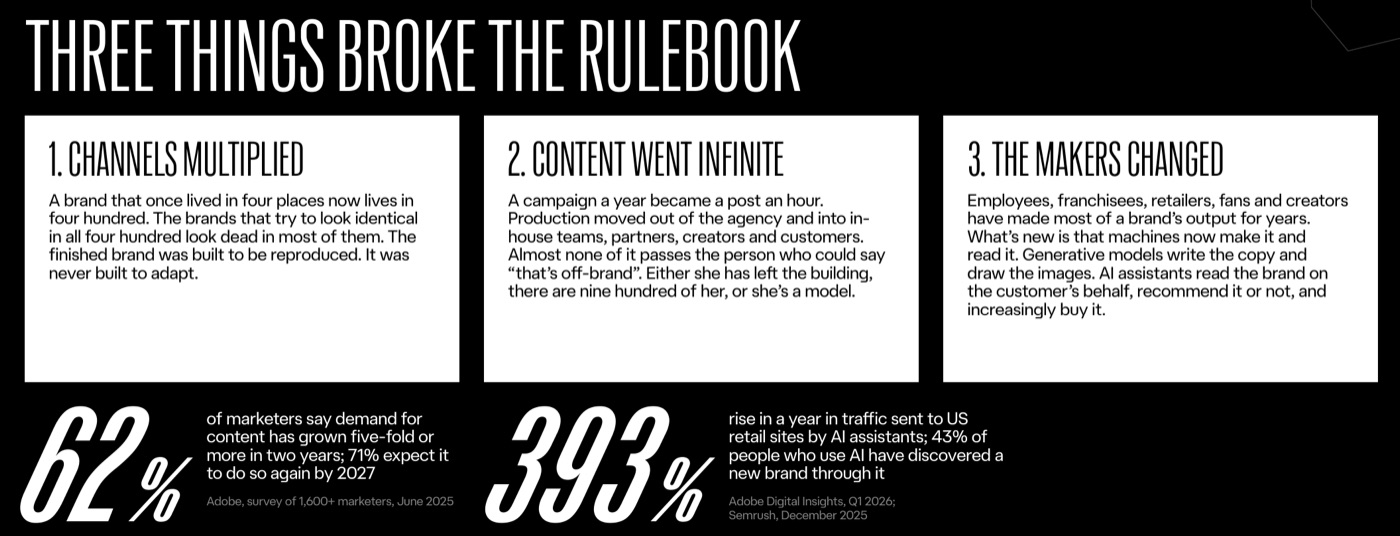
Source: FutureBrand, From Artefact to Infinite (2026), p. 7.
So every brand on Amazon is now described to customers by a machine, in the machine's words. What does the machine use? Not your brand manual. It uses what your brand has done, repeatedly, in public, and what it has written down somewhere it can read.
The ketchup test
My favourite case in the report is Heinz. In 2022 its agency asked an AI image generator to draw "ketchup", no brand mentioned. Ketchup in space, ketchup as a stained-glass window, ketchup as a Renaissance painting. Almost every image was a Heinz bottle.
Nobody had briefed the machine on Heinz. A hundred and fifty years of the same bottle had. Heinz ran the drawings as ads ("Even AI knows ketchup has to be Heinz") and got 850 million earned impressions. FutureBrand's line on it is the best sentence in the report: being legible to a machine is what you get for being unmistakable to people for a very long time.
Which is great news if you are Heinz. If you are a five-year-old brand that changed its tone of voice three times, the machine will describe you confidently and wrongly, to millions of people at once.
Dove wrote a brand book for robots
The case I'd show every CMO is Dove. Twenty years of Real Beauty taught image generators something, but Dove didn't leave it there. It pledged never to use AI to represent women in its ads, and it published Real Beauty Prompt Guidelines: a plain-language playbook for prompting an image generator to show the kind of woman Dove would show.
That is the shift in one document. Dove wrote its behaviour down in a form a machine can use. Not the logo clear-space rule. The conduct.
Character, not a document
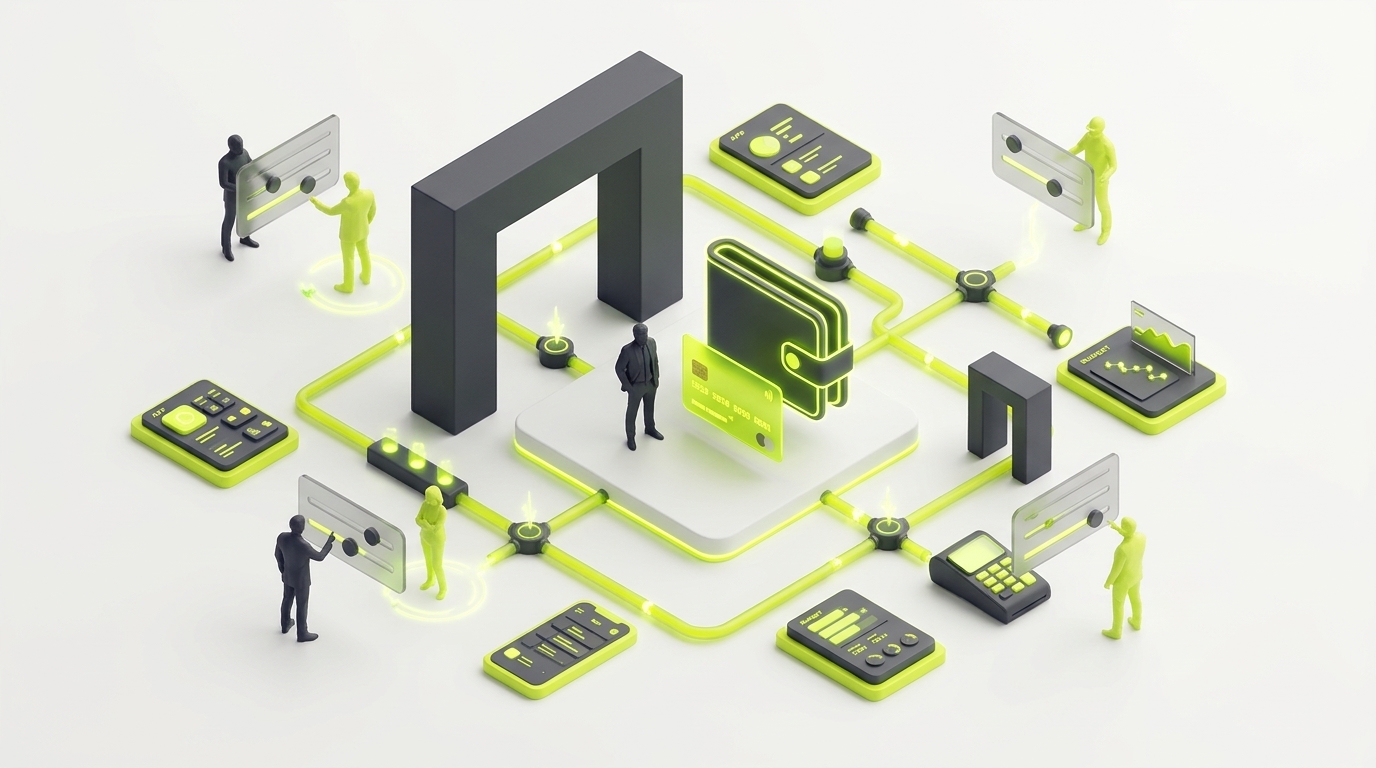
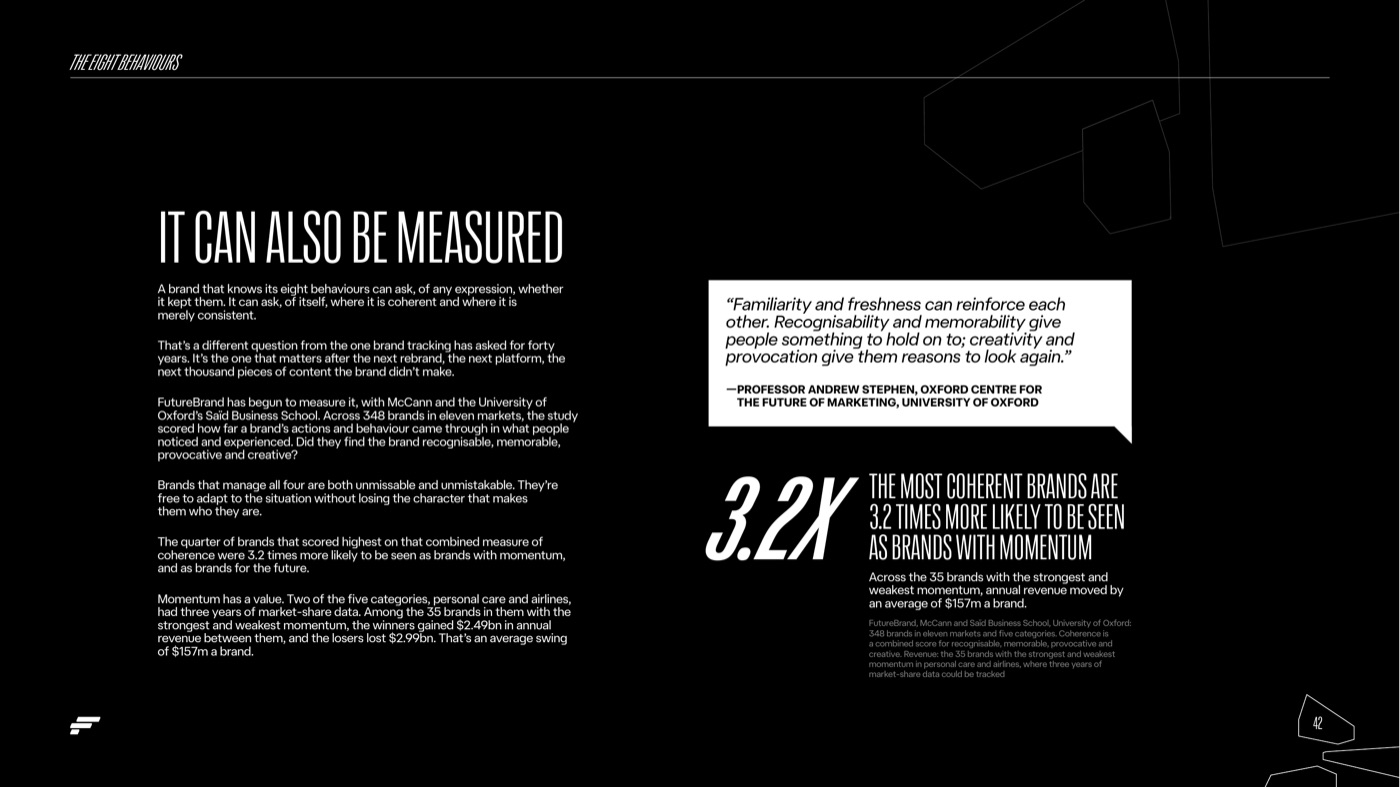
FutureBrand's answer to all of this is "coherence at scale": brands held together by consistent behaviour instead of identical artefacts. It boils the brand down to eight behaviours: how it looks, moves, sounds and talks, how it feels to be with, how it occupies a space, how it decides what to do next, and how it interacts with the people, and now the machines, that choose it.
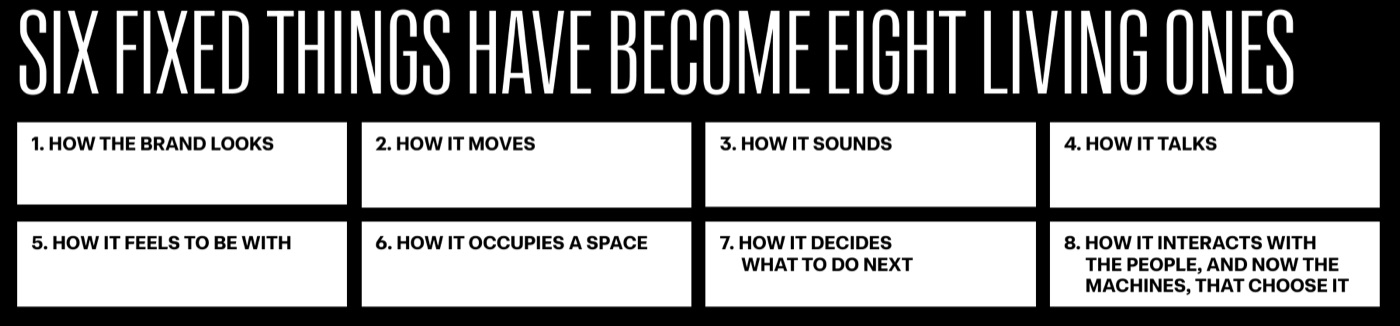
Source: FutureBrand, From Artefact to Infinite (2026), p. 41.
The sentence that stuck with me is about voice: a character clear enough for a new starter on the social team to speak is clear enough for a language model to speak too. Where the character isn't clear, the model makes one up, and you meet it for the first time in a customer's screenshot.
This is the exact problem I kept running into when we started using AI at the agency. The model wasn't stupid. It just had nothing to go on except the average of the internet, so it wrote like the average of the internet. That's why we built Brief Zero in Brand Studio: one context pack about the brand (story, audience, voice, proof, territory) that every AI tool reads before it writes. I wrote about the logic in AI slop is a context problem, and about how Vercel's marketing team arrived at the same idea in this piece.
FutureBrand's report is the agency-side version of the same conclusion, at the scale of Coca-Cola and Amazon. The brand guideline of the next decade is not a PDF of logo misuses. It's a description of behaviour, written for three readers at once: the new starter, the franchisee in another country, and the model.
What to do on Monday
Open your brand manual and count the pages about how the brand looks. Then count the pages about how it talks, decides and behaves. If the first number is ten times the second, you've written a book for the one reader who doesn't need it.
Then try FutureBrand's test on your own brand: strip out the logo, the name, the colours and the packaging, and ask whether anyone, human or machine, could still tell it's you.