Tracksuit's Black Friday 2026 report in two editions: UK challengers lose at preference despite trust, Walmart matches Amazon on fame and price and still trails 19% to 44%. The shared gap is delivery.
Every November a retail client asks some version of the same question: what should we do for Black Friday? It is a fair question, asked about eleven months late.
Tracksuit just put numbers on that feeling. In October 2026, before a single discount went live, its Marketing Science team surveyed 10,442 adults in seven markets about 15 major retailers each. The report comes in country editions, and reading the UK edition next to the US edition is more useful than reading either alone. Same race, same favourite, two very different ways of losing to it.
The race is run before the starting gun
Both editions open with the same finding. Across 101 retailer-and-market pairs, the retailers shoppers prefer are the ones they already know and consider (mental availability) and the ones they associate with being easy to use, having a wide range of deals, having the best deals and shipping reliably (Tracksuit's own measure of physical availability). It is a correlation, not proof of cause, and Tracksuit says so. It is also Byron Sharp's mental availability and physical availability showing up in a sale that most marketers still plan as a pricing event.
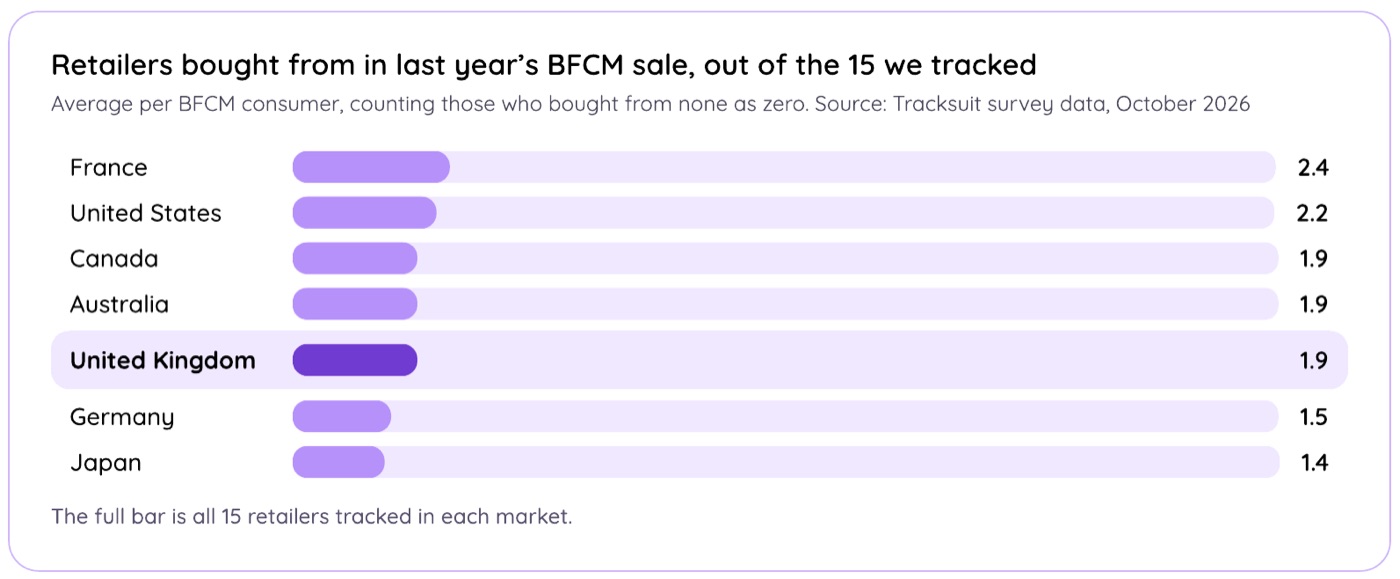
The scale is similar on both sides of the Atlantic. 68% of UK adults bought in last year's sale or are open to it, about 38 million people. In the US it is 64%, about 178 million. And in both countries the basket is tiny: the average shopper buys from about two of the 15 retailers (1.9 in the UK, 2.2 in the US). Black Friday is not a crowded marketplace. It is a shortlist, and the shortlist was written before October.
Source: Tracksuit Originals, Race to the Bottom Brand, Black Friday 2026
The UK: Amazon and then a long silence
In the UK, 50% of Black Friday shoppers prefer Amazon. Argos is second on 8%. That is not a race, that is a queue.
The interesting part is where the local retailers lose people. They do not lose them at awareness. Argos turns 71% of the people who know it into people who would consider it, which is close to Amazon's 80%. Then only 15% of those considerers prefer Argos, against 70% for Amazon. Currys does the same trick with worse numbers: 49% consider it, 5% prefer it. The British challengers get invited to the party and then nobody dances with them.
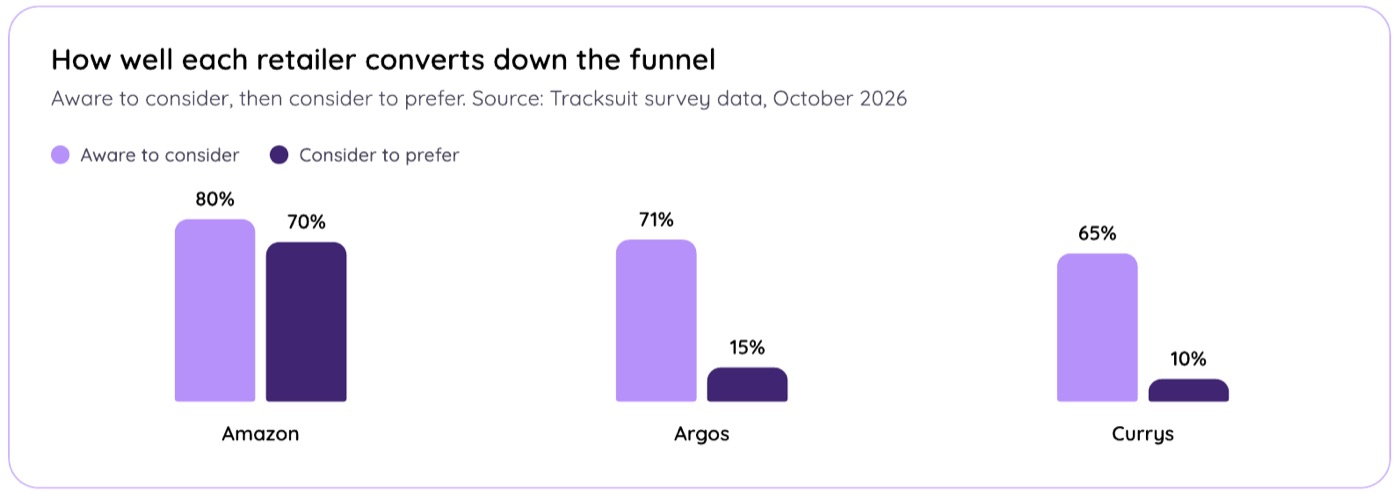
UK funnel conversion. Source: Tracksuit Originals, UK edition
And it is not because they are distrusted or expensive. M&S (60%) and John Lewis (54%) score higher than Amazon (53%) on "is a brand I trust". Argos and Tesco beat Amazon on "is affordable". The gap is one boring line: reliable shipping. 52% associate it with Amazon, and no British retailer gets above John Lewis's 31%.
The US: a real rival, and still 44% against 19%
The US edition is the more uncomfortable read, because it has the case every challenger dreams of. Walmart is as famous as Amazon. More American shoppers name Walmart unprompted as a Black Friday retailer (59%) than Amazon (55%). Prompted, it is 82% against 87%. Walmart also owns price: 63% associate it with "is affordable", more than any retailer in the survey, against 48% for Amazon. It is level on "has a wide range of deals" (48% against 49%).
Famous, cheap, full of deals. Preferred by 19%. Amazon is preferred by 44%.
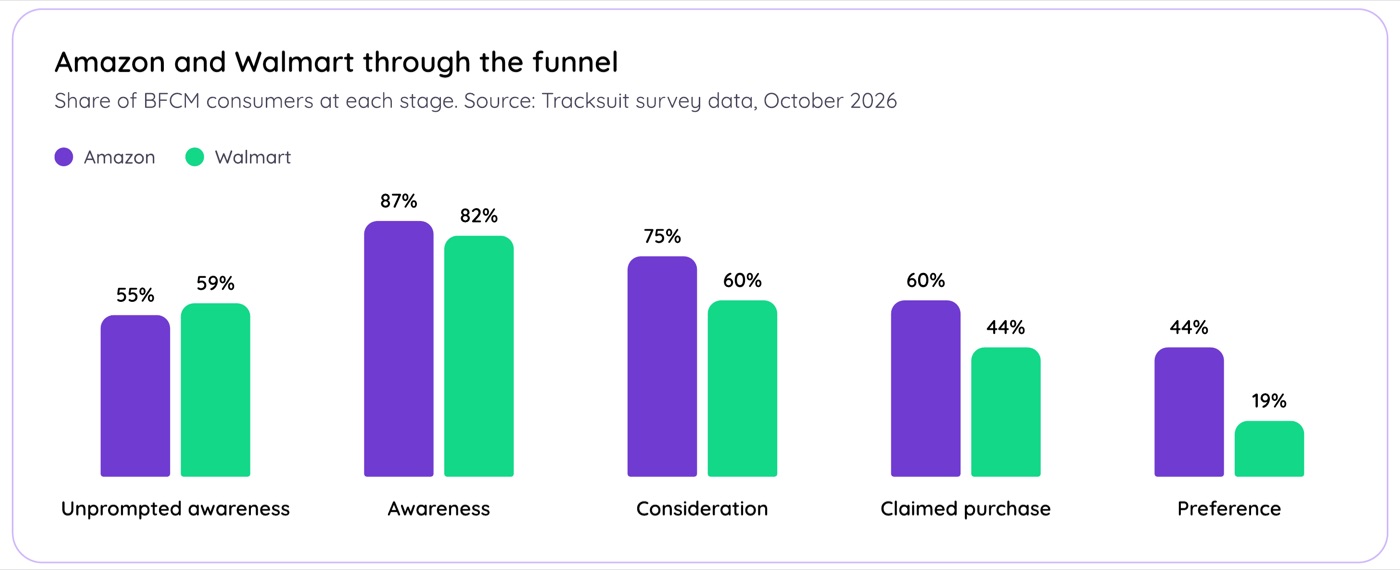
Amazon and Walmart through the funnel. Source: Tracksuit Originals, US edition
The gap opens at consideration (75% against 60%) and is widest at preference. Walmart converts 73% of the people aware of it into considerers, then only 32% of those into preferrers. Target goes 64% then 16%, Best Buy 58% then 9%. Same leak as in Britain, one step later.
And the widest single gap is the same line as in the UK. 63% of Americans aware of Amazon associate it with reliable shipping, against 31% for Walmart and an average of 19% for the other 14 retailers. Ease of use follows (62% against 42%).
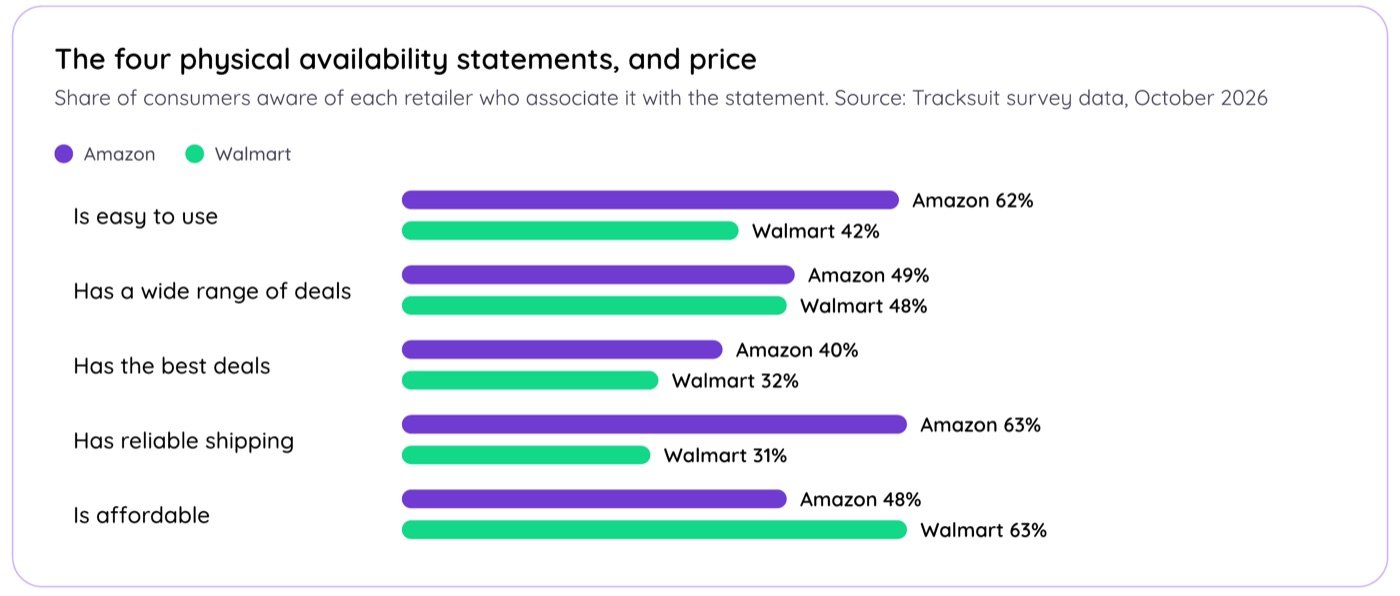
Source: Tracksuit Originals, US edition
Trust is a feeling. Preference is a habit.
Both editions carry a finding that should end a few brand workshops. In the US, Home Depot (48%) and Costco (46%) are trusted as much as Amazon (46%). Their Black Friday preference is 2% and 5%. In the UK, M&S out-trusts Amazon by seven points, and no local retailer is preferred by more than 8%.
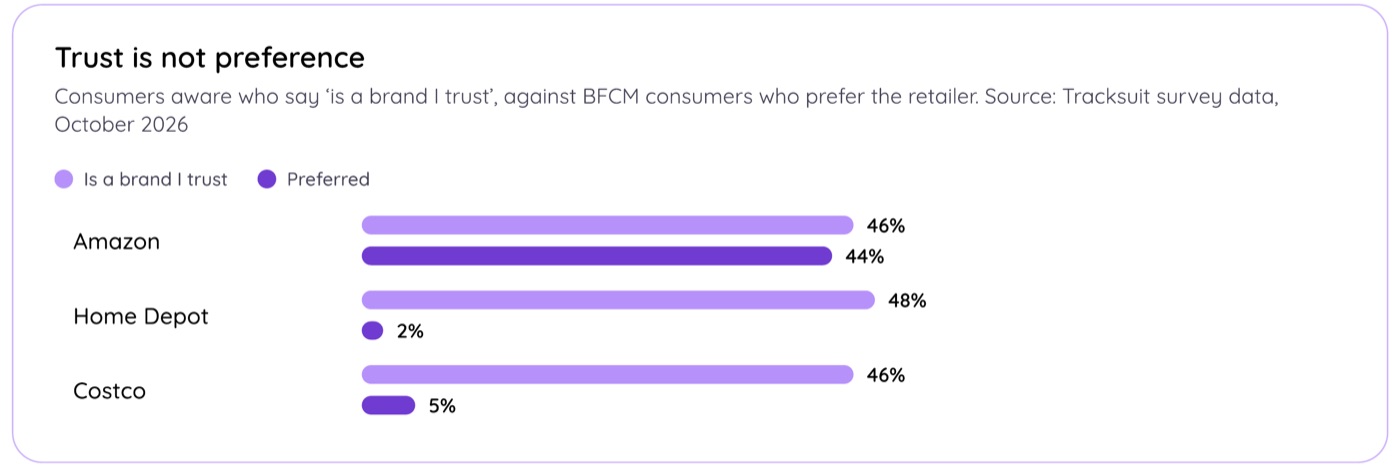
Source: Tracksuit Originals, US edition
I spend a lot of strategy time on trust, so I take this personally. Trust is real and worth having, but it is the reason people keep you on the list. It is not the reason they pick you on the day. The thing that decides the day is closer to "I know exactly what happens after I click buy", and that is a promise about delivery, stock and returns, which most brand platforms leave to the operations team.
The other end of the scale makes the same point from the opposite side. Temu is known by 43% of US shoppers and considered by 13%. In the UK, Temu and Shein are known by 54% and 51% and considered by 20% and 18%. They have the price story and almost none of the rest. Fame without the rest of the pattern buys you a name, not a basket.
Two countries, two playbooks, one shared line
Tracksuit closes each edition with advice for retailers racing Amazon, and the differences are worth reading side by side.
In the UK, the headline is "be the second tab". With 1.9 retailers per shopper there is always a second basket, and "the one I check after Amazon" is a position a retailer can claim quickly. British challengers are told to lead with established trust: "the deal you can trust".
In the US, the headline is "lead with reason". Walmart shows that a challenger can own price and fame. The advice is to pick one reason you can prove and build the plan around it, then turn trust into a reason to buy rather than browse.
Both editions put the same advice first. The UK calls it "sell certainty as well as price", the US calls it "make delivery as loud as the discount". Put delivery dates, stock and returns next to the price. The Black Friday creative I see usually does the opposite. The discount gets the 72-point type and the delivery promise lives in the footnote, which is precisely the one thing shoppers think only Amazon does well.
Both also end on habit. 39% of Americans and 35% of Britons aware of Amazon associate it with "is where I shop every BFCM". Walmart, the best American challenger, is at 26%. That association gets built in the weeks after the sale, through email, loyalty and a reason to come back next year, not in the week before it.
What to do with this before 27 November
It is late for this year, so be honest about what can still move. Fame and trust cannot. The second tab and the delivery promise can. Check whether your Black Friday ads say anything about when the parcel arrives, and whether your site makes returns as easy to find as the discount.
Then put a date in January to start next year's Black Friday. If most buyers decide before they start shopping, the sale is not the race. It is where the results are announced.
Caveat from the source: this is the first, pre-sale wave of a tracker, and purchase data is claimed rather than observed. Tracksuit will publish a follow-up in January 2027 on how the sale played out.