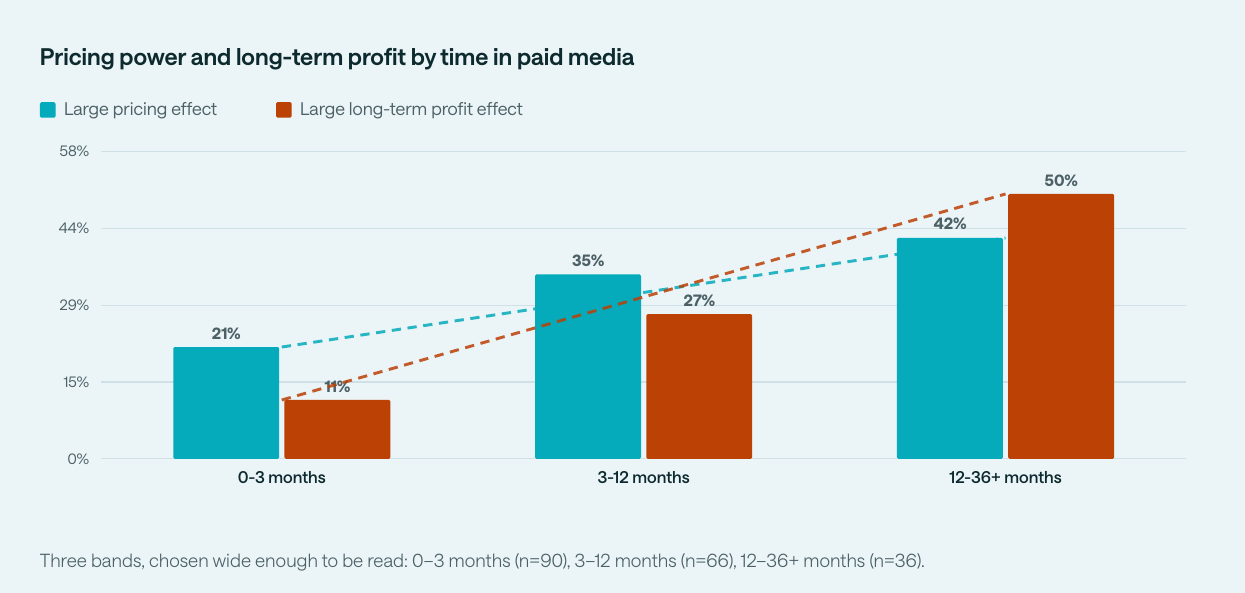
A study of 217 campaigns found one variable that best predicts whether advertising turns growth into profit: humour. 75% of funny growers got richer, against 42% of the rest.
There is a joke on page four of a marketing effectiveness report. A real one, set in large type with a page to itself: "We didn't set out to be a non-profit organisation. It just turned out that way."
It earns the page. James Hurman's new report, The Funny Thing About Profit, looked at 217 New Zealand campaigns and found that the best single predictor of whether advertising makes a company richer is whether the ad was funny.
Budget came ninth. The first media variable turns up in sixth place.
Bigger is not the same as richer
The report starts with a count. Of the 217 for-profit campaigns in the Aotearoa Effectiveness Database, 76 produced a large gain in long-term sales. That is the group every marketer wants to be in.
Only 45 of those 76 also produced a large gain in long-term profit. The other 31 sold more and earned nothing extra for it.
Going the other way is close to impossible. Of the 141 campaigns that did not grow volume, seven grew profit. Growth is the entry ticket. The interesting question is why 31 ticket holders left with empty pockets and what the other 45 did differently.
The chart with the joke at the top
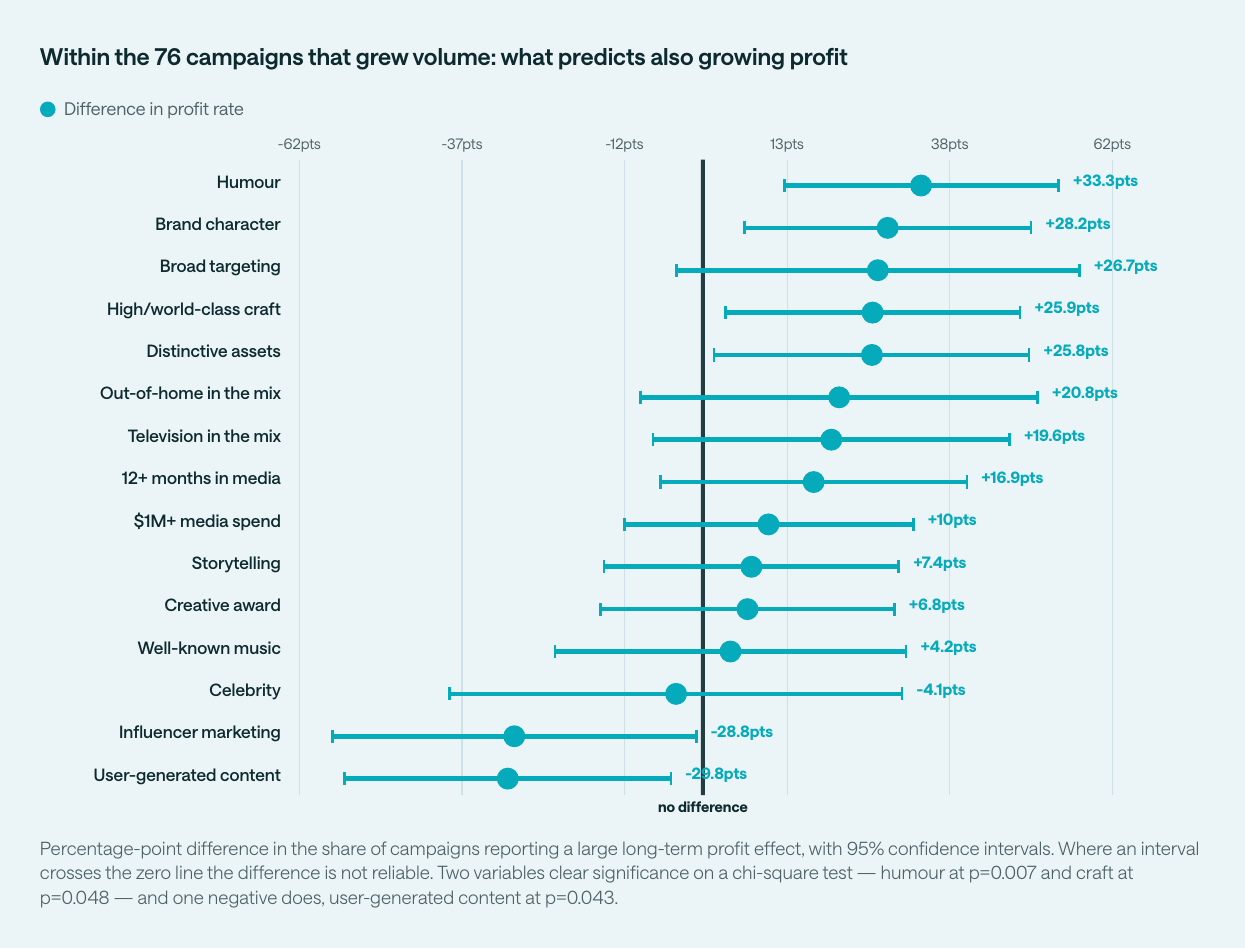
Hurman took the 76 growers and tested fifteen creative and media variables against one outcome: did profit grow too?
Source: James Hurman, The Funny Thing About Profit, Aotearoa Effectiveness Database / Commercial Communications Council NZ, 2026
Among campaigns that grew, 75% of the funny ones also grew profit. For the rest it was 42%. A 33-point gap, the largest on the chart and the most clearly significant.
Two more things sit close behind. Work made to a high or world-class standard of craft converted growth into profit 69% of the time against 43%. Campaigns built around a recurring brand character did it 80% of the time against 52%.
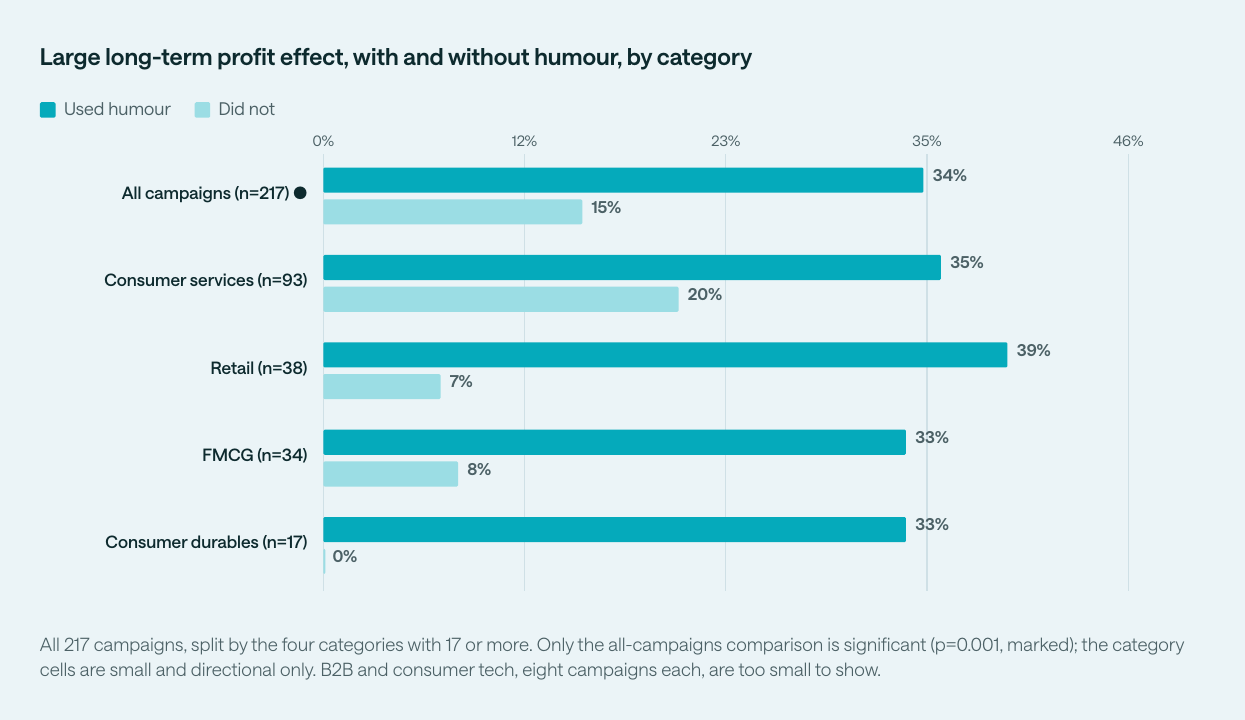
Humour is the only one of the three that survives every control. Hold television, spend and duration constant and it still more than quadruples the odds. It also shows up outside the growers: across all 217 campaigns, funny work reported a large long-term profit effect 34% of the time against 15%.
At the bottom of the chart, pointing the wrong way, are user-generated content and influencer marketing. Each costs a growing campaign about 30 points of profit conversion. That deserves its own post.
"That's fine for snacks, but we are a bank"
This is the objection every creative team has heard, usually in a meeting room with a view of a car park. Humour belongs in FMCG. Our category is serious.
Source: James Hurman, The Funny Thing About Profit, Aotearoa Effectiveness Database / Commercial Communications Council NZ, 2026
The data does not support it. Humour appears in 37% of consumer services campaigns, which is banking, insurance, telco and utilities. Inside those categories, funny campaigns reported a large long-term profit effect 35% of the time against 20% for the rest.
The category cells are small and the report says so. Only the all-campaigns comparison is statistically solid. But when Hurman tested whether the humour effect differs between serious and light categories, he found nothing. His line on it is the best in the report: "What's category-specific isn't whether humour works. It's the belief that it doesn't."
Why a laugh ends up in the margin
The lazy explanation is that people like funny ads, so they buy more. That is not what the data shows. Funny and unfunny campaigns both grew. Only one kind got paid for it.
The better explanation comes from forty years of psychology on what researchers call affect, the quick good-or-bad feeling that attaches to a thing before you reason about it. When people feel good about an option, they overestimate its benefits and underestimate its costs.
A price is a cost. A brand that makes you feel good is a brand whose price looks smaller than it is. That is pricing power, explained without an economist.
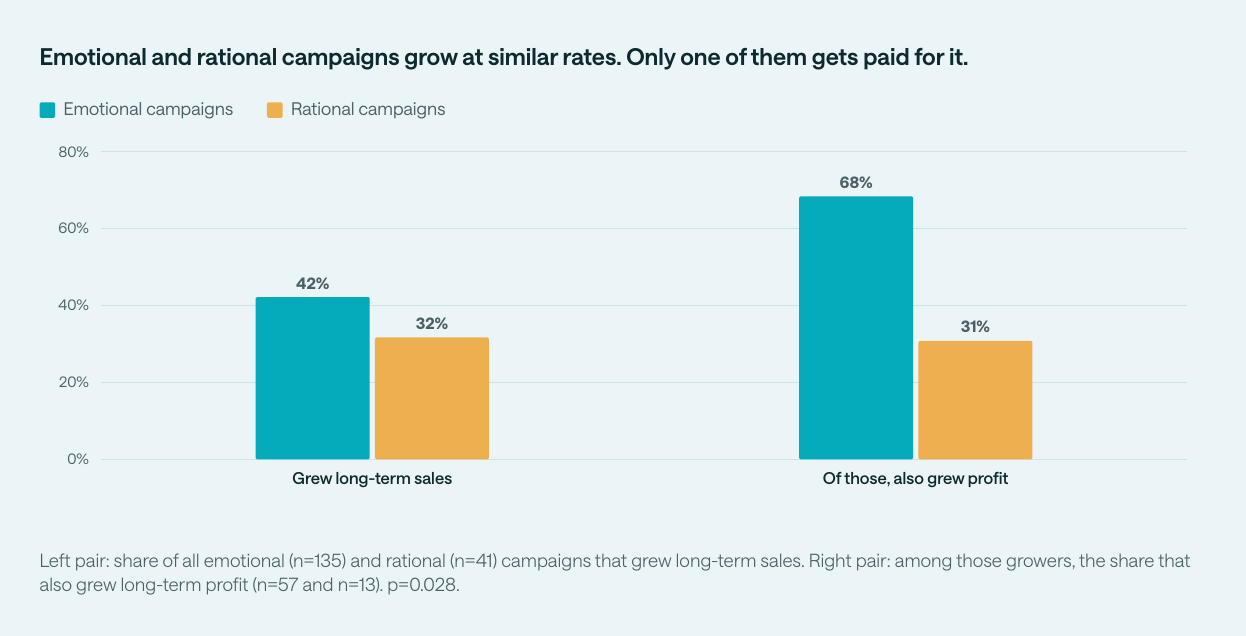
The same pattern holds one level up. Emotional and rational campaigns grow sales at similar rates, 42% and 32%. Among the ones that grew, 68% of emotional campaigns also grew profit. For rational campaigns it was 31%.
Source: James Hurman, The Funny Thing About Profit, Aotearoa Effectiveness Database / Commercial Communications Council NZ, 2026
Hurman's summary: "Rational advertising wins the argument. Emotional advertising earns the right not to have it in the first place."
And humour is the cheap way in. As the report puts it, it is hard to make someone feel moved in fifteen seconds. It is not hard to make them laugh. If you have read our piece on what entertaining advertising earns, this is the profit line of the same story.
Before you brief a comedian
Three honest limits. The database is a survey of Effie entrants who rate their own campaign's effects on a six-point scale. It shows association and cannot prove cause. And Hurman himself says to read humour "as a proxy, not a prescription". Funny is the most visible marker of work that is emotional, broadly targeted and memorable. Those are the properties doing the work.
Entrants grading their own homework is not a laboratory. But funny and serious entrants are equally generous to themselves, which makes the gap between them harder to wave away. It also matches what System1 and the IPA have found on characters and consistency in much larger datasets. We have already turned one Hurman effectiveness chart into a drum machine, so we are biased towards taking him seriously.
The practical use is small and specific. The next time a joke gets cut from a script in the third round of approvals because the category is serious, ask what the cut costs. On this evidence the answer is somewhere near 33 points of your chance of turning growth into profit.
Put that number in the approval deck. Nobody has ever cut a line item that large for being silly.