A KPI tells you where the needle is. An OKR says which needle you'll move this quarter, by how much. The difference, with Google Chrome and Monzo examples from our frameworks library.

I've sat on enough Effie juries to recognise a certain kind of case within the first page. The objective says "increase brand awareness", the KPI says "brand awareness", and the result says awareness went up. It's like a weather forecast that says it will be weather. Nobody lied, but nobody decided anything either.
That mess usually starts with two acronyms people use as if they were the same: OKR and KPI. They aren't. A KPI is a gauge. An OKR is a bet. You need both, and most teams have plenty of the first and none of the second.
The short answer
A KPI (key performance indicator) is a number you watch all the time to see if the business is healthy. Revenue, churn, share of search, spontaneous awareness. It has no deadline, because the business never stops needing it.
An OKR (objectives and key results) is a decision to change something by a date. One qualitative Objective, about three numeric Key Results with a starting point and a target, scored at the end of the quarter.
A KPI tells you where the needle is. An OKR says which needle you're going to move this quarter, by how much, and admits in advance that you might fail.
Where OKRs come from
OKRs are older than most people using them. Andy Grove built them at Intel in the 1970s as a sharper version of Peter Drucker's management by objectives. John Doerr learned them in Grove's internal course, took them to a very young Google in 1999, and wrote the whole thing up in Measure What Matters. The origin story is worth ten minutes if you've only ever met OKRs as a spreadsheet template.
The best known example from that book is Chrome. The Objective was something like "build the best browser", and the proof was a hard number of weekly active users. Here's how the OKRs worked example in our library writes it out.
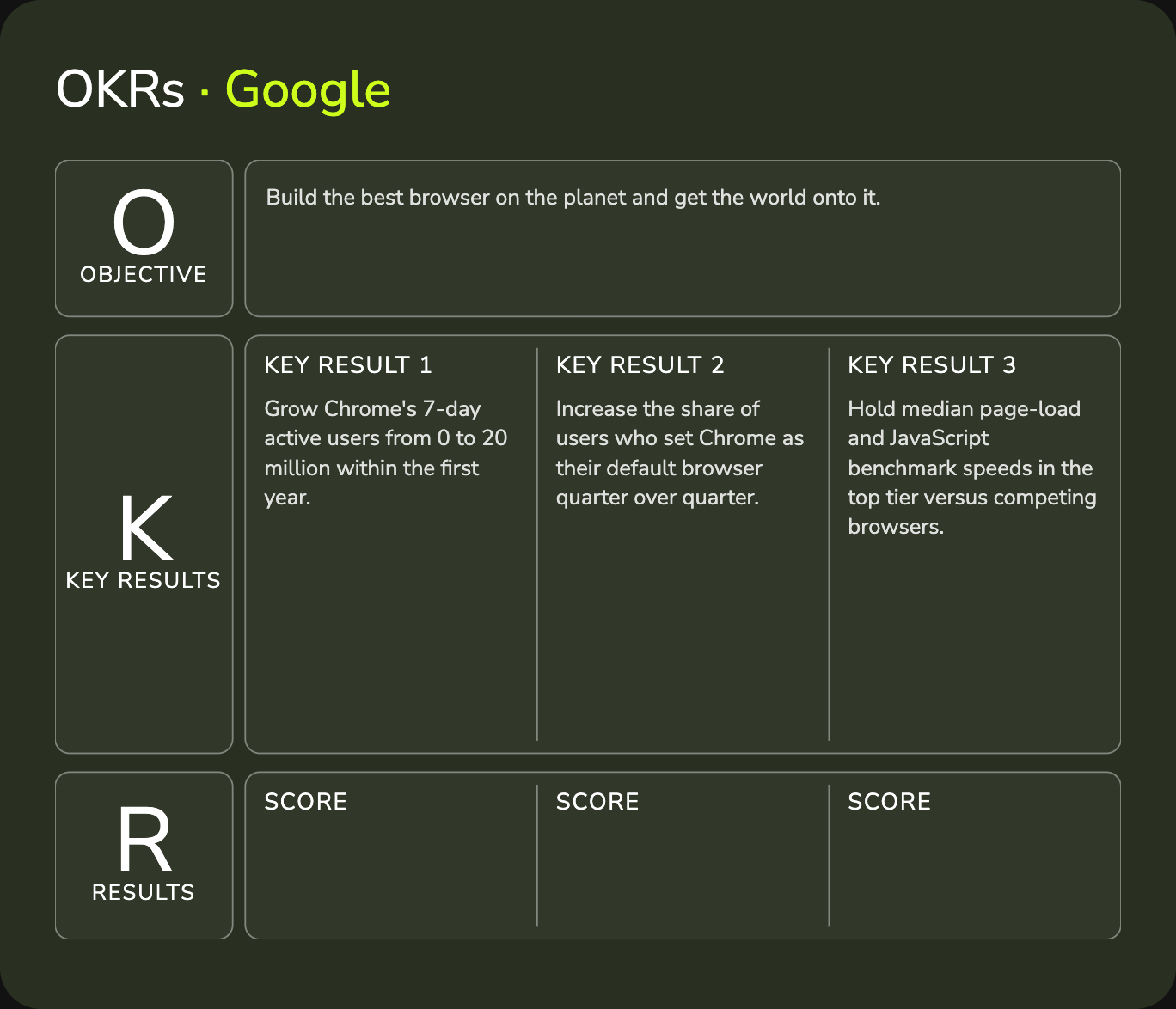
OKRs: Google Chrome - see the full breakdown
Look at Key Result 3. Page-load speed is a KPI. Browser teams watch it every day. In this OKR it does a different job. It's the guardrail that stops the team from chasing users with features that make Chrome slow. Google then turned that same number into advertising. The Speed Test film is a KPI dressed up as a story, with a browser racing a potato cannon.
Watch: Google Chrome: Speed Test - see it in our campaigns library
How the two work together
The cleanest way to see the difference is to take one company and look at both. A bank like Monzo will have a dashboard full of KPIs: active users, deposits, transactions, complaint rate, support response time. All of them matter all the time. None of them is a plan.
An OKR picks one of those numbers and says "this quarter, we move it". In the Monzo example from our library, the Objective is to become the account people pay their salary into, rather than the spare-change app. The first two Key Results are KPIs the team has decided to push: salary deposits from 28% to 45%, and weekly transactions from 41% to 55%. The third is a KPI they promise not to break while they push.
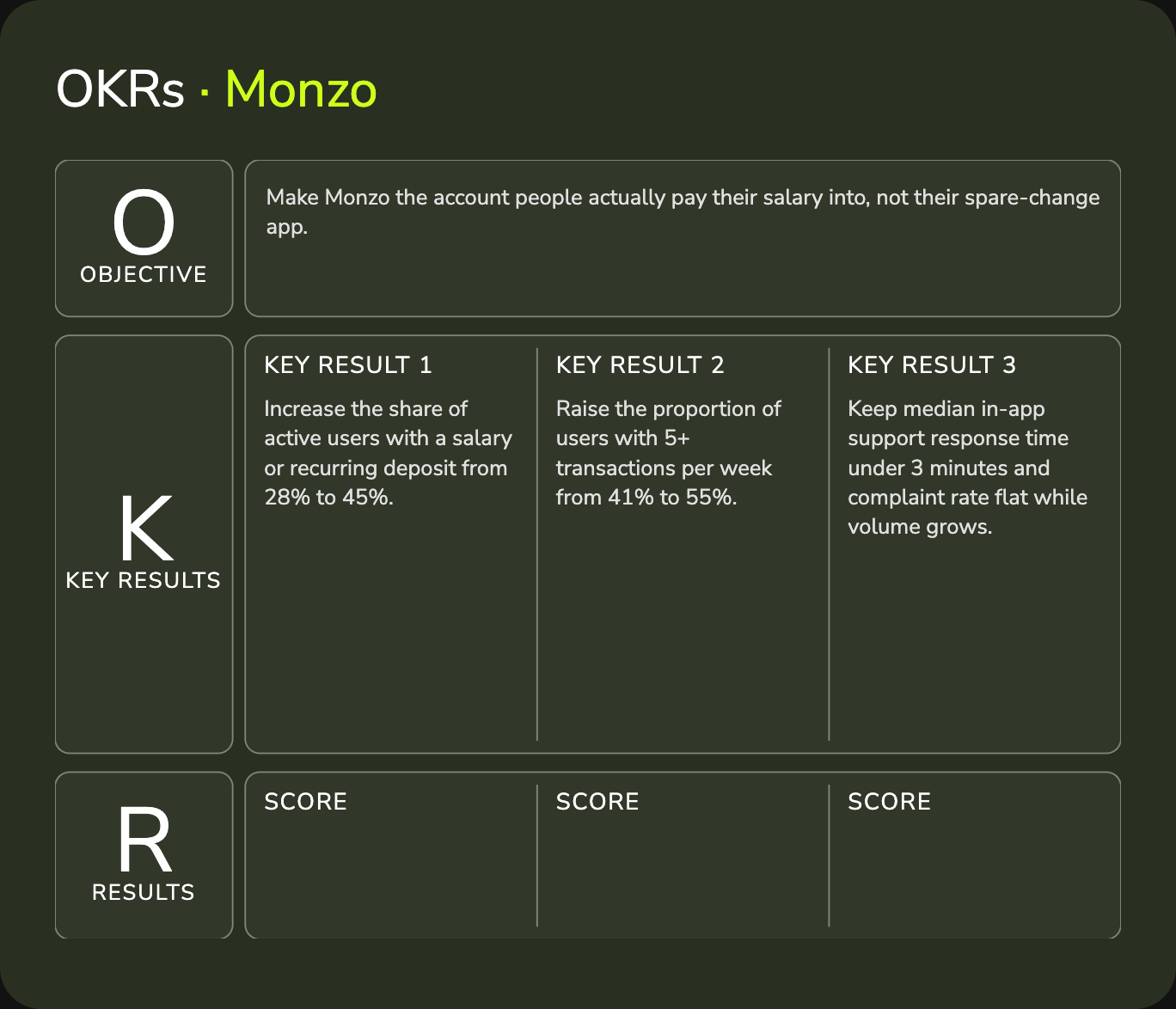
OKRs: Monzo - see the full breakdown
(These are illustrative OKRs we wrote to teach the framework, not Monzo's internal goals. Monzo hasn't sent us its spreadsheet, which is probably wise.)
So the relationship is simple. KPIs are the list of things you could move. A Key Result is the one you chose to move. When the quarter ends, the KPI stays on the dashboard and the OKR gets a score.
Where teams get it wrong
The most common mistake is the renamed KPI. "Maintain 99.9% uptime" or "keep NPS above 40" are useful, but they describe business as usual. If the team would have hit the number anyway, it isn't an OKR. It's a KPI that someone moved to a nicer slide.
The second is the output Key Result. "Launch the loyalty programme" or "publish 12 videos" are tasks. You can finish every task and still miss the Objective. A real Key Result measures what changed because of the work, the way the Monzo example measures salary deposits instead of "ship the salary feature".
The third is money. Tie OKRs to bonuses and people stop setting ambitious targets, which is the whole point of the format. Doerr's team calls this sandbagging. A stretch OKR that lands around 70% is a good quarter. A team that scores 100% every time is aiming low.
Marketing has its own version of all three. The briefs that land on our desks at TRIAD, where I'm a co-owner, love a line called "KPIs" with reach, awareness and engagement listed under it. Those are fine gauges. But nobody has said which one has to move, from what to what, and what we're willing to give up to get there. I'd rather have one honest Key Result in a brief than a list of six KPIs.
Which one do you need?
You want to know if the business is healthy. Use KPIs and look at them every week.
You want a team to change something specific in the next three months. Write an OKR, and borrow its Key Results from your KPIs.
You don't yet know what you're trying to change. Neither tool will help. That's a strategy question, and frameworks like Purpose, Vision & Mission come before the numbers.
The full OKRs page, with the components, the pitfalls and all three worked examples, is in the marketing frameworks library. Open your dashboard on Monday, circle the one KPI you'd be embarrassed to see flat in March, and write its from-to number in a sentence. That's your first Key Result.