Brand Strategy Template
This template is two frameworks strategists actually use, in the order they work: the Brand Onion to decide what the brand is, then a Positioning Statement to decide where it fights. Fill it in right here, it saves in your browser.
What the brand is, in five layers
Fill it from the outside in. Attributes are facts anyone can check, so start there, turn them into benefits, and only then argue about values and essence. Write the essence first and the other four layers end up decorating a wish.
Attributes
What are the tangible, demonstrable, hard-to-fake facts about what this product or service is?
Benefits
What does this product actually deliver to a human - both rationally and emotionally?
Personality
If the brand walked into the room as a person, how would they behave - and what would they refuse to do?
Values
What would this brand sacrifice to stay true to itself, even when the trade-off is expensive or inconvenient?
Essence
If we deleted everything else and could keep one phrase, what would describe what this brand fundamentally is?
Where it fights, in one sentence
The onion describes the brand on its own. Positioning puts it next to the alternatives people actually consider. Write each part so the five read as one sentence - and if that sentence would fit your biggest competitor just as well, it is not a position yet.
Target
Who is this specifically for - the one person who lights up when they hear it, not the widest crowd we can defend in a meeting?
Need
What is the actual job, frustration, or unmet need this person is trying to solve - in their words, not our feature list?
Frame of reference
What category or competitive set do we want to be compared against - and is that the fight we can actually win?
Point of difference
What is the one thing we do that rivals inside this exact frame genuinely don't - and would struggle to copy?
Reason to believe
What's the proof that makes the difference credible - the thing that turns a claim into something a skeptic would actually buy?
Liquid Death, filled in
A lesson in extreme inside-out coherence: a 'boring' category (water) made unmistakable because every outer layer faithfully expresses a sharp inner essence. The brand grew from a Facebook video to a multi-billion valuation by following the Onion logic relentlessly.
Attributes
Tallboy aluminium cans. Heavy-metal album-cover graphics. Names like 'Mountain Water' and 'Berry It Alive'. Horror-trailer ad campaigns.
Benefits
Functional: hydrate without contributing single-use plastic. Emotional: belong to a tribe that thinks the bottled-water industry is ridiculous.
Personality
Runs a horror trailer where the ad should be. Names a flavour after a murder pun. Records its hate comments as a metal album.
Values
Disrespect convention. Sustainability, not preaching. Fans, not buyers.
Essence
Death to plastic.
See it in action: the campaign. More onions: Coca-Cola and Aviation Gin, four SaaS brands side by side.
Prefer paper? Print the worksheets
Both frameworks as A4 worksheets, for the workshop where someone insists on sticky notes. Free with an account.
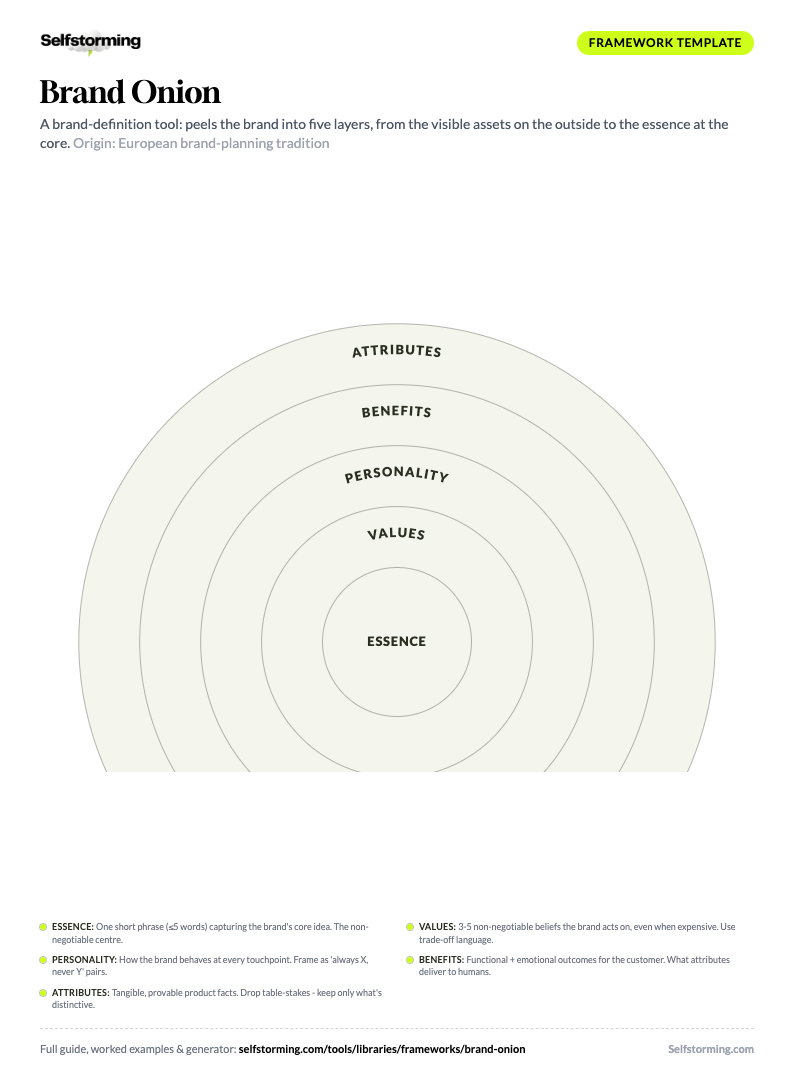
Brand Onion worksheet
Download PDF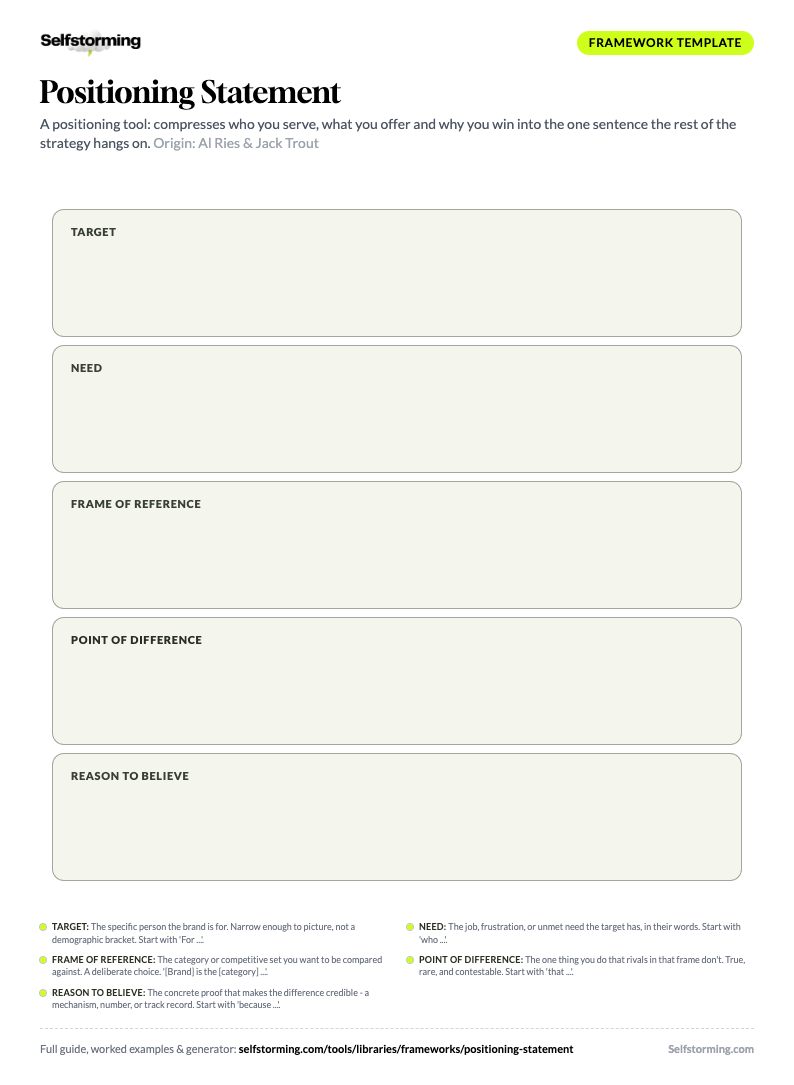
Positioning Statement worksheet
Download PDFWhat the template does not cover
An onion and a positioning statement are the core of a brand strategy, not all of it. You still need to know who actually buys the category, how the brand architecture works if there is more than one product, and a messaging framework a copywriter can use on Monday.
If your brand keeps describing itself in features, try the Brand Ladder instead of the onion - it forces a "so what?" between every rung. The full process, with the data from award-winning campaigns, is in the brand strategy guide.