Hook-Story-Offer

    Brunson's diagnostic is brutally simple: every ad is a hook, a story and an offer, and when something is not working, one of the three is broken. The hook earns attention, the story earns belief and desire, and the offer earns the click. Most brands obsess over the offer and neglect the hook - which is backwards, because nobody hears the offer if the hook fails.
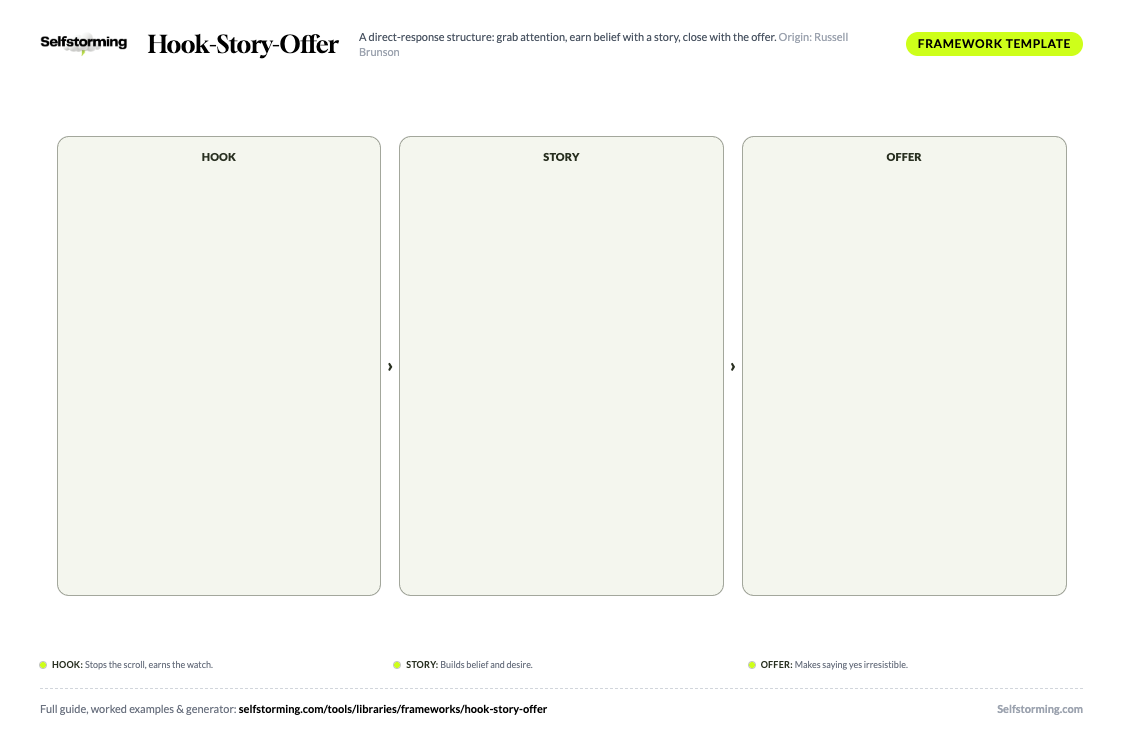
    Hook
    Story
    Offer

    HOOK-STORY-OFFER

    “Three beats - Hook, Story, Offer - that turn a scroll into a sale.”

    What is Hook-Story-Offer?

    Russell Brunson's three-beat structure for direct-response: a hook that stops the scroll, a story that builds belief and desire, and an offer they cannot refuse. If a campaign is failing, the answer is almost always a better hook, a better story, or a better offer - in that order.

    Worked Examples

    Three real brands. Different categories, different sizes. Same framework, filled in.

    Example 1

    LIVA (electrolytes)

    DTC supplement

    A 20-second UGC ad mapped to the three beats.

    Hook
    "You are not hungover, you are dehydrated." Straight to camera, mid-pour.
    Story
    Water alone flushes minerals out; the science in one line; the sachet going in.
    Offer
    "Headache gone in twenty minutes. 60-day guarantee, link in bio."
    Example 2

    An online fitness coach

    Info product

    A longer VSL-style ad.

    Hook
    "Cardio is the slowest way to lose fat. Here is what actually works."
    Story
    Client transformations, the training mechanism, why the gym myths fail.
    Offer
    A 12-week program, a results guarantee, and a one-click enrol.

    The 3 Layers, One By One

    Each one answers a specific question - here is how to fill it in, and how to tell a sharp answer from a lazy one.

    1. Hook

    What grabs attention and earns the next 3 seconds?

    The opening that stops the scroll - a bold claim, a pattern interrupt, a curiosity gap. Without the hook, nothing else is seen, so it carries most of the leverage.

    Good answer

    "You are not hungover, you are dehydrated." Said straight to camera, mid-pour.

    Wrong answer

    A slow, polite intro that gets skipped before the story begins.

    2. Story

    What builds belief and desire?

    The middle that makes them care and believe - the problem, the journey, the proof, the transformation. It bridges attention to wanting.

    Good answer

    The founder's struggle, the mechanism, and a quick before/after that makes the claim believable.

    Wrong answer

    Jumping straight from hook to offer with no belief built - so the offer feels like a cold pitch.

    3. Offer

    What makes saying yes irresistible?

    The close - the deal, the guarantee, the frictionless path to buy. A strong offer (see the Value Equation) turns built desire into action.

    Good answer

    "60-day money-back, free shipping today, two taps to checkout."

    Wrong answer

    A weak or buried offer that wastes the attention and belief you just earned.

    Origin & Lineage

    Popularised by Russell Brunson (DotCom Secrets / Expert Secrets) as the core diagnostic of his direct-response system. It distils classic salesmanship into three moving parts you can test independently.

    Critics

    It is a structure, not a guarantee - a slick hook-story-offer on a bad product still fails. It also leans long-form; on a 6-second feed ad the "story" beat has to be compressed almost to nothing, which is where Hook-Retain-Reward picks up.

    How To Build It

    A workshop flow that produces a usable v1 in a day - with the right people in the room, or just you and a Selfstorming strategy session right here.

    1

    Lead with the hook

    Write and test several openings - this is where most performance is won or lost.

    2

    Build the story

    Use problem, proof and transformation to earn belief before you ask for anything.

    3

    Sharpen the offer

    Make the deal irresistible and the path to buy frictionless (the Value Equation helps).

    4

    Diagnose by beat

    When an ad fails, isolate which of the three is broken and fix that one.

    5

    Compress for the feed

    On short video, keep the story to fast beats so you never lose the watch.

    How This Framework Compares

    AspectWhen It WorksWhen It Doesn't
    Hook-Retain-RewardUse HRR for short-form video retention mechanics.Hook-Story-Offer is the persuasion structure of the whole ad, including the offer.
    PASUse PAS as the angle inside the story beat.Hook-Story-Offer is the full ad spine; PAS is one way to build the story.

    Frequently Asked Questions

    What is Hook-Story-Offer?

    It is Russell Brunson's three-beat structure for direct-response ads: a hook that stops the scroll, a story that builds belief and desire, and an offer they cannot refuse. When an ad fails, one of the three is broken.

    How do you use Hook-Story-Offer in ads?

    Lead with the hook and test several, build the story with proof and transformation, then close with an irresistible offer. To fix a failing ad, isolate which of the three beats is weak.

    How is it different from Hook-Retain-Reward?

    Hook-Story-Offer is the persuasion spine of the whole ad including the offer; Hook-Retain-Reward is specifically about holding attention through a short video. Use HSO for the argument, HRR for the retention.

    Sources & Further Reading

    DotCom Secrets
    Russell Brunson (2015)