PASTOR

    PAS gets you started; PASTOR finishes the job. Where PAS names and agitates a problem, PASTOR adds the story and proof that build belief, the transformation that makes the result feel real, the offer, and an explicit call to respond. It is the workhorse structure for VSLs, long-form ads and sales pages where you have room to build a full case.
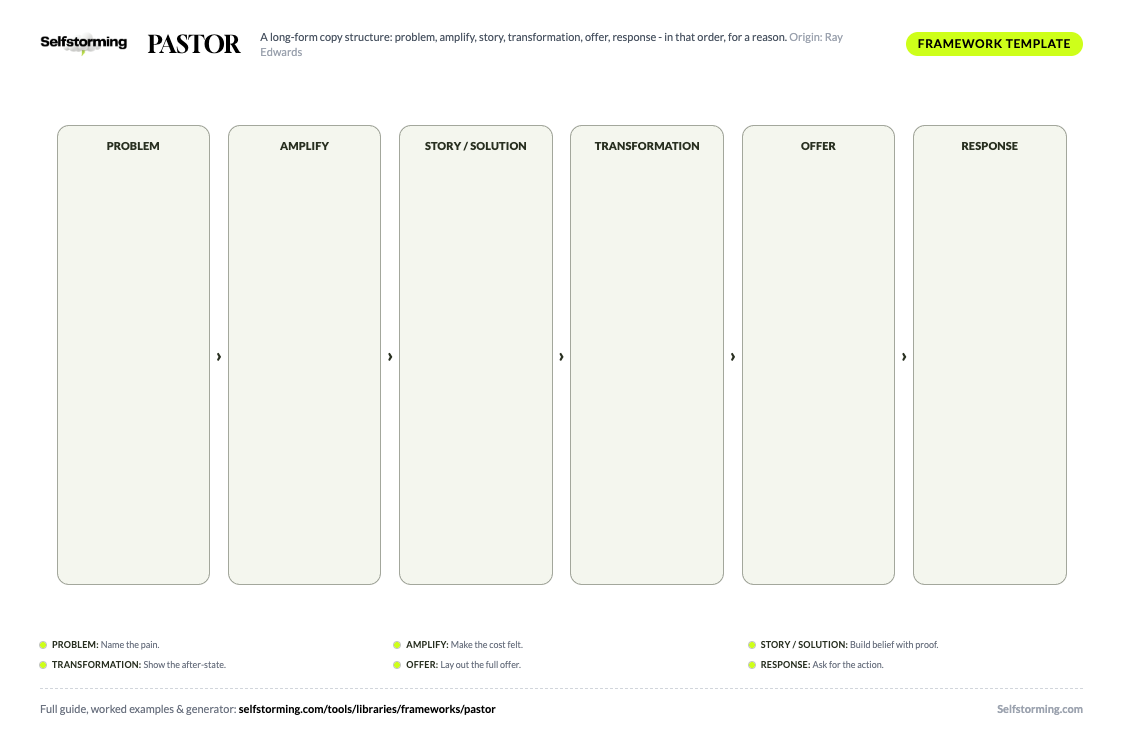
    Problem
    Amplify
    Story / Solution
    Transformation
    Offer
    Response

    PASTOR

    “Six beats - Problem, Amplify, Story, Transformation, Offer, Response - that walk a reader from pain to purchase.”

    What is PASTOR?

    A six-part persuasion structure for long-form copy and VSLs - Problem, Amplify, Story, Transformation, Offer, Response. Think of it as PAS with the proof, the offer and the close built in, so it carries a reader all the way from pain to purchase.

    Worked Examples

    Three real brands. Different categories, different sizes. Same framework, filled in.

    Example 1

    A performance-ads course

    Info product

    A VSL mapped to the six beats.

    Problem
    Your Meta ads stop working after a week and you cannot tell why.
    Amplify
    Wasted spend, missed targets, the stress of a dashboard you do not trust.
    Story / Solution
    The post-Andromeda testing system, the data behind it, student wins.
    Transformation
    A steady pipeline of winners and an account you actually understand.
    Offer
    The full course, templates, a community, and a results guarantee.
    Response
    "Enrol today - founding price closes Friday."

    The 6 Layers, One By One

    Each one answers a specific question - here is how to fill it in, and how to tell a sharp answer from a lazy one.

    1. Problem

    What pain are we naming?

    Open on the specific problem the reader feels. Concrete and recognisable - if they do not see themselves here, nothing after it lands.

    Good answer

    Naming the exact frustration: "Your ads stop working after a week and you do not know why."

    Wrong answer

    A vague or generic problem the reader does not feel is theirs.

    2. Amplify

    What is the cost of leaving it unsolved?

    Twist the knife - the consequences, the cost of inaction, what it keeps costing them. This is the emotional engine.

    Good answer

    Spelling out the wasted spend, the missed targets, the stress that follows them home.

    Wrong answer

    Naming the problem but never making its cost felt.

    3. Story / Solution

    Where did the solution come from?

    Tell the story of the solution - the discovery, the mechanism, the proof. Story builds belief that there is a real way out.

    Good answer

    The origin of the method, plus data and testimonials that make it credible.

    Wrong answer

    Asserting a solution with no story or proof to make it believable.

    4. Transformation

    What does life look like after?

    Paint the after-state - the transformation and testimonials. Let the reader pre-experience the result.

    Good answer

    Before/after results and a vivid picture of the day-to-day once it is solved.

    Wrong answer

    Listing features instead of showing the transformation they buy.

    5. Offer

    What exactly are they getting?

    Lay out the offer in full - what is included, the value, the guarantee, the price. A strong offer (Value Equation) closes here.

    Good answer

    A clear bundle, a risk-reversal guarantee, and an honest price justified by the value.

    Wrong answer

    A vague or buried offer after all that build-up.

    6. Response

    What is the one next step?

    Ask for the action, explicitly and with urgency. Tell them exactly what to do now and why now.

    Good answer

    "Click below, start today, 60-day guarantee - the price goes up Friday."

    Wrong answer

    Ending without a clear, urgent ask, so the built desire leaks away.

    Origin & Lineage

    Coined by copywriter Ray Edwards as a complete, memorable structure for persuasive sales copy. It packages the classic direct-response arc into six teachable steps.

    Critics

    It is built for long-form, so on a short feed ad most of the middle has to be cut - at which point you are basically back to PAS or Hook-Story-Offer. Followed mechanically it can also feel formulaic and same-y.

    How To Build It

    A workshop flow that produces a usable v1 in a day - with the right people in the room, or just you and a Selfstorming strategy session right here.

    1

    Name the problem

    Open on a specific pain the reader instantly recognises.

    2

    Amplify the cost

    Make the consequence of inaction felt, not just stated.

    3

    Tell the story

    Build belief with the origin, the mechanism and the proof.

    4

    Show the transformation

    Let them pre-experience the after-state.

    5

    Lay out the offer

    Make it complete, valuable and risk-free (Value Equation helps).

    6

    Ask for the response

    Give one clear, urgent next step.

    How This Framework Compares

    AspectWhen It WorksWhen It Doesn't
    PASUse PAS for short, punchy ads.PASTOR adds story, transformation, offer and close for long-form.
    Hook-Story-OfferUse HSO for the three-beat ad spine.PASTOR is the fuller six-beat structure for VSLs and sales pages.

    Frequently Asked Questions

    What is the PASTOR framework?

    PASTOR is a six-part copywriting structure - Problem, Amplify, Story, Transformation, Offer, Response - that walks a reader from pain to purchase. It is essentially PAS with the proof, offer and close built in.

    How do you write copy with PASTOR?

    Name a specific problem, amplify its cost, tell the story and proof of the solution, show the transformation, lay out the offer, and ask for the response with urgency.

    How is PASTOR different from PAS?

    PAS is the short problem-agitate-solve arc; PASTOR extends it with story, transformation, offer and a clear call to respond, making it suited to long-form copy and VSLs.

    Sources & Further Reading