Market Sophistication
Awareness is about the buyer; sophistication is about the market. The same claim that crushes in a fresh market is invisible in a tired one, because the audience has heard it a hundred times. Schwartz's five levels tell you whether to lead with the claim, a bigger claim, a unique mechanism, a better mechanism, or - when claims are exhausted - identity and belonging. Get the level wrong and even a true claim sounds like noise.
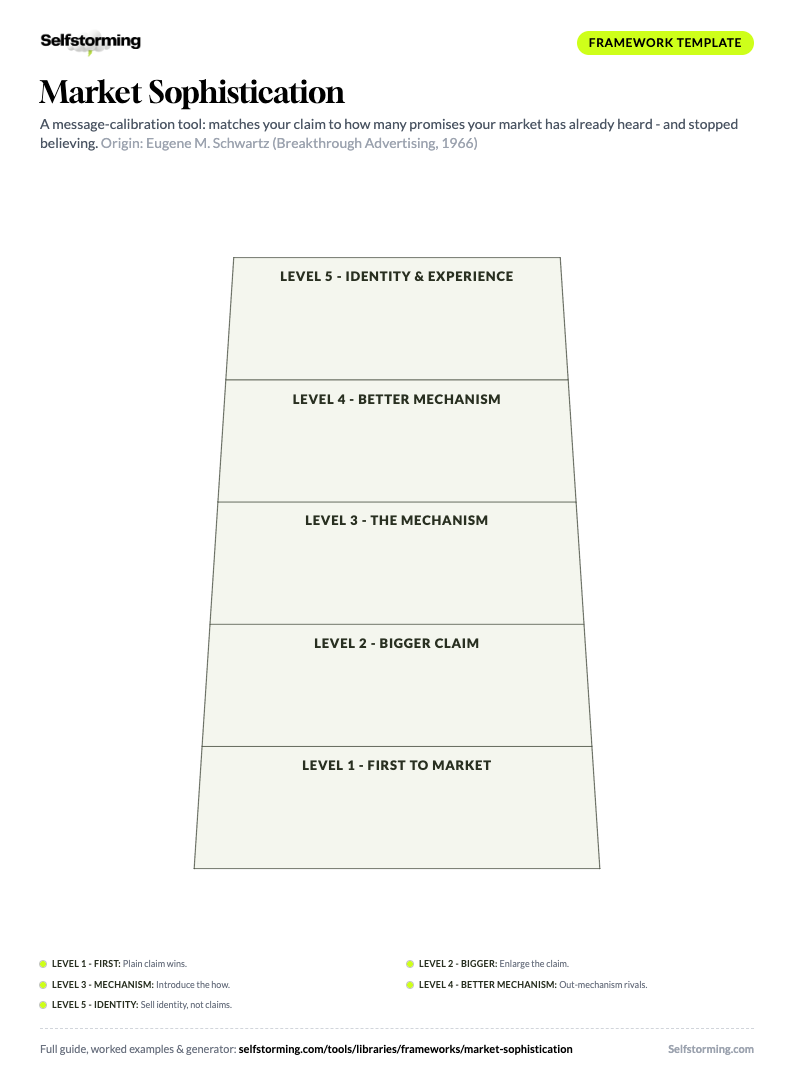
Print it. Fill it in.
The Market Sophistication as a printable A4 worksheet - write straight into the framework, on paper or in any PDF app.
Download the PDF templateMARKET SOPHISTICATION
A message-calibration tool: matches your claim to how many promises your market has already heard - and stopped believing.
What is Market Sophistication?
Eugene Schwartz's five levels of how many claims a market has already heard. Level 1 is a virgin market where a plain claim wins; by Level 5 everyone has heard every claim and you must stop competing on promises and sell identity instead. It tells you how hard you have to work to be believed - and when claims stop working.
Worked Examples
Three real brands. Different categories, different sizes. Same framework, filled in.
A new electrolyte brand
DTC supplementReading where the hydration market actually sits (Level 4-5) and acting on it.
The 5 Layers, One By One
Each one answers a specific question - here is how to fill it in, and how to tell a sharp answer from a lazy one.
1. Level 1 - First to market
Has the market heard this claim before?
A virgin market. Be direct - just state the claim plainly and you win, because nobody else is making it yet.
"This pill makes you lose weight." When nobody has said it, the bare claim is enough.
Over-complicating a fresh market with mechanisms it does not need yet.
2. Level 2 - Bigger claim
Are competitors now making the same claim?
Rivals have copied you. Win by enlarging the claim - bigger, faster, more.
"Lose twice the weight in half the time." Out-claim the copycats.
Matching the competitor's claim instead of beating it.
3. Level 3 - The mechanism
Has the bidding war on claims topped out?
Claims have maxed out and stopped being believed. Introduce a unique mechanism - the how - that makes your claim credible again.
"Lose weight thanks to a new fat-blocking enzyme." The mechanism revives belief.
Still shouting a bigger number when the market has stopped believing numbers.
4. Level 4 - Better mechanism
Are competitors now copying your mechanism?
Everyone has a mechanism now. Win with a better, more elegant, or more believable mechanism.
"A second-generation enzyme that works without the side effects." Out-mechanism them.
Inventing a fake mechanism the market can see through.
5. Level 5 - Identity & experience
Has the market heard every claim and every mechanism?
Claims and mechanisms are exhausted and distrusted. Stop competing on promises - sell identity, belonging, brand and experience instead.
Not "lose weight" but "join the people who train like this". Identity over claim.
Making yet another claim in a market that has heard them all and tuned out.
Origin & Lineage
From Eugene Schwartz's Breakthrough Advertising (1966), the sister concept to his five stages of awareness. Still the sharpest model of why claims wear out and what to do when they do.
Critics
Diagnosing the exact level is a judgement call, not a measurement, and markets do not move in clean steps. It also tempts brands to escalate mechanisms forever when sometimes the right move at Level 5 is to leave the claims game entirely.
How To Build It
A workshop flow that produces a usable v1 in a day - with the right people in the room, or just you and a Selfstorming strategy session right here.
Diagnose the level
Audit how many competitors are making your claim and how tired the market sounds.
Match the move
Plain claim at Level 1, bigger claim at 2, mechanism at 3, better mechanism at 4, identity at 5.
Escalate when claims fade
The moment numbers stop being believed, switch from claim to mechanism.
Leave the claims game at Level 5
When everything has been said, compete on identity, brand and belonging.
Re-check often
Sophistication only moves one way - up - so revisit before each new campaign.
How This Framework Compares
| Aspect | When It Works | When It Doesn't |
|---|---|---|
| Customer Awareness Stages | Use awareness to match the message to where the buyer is. | Sophistication matches the message to how tired the market is - they work together. |
| Positioning Statement | Use positioning to define your one slot in the category. | Sophistication tells you how loudly the category has already shouted, so you know how to break through. |
Frequently Asked Questions
What is Market Sophistication?
It is Eugene Schwartz's model of how many times a market has already heard your claim - five levels, from a virgin market where a plain claim wins to an exhausted one where you must sell identity instead of promises.
How do you use Market Sophistication in marketing?
Diagnose your level by how many competitors make your claim, then match the move: state the claim at Level 1, enlarge it at 2, add a mechanism at 3, a better mechanism at 4, and switch to identity and brand at 5.
How is sophistication different from awareness?
Awareness is about the individual buyer's knowledge; sophistication is about how tired the whole market is. Awareness tells you what to say; sophistication tells you how hard you have to work to be believed.
Sources & Further Reading
Related Frameworks
Brand Onion
Five concentric layers from outer to inner: Attributes (provable product facts), Benefits (functional + emotional outcomes), Personality (ho
Brand Archetypes
Twelve characters drawn from Jungian psychology, grouped into four families by core human motivation: Independence & Fulfillment (Innocent,
Brand Key
Eight sections, built outside-in: Root strengths (your heritage and core competence), Competitive environment (the real alternatives), Targe
Brand Identity Prism
Six facets on a prism, two per axis. Physique (tangible features and look) and Personality (character, as if a person) form the picture-of-s