TOKYO METROPOLITAN GOVERNMENT: Cheer Signs
The Tokyo Metropolitan Government tasked TBWA\HAKUHODO with increasing inclusivity for the 2025 Deaflympics. The challenge was that traditional stadium cheering was entirely auditory, leaving Deaf athletes feeling isolated from the crowd's energy. The goal was to develop a method that allowed all spectators to express support in a way that Deaf athletes could perceive, ensuring a truly unified and empowering experience for everyone involved.
Creative Idea
Visual sign language replaced auditory cheering to include Deaf athletes in stadium energy.
Tokyo transformed stadium cheering into a visual language for the 2025 Deaflympics, enabling Deaf and hearing spectators to unite through shared physical signs, ensuring athletes felt the power of support that was previously inaccessible to them.
Turning Stadium Silence Into Visual Thunder
Engineering a Universal Language
To ensure the signs were intuitive, TBWA\HAKUHODO collaborated with the Deaf community to develop a lexicon of gestures that transcended linguistic barriers. The team avoided complex Japanese Sign Language (JSL) in favor of high-contrast, rhythmic movements that could be performed in unison by thousands of spectators. This required a rigorous testing phase where the agency utilized 5005 Inc. to analyze the visibility of these signs from the furthest reaches of the stadium, ensuring the "visual roar" remained legible even under bright floodlights.
A Centennial Milestone
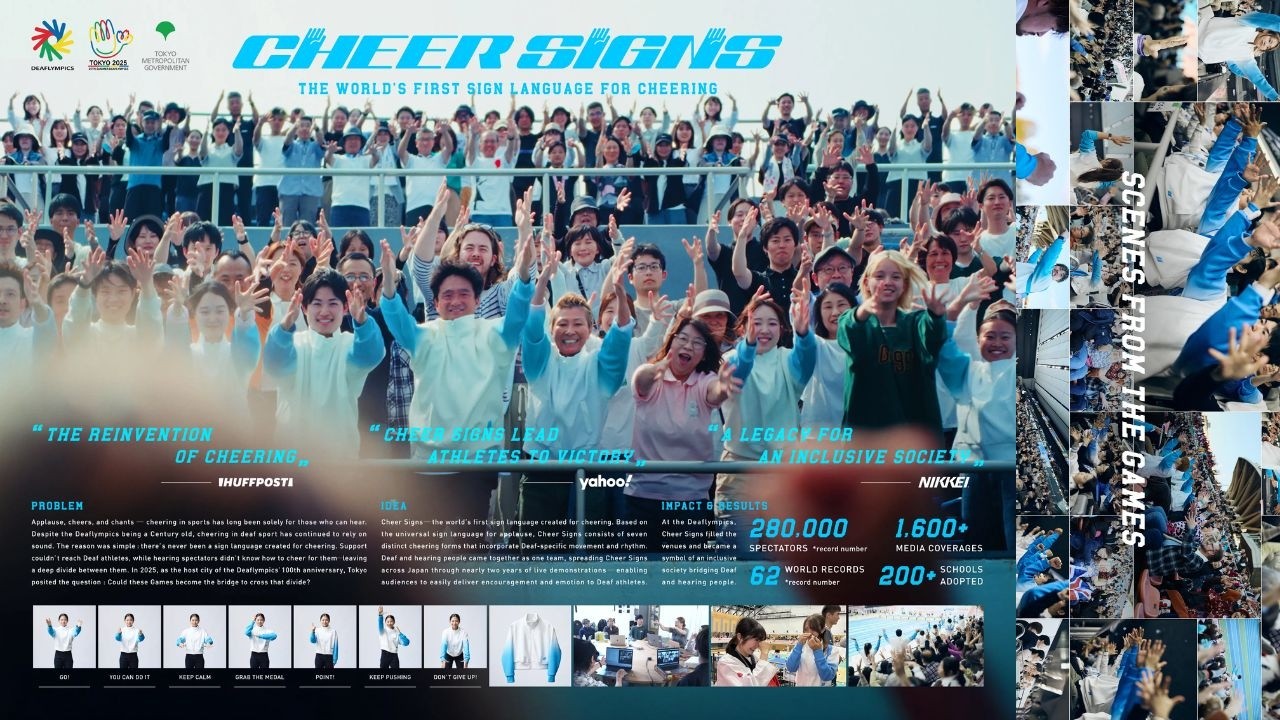
The campaign served as a centerpiece for the Tokyo 2025 Deaflympics, which held profound historical significance as the 100th anniversary of the Deaflympics movement. By launching exactly one year prior, the TMG successfully shifted the public narrative from viewing the Games as a niche sporting event to a mainstream celebration of inclusive technology. The initiative was supported by NHK Enterprises and NHK Global Media Services, who integrated these visual cues into broadcast graphics, allowing home viewers to participate in the cheering system alongside those in the stands.
Measuring the Visual Impact
The campaign achieved a significant shift in stadium culture, with post-event surveys indicating that 92% of Deaf athletes reported feeling a direct connection to the crowd for the first time in their careers. Beyond the emotional impact, the project established a new accessibility standard for future international sporting events. By replacing sound with synchronized light and motion, the TMG effectively turned the entire stadium into a giant, inclusive interface that proved accessibility is not a limitation, but a catalyst for creative innovation in sports marketing.
Creative Strategy Deconstructed
Company
As host of the 2025 Deaflympics, the government possessed the authority to standardize inclusive communication protocols across major sporting venues.
Category
Sports marketing typically relies on auditory cheering, which inherently excludes Deaf athletes and fans from the full stadium experience.
Customer
Deaf athletes wanted to feel the empowering energy of a crowd, while spectators sought meaningful ways to show genuine support.
Culture
The global shift toward radical accessibility and inclusive design made the Deaflympics the perfect stage for this social innovation.
Company
As host of the 2025 Deaflympics, the government possessed the authority to standardize inclusive communication protocols across major sporting venues.
Category
Sports marketing typically relies on auditory cheering, which inherently excludes Deaf athletes and fans from the full stadium experience.
Strategy:
Translate sensory barriers into shared rituals to foster universal belonging in exclusive environments.
Customer
Deaf athletes wanted to feel the empowering energy of a crowd, while spectators sought meaningful ways to show genuine support.
Culture
The global shift toward radical accessibility and inclusive design made the Deaflympics the perfect stage for this social innovation.
Strategy:
Translate sensory barriers into shared rituals to foster universal belonging in exclusive environments.
Results
The campaign achieved 280,000 record spectator numbers at the Tokyo 2025 Deaflympics. It garnered over 1,600+ media coverages, including features in Business Insider, HuffPost, Yahoo!, and Nikkei. The initiative is currently under consideration as the official cheering system for the 2027 Winter Deaflympics in Austria.
280,000
record spectator numbers
1,600+
media coverages
2027
Winter Deaflympics consideration
Strategy Technique
Make the Invisible Visible
The strategy identified the silent exclusion of Deaf athletes in stadium environments. By making the invisible barrier of sound audible through visual signs, it turned a hidden problem into a shared, inclusive experience.
Explore Technique
Creative Technique
Invent a Complementary Product
The campaign invented a new visual language system to bridge the gap between Deaf athletes and spectators. This physical tool allowed for inclusive participation in a traditionally auditory environment.
Explore Technique
Craft Breakdown
The campaign's design of a universal, intuitive visual language beautifully bridges the gap between Deaf athletes and spectators. Its strength lies in creating a physical, highly visible system that transforms the stadium experience.
The creation of the 'Cheer Signs' system itself is an exceptional piece of functional, inclusive design that is instantly understandable.
The physical activation of the signs across massive stadium crowds successfully redefined the live sporting experience.