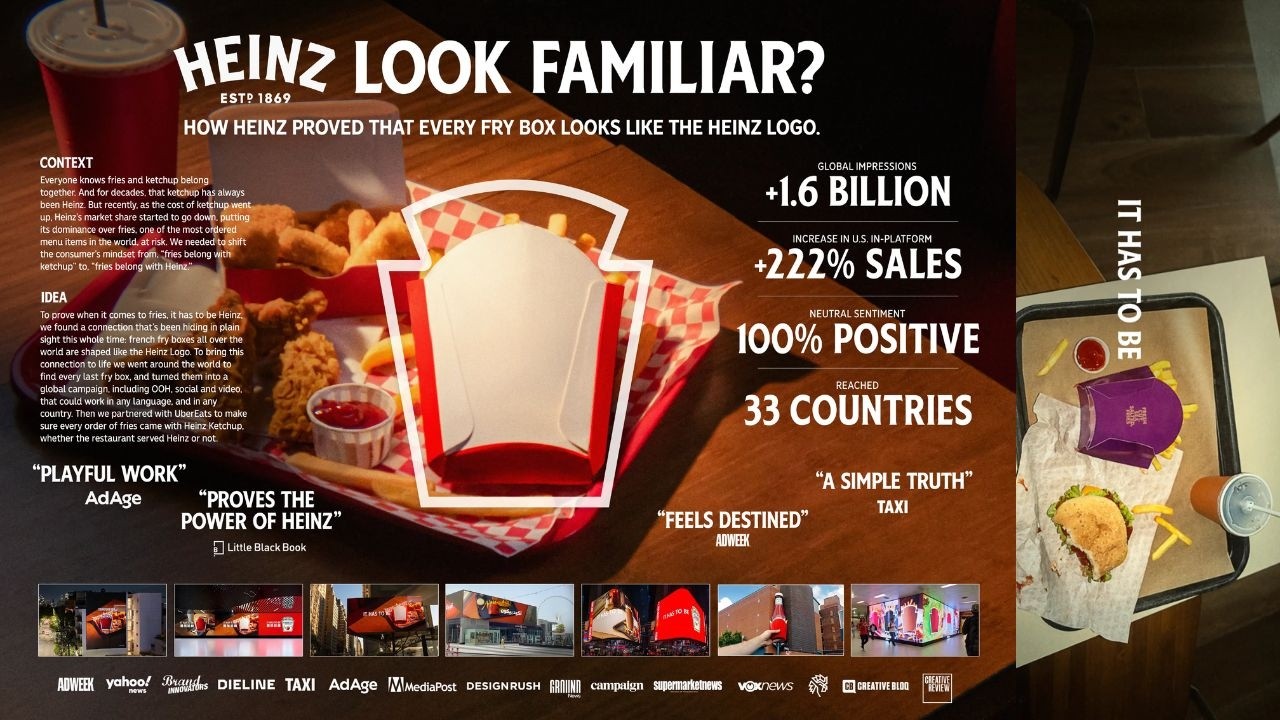
Heinz: Look Familiar?
Kraft Heinz tasked Rethink with combating the commodity trap of generic ketchups during a period of rising food prices. The goal was to reclaim market share and reinforce brand iconicity among global consumers. The client needed a strategy that moved beyond traditional product-focused advertising to prove the brand's essential role in the dining experience, without relying on standard logo-heavy creative executions.
Creative Idea
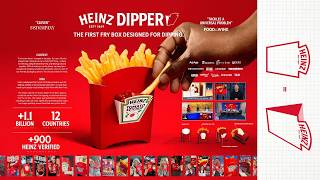
The campaign revealed that standard fry boxes are shaped exactly like the Heinz logo.
Heinz transformed the New York Times and global OOH into a visual manifesto by highlighting that the shape of a standard fry box perfectly mirrors the iconic Heinz keystone, proving the brand is so iconic it needs no logo to be recognized.
The Shape That Proved Heinz Essential
A Global Visual Language
The campaign relied on a high-stakes bet on brand recognition. By stripping away the logo and the bottle, Rethink forced consumers to identify the brand through the Keystone silhouette alone. This minimalist approach was executed across eight key markets, including the United States, China, and the United Arab Emirates. The production team utilized high-contrast photography to emphasize the geometry of the fry boxes, ensuring the visual joke remained legible whether on a digital billboard in Dubai or a print spread in a London newspaper.
Driving Sales Through Utility
Beyond the visual stunt, the campaign integrated tactical sales drivers to combat rising commodity costs. In Canada, the agency partnered with Uber Eats to offer a 50% discount on Heinz Ketchup for customers ordering fries, effectively turning a brand awareness play into a direct conversion tool. Further regional activations included a partnership with Carl's Jr., which provided free ketchup with qualifying orders. These efforts helped the brand achieve a 222% increase in sales and generated over 1.6 billion global impressions.
Trusting the Audience
The campaign’s success was rooted in a deliberate lack of celebrity influence. By avoiding influencers and actors, the creative team kept the focus entirely on the product pairing. As Jessica Apellaniz, the Cannes Lions Print & Publishing Jury President, noted, the campaign was rewarded for the "presence of the brand" rather than the "absence of the product." It stands as a case study in how a legacy brand can leverage its own design history to remain relevant, proving that even a generic fry box can become an owned media asset for Heinz.
Creative Strategy Deconstructed
Company
Heinz leveraged its 150-year-old iconic keystone silhouette as a distinct visual asset that consumers recognize instantly without any branding.
Category
Ketchup brands typically rely on loud, logo-heavy advertising to fight for attention in a crowded, commodity-driven market.
Customer
Consumers subconsciously associate the experience of eating fries with the specific taste and presence of Heinz ketchup.
Culture
The rise of minimalist, high-craft advertising allowed a wordless, logo-free visual to stand out against traditional, cluttered media.
Company
Heinz leveraged its 150-year-old iconic keystone silhouette as a distinct visual asset that consumers recognize instantly without any branding.
Category
Ketchup brands typically rely on loud, logo-heavy advertising to fight for attention in a crowded, commodity-driven market.
Strategy:
Leverage subconscious visual recognition to establish brand dominance without explicit product placement.
Customer
Consumers subconsciously associate the experience of eating fries with the specific taste and presence of Heinz ketchup.
Culture
The rise of minimalist, high-craft advertising allowed a wordless, logo-free visual to stand out against traditional, cluttered media.
Strategy:
Leverage subconscious visual recognition to establish brand dominance without explicit product placement.
Results
The campaign generated 1.6 billion global impressions. It was rolled out across 33 countries and featured a global partnership with Uber Eats to bundle Heinz ketchup with fry orders.
1.6B
global impressions
33
countries launched in
Strategy Technique
Make the Invisible Visible
By highlighting the subconscious familiarity of the keystone shape, the brand turns a mundane, overlooked design detail into a powerful proof of its own cultural ubiquity.
Explore Technique
Creative Technique
Expose the Hidden
The campaign reveals a visual parallel between generic fry boxes and the brand's keystone logo. It exposes a hidden design truth that consumers encounter daily but never consciously noticed.
Explore Technique
Craft Breakdown
This campaign is elevated by a brilliant visual insight that connects a universal fast-food element directly to the brand's iconic logo shape. The execution relies on minimalist design and clever media placement to make the connection undeniable.
The simple yet powerful visual overlay of the Heinz keystone outline onto generic fry boxes is a masterclass in minimalist brand association.
The global out-of-home placements and the clever Uber Eats integration allowed the brand to intercept consumers at the exact moment of consumption.