2026Chunichi Shimbun CoMedia & EntertainmentCase video
Chunichi Shimbun Co: Endangered Species AR Bird Watching Newspaper
Chunichi Shimbun Co tasked Dentsu with increasing reader engagement and environmental awareness in the Chubu region. The client needed a way to revitalize the newspaper format while educating the public about local endangered bird species. The goal was to bridge the gap between traditional print media and modern digital interaction to foster a deeper connection between the community and their natural surroundings.
Creative Idea
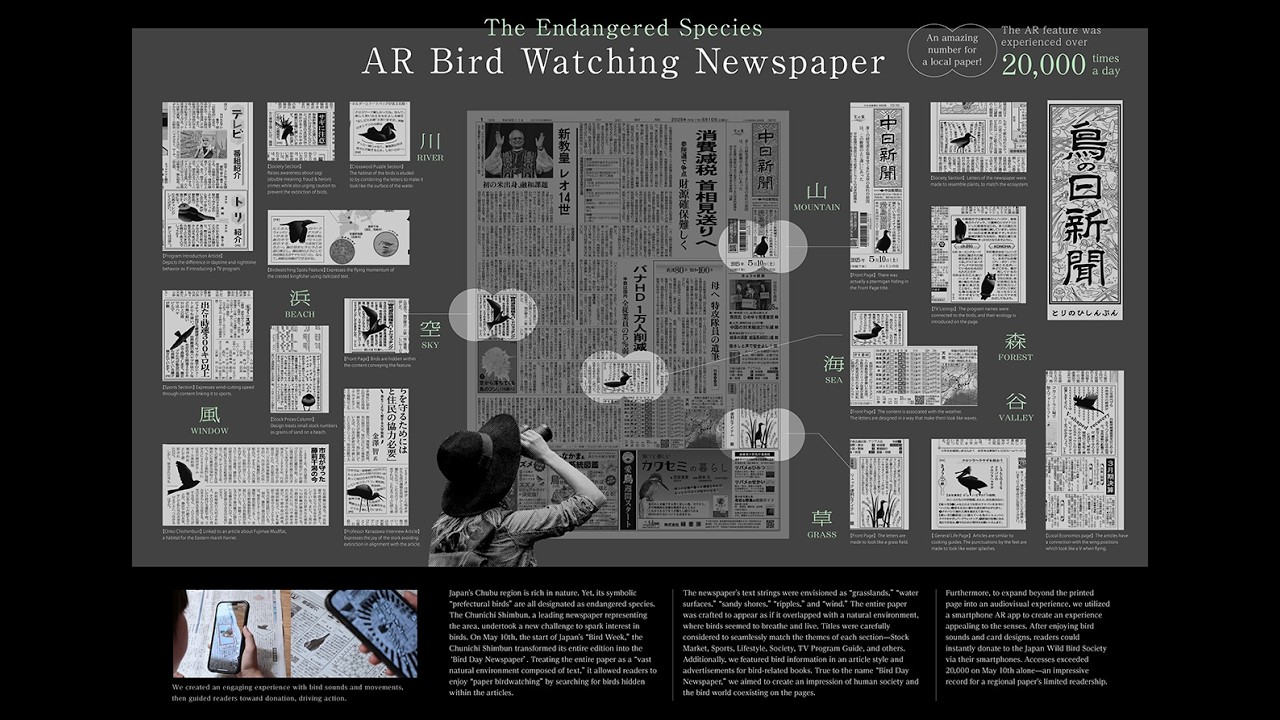
Newspaper text layouts formed natural habitats that revealed hidden endangered birds via AR.
Chunichi Shimbun transformed its newspaper into a living ecosystem by using text-based layouts to mimic natural habitats. By integrating AR, it turned static print into an interactive birdwatching experience, reconnecting readers with local endangered species in their own backyard.
Typography as Habitat for Endangered Species
Crafting Landscapes from Language
The production process required a meticulous approach to typography, where character spacing and density were choreographed to mimic natural textures. Rather than relying on traditional graphic design, the team at Dentsu Chubu and drawrope treated the newspaper page as a physical canvas. By manipulating the rhythm and scale of text, they created visual representations of natural elements like grass, sea, beach, ripples, and wind. This technique ensured that the words functioned simultaneously as legible news content and as a structural landscape, allowing the AR overlay to integrate seamlessly without the need for external digital interfaces.
Localized Conservation Through Technology
The campaign focused exclusively on birds native to the Chubu region of Japan, many of which are currently threatened or endangered. By embedding these species into the texture of a daily medium, the project aimed to make conservation feel intimate and immediate rather than a distant, abstract concept. The AR experience, developed in partnership with Cloud CIRCUS, required precise technical calibration to ensure the hidden birds appeared to live within the typographic environments. This design choice forced a balance between maintaining the readability of the news and the visual integrity of the natural habitats.
Industry Significance
The project serves as a case study in how print media can evolve to offer immersive, interactive experiences without abandoning traditional typographic art. By transforming the newspaper into a "vast natural environment composed of text," the agency successfully bridged the gap between legacy print and digital engagement. The campaign achieved 100% circulation engagement among subscribers in the targeted release areas, proving that physical newspapers remain a viable platform for high-tech, interactive storytelling when the design is deeply integrated with the medium itself.
4C Framework deconstruction
Company
As a regional newspaper, it possessed the unique ability to reach local households and influence community awareness through physical print media.
Category
Newspapers typically rely on static text and photography, often failing to engage younger, digital-first audiences with traditional, long-form environmental reporting.
Customer
Readers felt disconnected from their local environment and were unaware of the endangered species living in their immediate geographical surroundings.
Culture
The rise of AR technology and growing public interest in local conservation during Bird Week provided the perfect context for this initiative.
Company
As a regional newspaper, it possessed the unique ability to reach local households and influence community awareness through physical print media.
Category
Newspapers typically rely on static text and photography, often failing to engage younger, digital-first audiences with traditional, long-form environmental reporting.
Strategy:
Integrate digital interactivity into physical media to transform passive consumption into active, localized environmental stewardship.
Customer
Readers felt disconnected from their local environment and were unaware of the endangered species living in their immediate geographical surroundings.
Culture
The rise of AR technology and growing public interest in local conservation during Bird Week provided the perfect context for this initiative.
Strategy:
Integrate digital interactivity into physical media to transform passive consumption into active, localized environmental stewardship.
Results
The AR bird watching feature was performed 20,000 times and became a hot topic on social media. The campaign sparked real-world actions including attendance at the Bird Exhibition at the Science Museum, participation in local symposiums, and educational use in school classrooms. Additionally, donations were collected for the Wild Bird Society of Japan.
20,000
AR bird watching experiences performed
Strategy Technique
Make the Invisible Visible
By highlighting local endangered species that readers often overlook, the campaign forces a confrontation with environmental loss. It turns a mundane daily habit into a meaningful discovery of local ecological reality.
Explore Technique
Creative Technique
Expose the Hidden
The campaign uses AR to reveal endangered birds hidden within the newspaper's text-based landscape. This design choice makes the invisible threat of extinction tangible and interactive for the reader.
Explore Technique
Craft Breakdown
This campaign elevates traditional print journalism by seamlessly integrating interactive AR digital craft with thoughtful art direction, turning a broadsheet newspaper into an immersive wildlife conservation tool.
The seamless WebAR interaction tracks 2D newspaper print graphics to trigger responsive 3D animations and audio bird calls instantly.
Cleverly transforms broadsheet layout structures into symbolic natural bird habitats using elegant typographic and visual compositions.
“The brilliant synergy between tactile print art direction and digital WebAR innovation converts passive news reading into an engaging gamified learning experience.”