Sheba: Hope Reef
Sheba faced pressure from cheaper competitors and needed to justify its premium price. AMV BBDO London was tasked with evolving the brand's 'What Cats Want' positioning into a purpose-led platform. The goal was to engage environmentally conscious cat owners by demonstrating a radical commitment to fish sustainability, ensuring the brand's long-term survival in a world facing marine ecosystem collapse.
Creative Idea
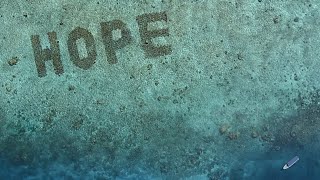
They built a massive, living coral reef that spells 'HOPE' visible from space.
Sheba built the world's largest coral restoration project - a living billboard spelling 'HOPE' visible from space - to prove that protecting the oceans is the only way to ensure a future where cats can continue to enjoy fish.
The Living Billboard Visible From Space
A Self Destructing Masterpiece
The project’s centerpiece is a massive underwater installation spelling HOPE in letters 35 - 45 meters high. Built using 840 handmade "Reef Stars" - hexagonal steel structures crafted by the local community in Bontosua, Indonesia - the reef is so large it can be seen on Google Earth at coordinates -5.08642, 119.355. In a poetic twist of "self - destructing" design, the campaign is intended to disappear; as the coral matures, it will eventually swallow the steel letters, turning the man - made message into a natural, seamless part of the ocean floor.
The Channel That Grows Coral
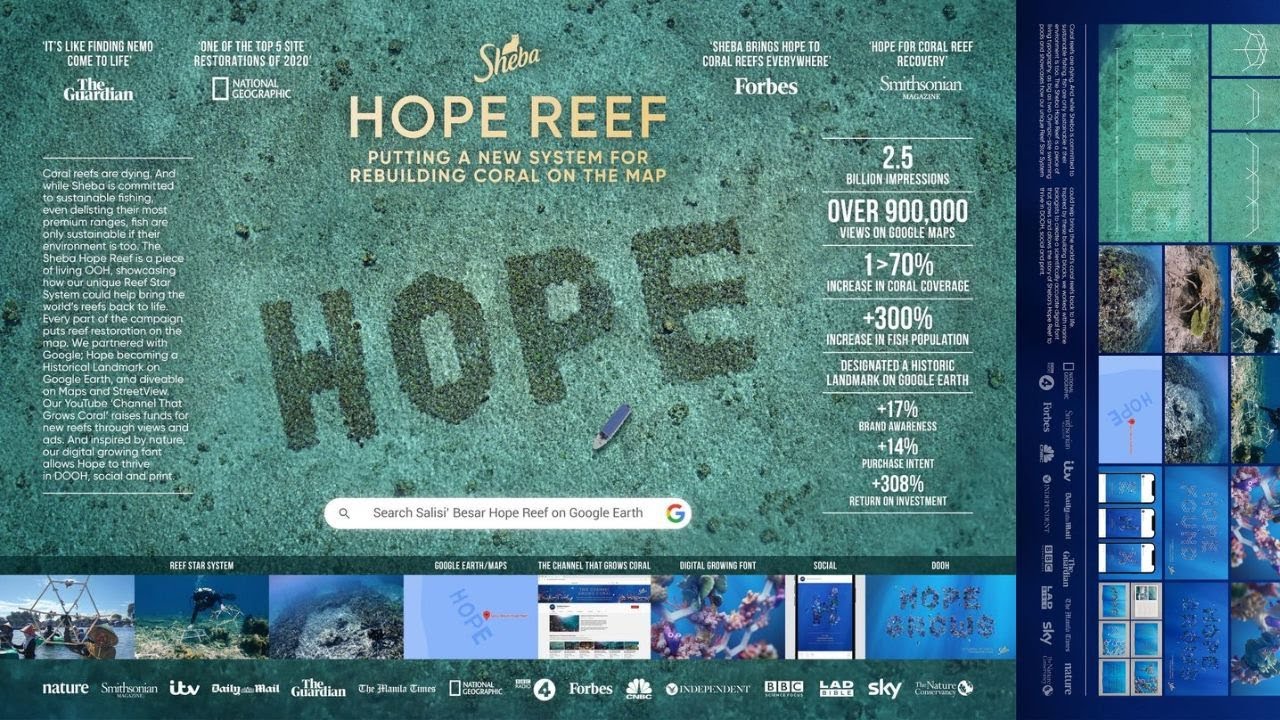 To fund the restoration, AMV BBDO and Google launched the first - ever 100% monetized YouTube channel for sustainability. Every view of the campaign films generated ad revenue donated directly to The Nature Conservancy. This digital ecosystem reached 20 million views, while the broader campaign earned 2.5 billion media impressions. The technical execution by Framestore involved using Houdini to procedurally generate millions of scientifically accurate coral assets for the launch film, ensuring the VFX matched the biological reality of the site.
Commercial Growth Through Mutual Value
The initiative proved that environmental restoration drives the bottom line. The campaign delivered a 308% ROI in major markets and a 10.4% sales lift in physical stores. Beyond the numbers, the biological impact was staggering: coral cover increased from 2% to 70% in just two years, while fish abundance surged by 300%. The project has since expanded to 12 countries, supported by ambassadors like Auliʻi Cravalho and Paralympic swimmer Ellie Simmonds, and even produced a feature - length documentary, Reef Builders, for Prime Video.
Creative Strategy Deconstructed
Company
Sheba's commitment to 100% sustainable fish sourcing and Mars' proprietary Reef Star restoration technology.
Category
Competitors focused solely on cat taste and enjoyment, ignoring the environmental cost of the fish they served.
Customer
Premium pet owners who felt guilty about their environmental footprint and wanted brands to take real responsibility.
Culture
Growing global alarm over the 'ticking bomb' of reef extinction and the potential loss of all wild fish.
Company
Sheba's commitment to 100% sustainable fish sourcing and Mars' proprietary Reef Star restoration technology.
Category
Competitors focused solely on cat taste and enjoyment, ignoring the environmental cost of the fish they served.
Strategy:
Transform a brand promise into a physical infrastructure that restores the natural resources essential to the product's future.
Customer
Premium pet owners who felt guilty about their environmental footprint and wanted brands to take real responsibility.
Culture
Growing global alarm over the 'ticking bomb' of reef extinction and the potential loss of all wild fish.
Strategy:
Transform a brand promise into a physical infrastructure that restores the natural resources essential to the product's future.
Results
The project has grown more than 40,000 sq m of coral. Over 1 million people have explored the site on Google Maps and Street View. In just two years, coral coverage increased from 1% to 70%. Overall coral coverage increased by 6900%. Fish populations have grown by 300%. The project has been recognized as one of the Top 5 site restorations of 2020 by National Geographic. The restoration system is now being adopted by governments in Mexico, the US Virgin Islands, Maldives, Seychelles, and Australia.
6900%
increase in coral coverage
300%
growth in fish populations
40,000+
sq m of coral grown
Strategy Technique
Turn Brand Values Into Action
Sheba moved beyond sustainability claims by investing in a massive engineering project that physically restored marine life, proving their commitment to 'What Cats Want' through tangible environmental impact.
Explore Technique
Creative Technique
Turn Message into Product
By turning the word 'HOPE' into a massive, living underwater structure, Sheba transformed a traditional advertising message into a functional ecosystem that physically restores the very resource the brand depends on.
Explore Technique
Craft Breakdown
This campaign excels through its innovative use of physical environmental engineering as a medium for brand storytelling, turning a restoration project into a global landmark.
The creation of a massive, living underwater structure that functions as both a biological habitat and a legible brand message is a masterclass in large-scale experiential work.
The aerial drone footage and macro underwater photography capture the scale and the intricate beauty of the restoration with cinematic precision.
Integrating the physical reef with Google Earth and using YouTube ad revenue to fund the project creates a self-sustaining media ecosystem.
The visual integration of the hexagonal 'Reef Star' geometry into the campaign's graphics creates a cohesive look between the technology and the marketing.
The synergy between environmental engineering and digital media platforms (Google Earth/YouTube) transforms a local restoration into a global, interactive brand experience.