Google: Real Tone
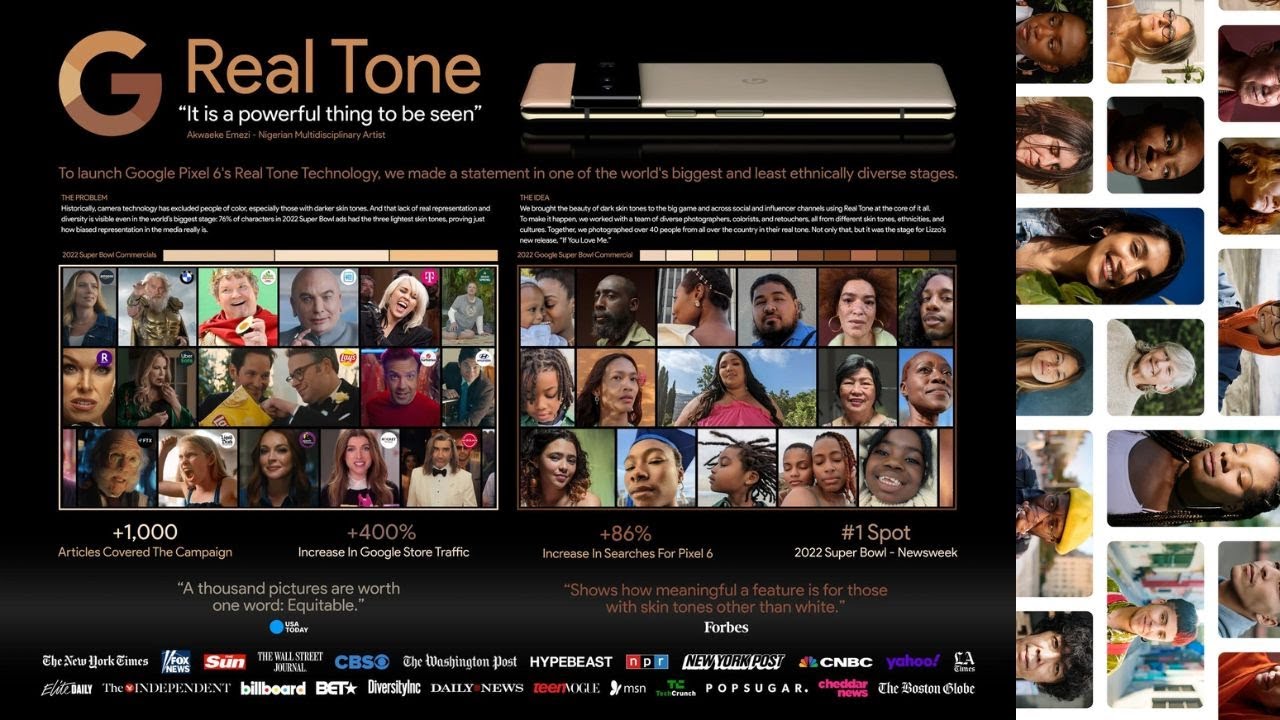
Google needed to launch the Pixel 6 in a crowded smartphone market dominated by Apple and Samsung. They sought to differentiate their camera technology by addressing a long - standing technical failure: the inability of sensors to accurately photograph darker skin tones. The goal was to build brand affinity with diverse audiences and establish the Pixel as the most inclusive smartphone on the market.
Creative Idea
Used the Super Bowl to expose photography's racial bias while showcasing accurate skin tone technology.
Google Pixel 6 introduced Real Tone technology to fix the historical bias of camera sensors that excluded people of color, launching on the Super Bowl stage to prove that everyone deserves to be seen as they truly are.
Correcting a Century of Photographic Bias
From Shirley Cards to Software
The campaign addressed a historical technical failure rooted in the 1950s "Shirley Cards" - skin tone calibration tools that featured only white models. To dismantle this legacy, Google engineers and the Google Devices & Services Creative Team partnered with image experts like Kira Kelly and Aundre Larrow. They tested the Pixel 6 across thousands of lighting conditions, significantly expanding the image datasets used to train the camera’s AI. This shifted the industry conversation from megapixels to image equity.
A Global Stage for Lizzo
The Super Bowl spot, titled "Seen on Pixel," was directed by Joshua Kissi and produced by Prettybird. It featured a world premiere of Lizzo’s track "If You Love Me," which aired months before her album *Special* was released. The production was intentionally inclusive, employing a diverse crew of colorists and retouchers to ensure the Real Tone philosophy was applied both behind and in front of the lens.
Massive Search and Sales Lift
The impact was immediate. Following the Super Bowl, searches for Google Pixel 6 spiked 86x, and the Google Store saw a 400% increase in traffic. The campaign achieved 12.5% higher brand memorability than the average Big Game ad. In the UK, the "Highlife" partnership with Channel 4 led to a 20% lift in unaided awareness and produced the first - ever smartphone - shot covers for GQ and Glamour magazines.
Representation by the Numbers
The creative was a direct response to a stark industry reality: a study cited by the team found that 76% of characters in 2022 Super Bowl ads represented the three lightest skin tones. Google countered this by featuring over 40 people of color in their spot, including icons like Ruby Bridges and Dolores Huerta.
Creative Strategy Deconstructed
Company
Advanced AI camera algorithms specifically engineered to capture the nuances and beauty of diverse skin tones with technical precision.
Category
Smartphone brands traditionally focused on megapixels and brightness, ignoring the inherent racial bias built into standard camera sensor calibration.
Customer
People of color who felt invisible or misrepresented by technology that either washed them out or failed to capture their true likeness.
Culture
A global movement demanding authentic representation and the dismantling of systemic biases within everyday technology and mainstream media.
Company
Advanced AI camera algorithms specifically engineered to capture the nuances and beauty of diverse skin tones with technical precision.
Category
Smartphone brands traditionally focused on megapixels and brightness, ignoring the inherent racial bias built into standard camera sensor calibration.
Strategy:
Transform technical product calibration into a moral imperative for equitable representation and visual visibility.
Customer
People of color who felt invisible or misrepresented by technology that either washed them out or failed to capture their true likeness.
Culture
A global movement demanding authentic representation and the dismantling of systemic biases within everyday technology and mainstream media.
Strategy:
Transform technical product calibration into a moral imperative for equitable representation and visual visibility.
Results
The campaign achieved significant impact: +1,000 publications worldwide covered the launch. There was an +86% increase in searches for Pixel 6. Google Store traffic saw a +400% increase. Newsweek named it the #1 Super Bowl Spot of 2022. The campaign was widely praised by major outlets like Forbes, USA Today, and The New York Times for its focus on equity and representation.
+400%
increase in Google Store traffic
+86%
increase in searches for Pixel 6
#1
Super Bowl Spot of 2022 by Newsweek
Strategy Technique
Attack a Cultural Blind Spot
By exposing the 'Shirley Card' bias and the lack of diversity in Super Bowl ads, Google turned a technical camera feature into a powerful statement on racial equity and representation.
Explore Technique
Creative Technique
Spotlight the Overlooked
The campaign highlights people of color who have historically been misrepresented by camera technology, using the Super Bowl's massive reach to showcase their true skin tones with unprecedented accuracy and beauty.
Explore Technique
Craft Breakdown
The campaign's excellence lies in its commitment to technical inclusivity, using cinematography and photography to solve a long-standing bias in camera technology.
The lighting and framing are specifically engineered to demonstrate the product's ability to capture dark skin tones with depth and accuracy.
The use of high-quality, diverse portraiture serves as the primary evidence of the campaign's success and emotional resonance.
The narrative effectively frames a technical feature as a necessary step toward social equity and representation.
The choice of Lizzo's 'If You Love Me' perfectly aligns with the theme of self-acceptance and being seen in one's entirety.
“The synergy between the technical product innovation (Real Tone) and the emotional storytelling (Lizzo's music and personal testimonials) creates a powerful narrative of progress.”