2024AsterHealthcareCase video
Aster: Impossible Journey
Aster, in partnership with Area 23, sought to address the critical racial disparities in US maternal health. The challenge was to move the stagnant Mamas First Act through Congress by engaging lawmakers and healthcare leaders. The goal was to shift the conversation from clinical statistics to urgent human reality, compelling decision-makers to prioritize equitable care for Black mothers.
Creative Idea
Hand-painted film frames were mailed to lawmakers to force attention on maternal inequality.
Aster used a hand-painted animated film to contrast the disparate maternal health journeys of Black and White mothers, turning physical art frames into tangible lobbying tools to compel Congress to pass the Mamas First Act.
Crafting Physical Art to Confront Maternal Inequality
An Illustrated Journey Through Systemic Risk
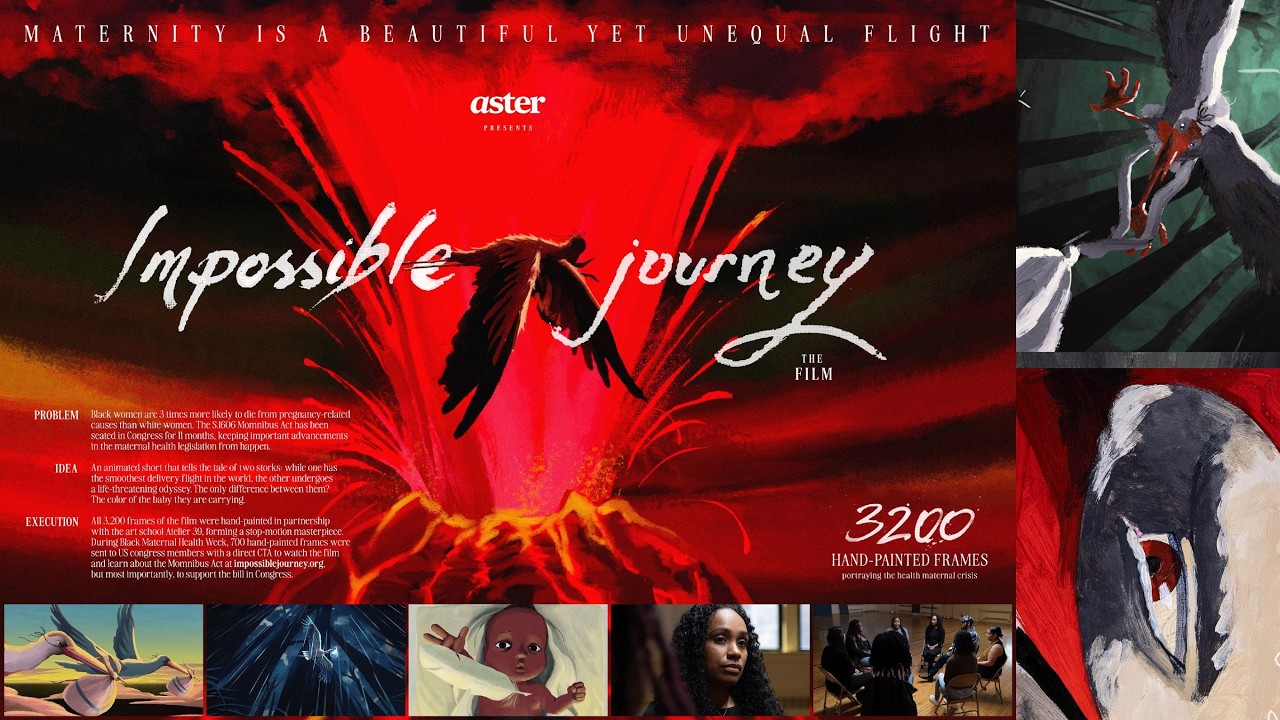
Created by Area 23 for Aster (San Francisco), *Impossible Journey* is an animated short film designed to spotlight Black maternal health disparities. In the U.S., Black women are three times more likely than White women to die from pregnancy-related causes, even though 85% of these pregnancy-related deaths are preventable. The film is dedicated to Amber Rose Isaac, a young Black woman who died from hospital negligence during a difficult birth.
The narrative contrasts the experiences of two storks: one faces a series of deadly hazards representing the systemic risks Black mothers encounter during childbirth, while the other experiences a seamless delivery reflecting the experience of White mothers. The film concludes with a live-action reading of an original poem by Bruce McIntyre, whose partner, Amber Rose Isaac, passed away in 2020.
Tactile Animation Built by Female Artists
Production took over a year across Brazil and New York City, led by production company The Youth (Curitiba) and directed by YUCA. To bring the film into the physical world, a team of nearly 40 artists - predominantly women and mostly Black mothers - spent approximately 1,500 hours hand-painting 3,200 individual physical frames using acrylics and chalk over printed digital vector sketches.
The visual visual design features an intentional color palette filled with blood-red lava, visceral thorns, and contrasting white feathers. Character designs were created primarily by Black mothers to ground the visual storytelling in authentic perspective.
Turning Animation Frames into Political Mailers
To push Congress to act on the Mamas First Act, which had stalled in the Senate without a vote, the campaign transformed the physical paintings into personalized direct mailers. During Black Maternal Health Week, 700 of the 3,200 hand-painted frames were mailed to members of Congress, state legislators, activists, and influencers. Each frame included a embedded QR code leading directly to the film and legislative background.
The remaining 2,500 physical frames were designated for direct outreach to the top 1,000 OB/GYNs in metropolitan areas and hospital administrators nationwide. In addition to legislative lobbying, Aster partnered with Ashé Birthing Services to expand community maternal health programs and boost funding for doulas.
Get Who To By deconstruction
The framework sharply reveals how transforming abstract maternal mortality statistics into visceral, human story art moves stagnant political decision-makers into immediate legislative action.
Results
The physical direct mail campaign achieved an opening rate exceeding 20%, successfully delivering individual artwork frames to roughly 100 lawmakers. *Impossible Journey* also collected major industry awards, including 2 Silver Cannes Lions in 2024, a Gold Cube at the 2025 ADC Awards, a Bronze Pencil at the 2025 One Show, and a Silver Award at Clio Health 2025.
>20%
Opening rate for lawmaker frame mailers
100
Lawmakers reached via hand-painted mailers
3,200
Individual physical frames painted with acrylics
2
Silver Cannes Lions won in 2024
Strategy Technique
Make the Invisible Visible
The campaign took the systemic, often ignored racial disparities in maternal healthcare and forced them into the physical space of legislators. It made a hidden, preventable crisis impossible to overlook by turning data into a visceral experience.
Explore Technique
Creative Technique
Use Art
The campaign utilized 3,200 hand-painted frames to make the abstract issue of maternal mortality tangible. By mailing these physical art pieces to lawmakers, the agency transformed static animation into a powerful, tactile lobbying instrument.
Explore Technique
Craft Breakdown
This campaign elevates social advocacy through extraordinary traditional animation craft, physically painting 3,200 individual frames with acrylics and chalk. Turning these physical paintings into direct mailers sent to lawmakers seamlessly bridges fine art and activism.
The meticulous process of digital vector sketching combined with 3,200 individually hand-painted physical acrylic frames gives the film an irreplaceable, visceral human texture.
Transforming actual hand-painted physical animation frames into personalized direct mailers sent to lawmakers and key influencers transforms cinema into direct lobbyist intervention.
Created primarily by Black mothers, the visual character designs and dark allegorical metaphors translate painful healthcare statistics into powerful visual imagery.
The intentional color palette of blood-red lava, visceral thorns, and contrasting white feathers creates an undeniable emotional weight across both digital and physical mediums.
“The emotional authority of the campaign stems from using the physical labor of hand-painting animation frames as both a metaphorical narrative tool and an actual physical direct-mail vehicle.”
Questions about Aster: Impossible Journey
Who created the Impossible Journey campaign?
The project was created for the San Francisco maternal health company Aster by advertising agency Area 23 (an IPG Health Company, New York), with production by Curitiba-based production house The Youth and direction by YUCA.
What is the story told in the Impossible Journey film?
The animated film follows a stork struggling to deliver a baby through severe hazards, representing the childbirth risks faced by Black mothers in the U.S. In contrast, another stork experiences an easy delivery, illustrating the journey of White mothers.
How was the Impossible Journey animation produced?
Over nearly 1,500 hours, a team of almost 40 artists - mostly Black mothers - hand-painted 3,200 individual frames using acrylics and chalk over printed digital vector sketches.
How were the physical animation frames used in lobbying?
During Black Maternal Health Week, 700 hand-painted frames were mailed directly to members of Congress, state legislators, and influencers with QR codes linking to the film and info on the Mamas First Act.
What awards did Impossible Journey win?
The campaign won two Silver Cannes Lions in 2024 (Film and Digital Craft), a Gold Cube at the 2025 ADC Awards, a Bronze Pencil at the 2025 One Show, and a Silver Award at Clio Health 2025.
Who is the poem at the end of the film dedicated to?
The film ends with a poem read by Bruce McIntyre and is dedicated to his partner, Amber Rose Isaac, who died in 2020 due to hospital negligence during childbirth.
Credits (19)
| Chief Creative Officer | Tim Hawkey |
|---|---|
| Executive Creative Director | Eduardo Tavares |
| Executive Creative Director | Tim Jones |
| Group Creative Director | Guy Bricio |
| Creative Director | Diego Tórgo |
| Creative Director | Sttenio Costa |
| Creative Director | Patrycja Lukjanow |
| Creative Director, Copy | Danielle Decatur |
| Copywriter | Albania Salas |
| Executive Producer | Andrew Pearson |
| Group Executive Integrated Producer | Saul Metnick |
| Integrated Producer | Nicole Hornbeck |
| Production Company | The Youth |
| Film Director | YUCA |
| Co-Founder, Aster | Fifi Kara |
| Co-Founder, Aster | Dr. Lailah Kara-Newton |
| Representative, Ashé Birthing Services | Emilie Rodriguez |
| Founder, saveArose Foundation | Bruce McIntyre |
| Co-Founder, Maryam | Dr. Carla Williams |
Sources (3)
- The One Show 2025 - Impossible Journey · oneclub.org
- Impossible Journey Film - Ads of the World · adsoftheworld.com
- Clio Awards - Impossible Journey · clios.com