2026WNBAMedia & EntertainmentCase video
WNBA: Line 'Em Up
The WNBA tasked JOAN Creative with addressing the structural play gap in public basketball courts. The goal was to extend the league's presence beyond broadcast media and into community infrastructure. The client needed to combat the implicit exclusion of female players by creating a permanent, physical monument to gender equity that would resonate with young athletes across the United States.
Creative Idea
Painting professional WNBA three-point lines onto public courts to physically integrate women's basketball.
The WNBA painted official professional three-point lines in Fire Orange on public basketball courts nationwide, transforming everyday blacktops into symbols of equity and ensuring young female players see their professional standard represented in the default architecture of play.
Painting the Standard for Future Generations
From Broadcast Brand to Built Brand
The campaign fundamentally shifted the WNBA from a broadcast-only entity to a physical, built brand. By utilizing professional-grade, high-durability paint in the league's signature Fire Orange, the team transformed weathered urban blacktops into permanent civic infrastructure. The precise dimensions of the arc were set to the official league standard of 22 feet, 1.75 inches, ensuring that young athletes could practice on the exact same geometry used by the pros.
Mobilizing Communities Through Advocacy
The project extended beyond the physical paint through a digital Advocacy Kit and a Park Locator tool hosted on `lineemup.wnba.com`. This allowed local hoopers to identify nearby courts with the new markings and provided a blueprint for communities to petition their local parks departments for similar upgrades. This grassroots momentum proved highly effective, directly prompting a city-wide public court audit in New York City to ensure equitable markings in future park redesigns.
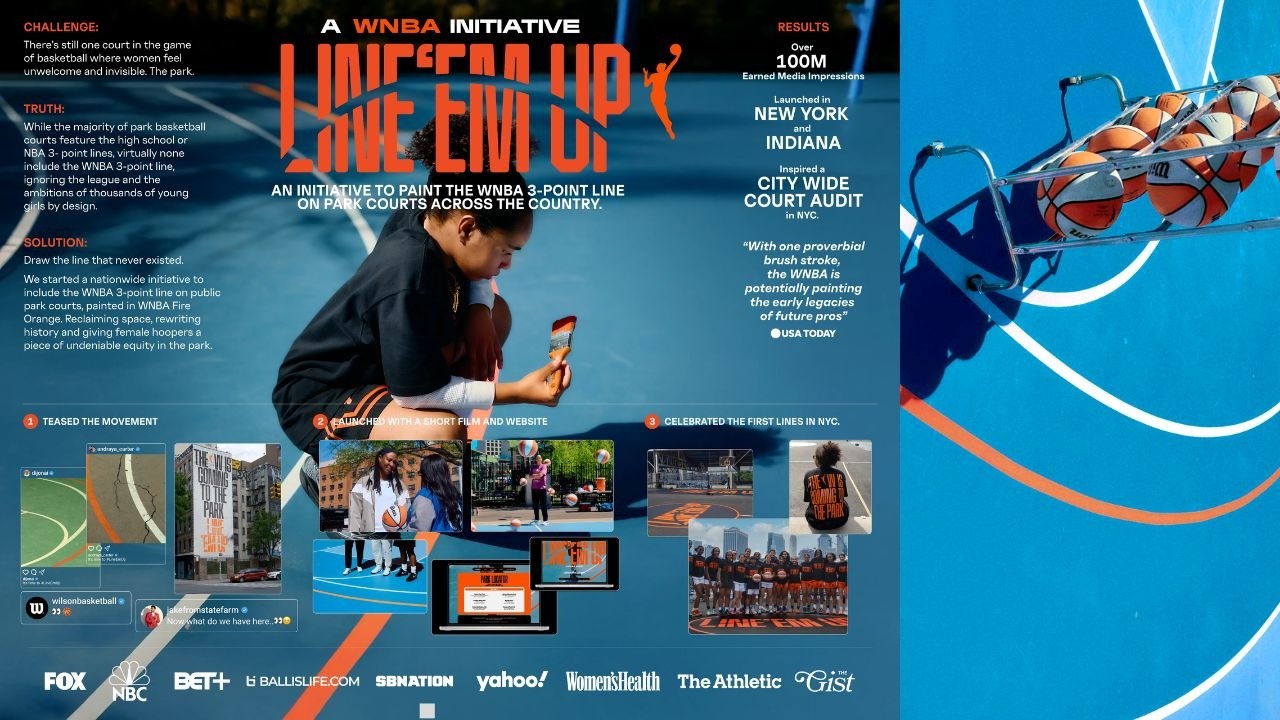
A Star-Studded Rollout
The hero film and social campaign featured a powerful lineup of basketball icons, including Sue Bird, Chamique Holdsclaw, Tina Charles, and Epiphanny Prince, alongside *Hoop York City* founder Alex Taylor. The rollout was carefully orchestrated through a mysterious social teaser phase where fragments of the Fire Orange line appeared across the feeds of players and influencers, building anticipation before the final reveal. The initiative ultimately generated over 100 million earned media impressions, earning widespread coverage from major outlets like NBC Sports, USA Today, and The Athletic. As noted by *USA Today*, the campaign effectively painted the early legacies of future professionals with a single brush stroke.
4C Framework deconstruction
Company
The WNBA leveraged its professional authority to define the official court dimensions and standards for women's basketball.
Category
Public basketball infrastructure typically prioritizes male-coded standards, leaving professional women's dimensions entirely absent from community blacktops.
Customer
Young female players felt excluded by the lack of professional representation in the spaces where they learn to play.
Culture
The rising demand for gender equity in sports turned a simple infrastructure upgrade into a powerful symbol of inclusion.
Company
The WNBA leveraged its professional authority to define the official court dimensions and standards for women's basketball.
Category
Public basketball infrastructure typically prioritizes male-coded standards, leaving professional women's dimensions entirely absent from community blacktops.
Strategy:
Normalize professional standards in public spaces to foster a sense of belonging for underrepresented athletes.
Customer
Young female players felt excluded by the lack of professional representation in the spaces where they learn to play.
Culture
The rising demand for gender equity in sports turned a simple infrastructure upgrade into a powerful symbol of inclusion.
Strategy:
Normalize professional standards in public spaces to foster a sense of belonging for underrepresented athletes.
Results
The initiative gained widespread media coverage featured on Fox 5 News, Women's Health, and USA Today. It received organic engagement and support on social media from major brand partners like Wilson Basketball and Jake from State Farm. Currently, all 15 WNBA teams are working to implement the 'Line 'Em Up' court painting initiative across their respective cities nationwide.
15
WNBA teams implementing initiative nationwide
Strategy Technique
Make the Invisible Visible
The strategy identifies a structural bias in public infrastructure that implicitly excludes women. By physically marking the court, the WNBA forces a conversation about equity and belonging in grassroots sports spaces.
Explore Technique
Creative Technique
Make the Invisible Visible
The campaign highlights the absence of WNBA markings on public courts, a detail previously overlooked by the public. By physically painting these lines, the brand makes a structural inequality impossible to ignore.
Explore Technique
Craft Breakdown
The campaign excels through Experiential Design and Media Planning by transforming a simple physical court line into a powerful national equity movement.
By physically painting the official WNBA three-point line on public park courts, the campaign turned a physical absence into permanent civic infrastructure and representation.
The strategic rollout—from cryptic social teasers to wildpostings, a launch film, and team-level activations across 15 markets—amplified the initiative's reach efficiently.