Reprieve Foundation: Not a Bug Splat!
Reprieve Foundation sought to raise global awareness about the devastating human cost of drone strikes in Pakistan, particularly the high civilian and child casualties. They aimed to challenge the dehumanizing 'bug splat' perception among drone operators and the wider public, making the issue undeniable and globally recognized.
Creative Idea
A giant child's face was installed in Pakistan, visible from above, to humanize drone strike victims.
To combat the dehumanization of drone strike victims, Reprieve Foundation installed a massive poster of a child's face in Pakistan, visible from the sky, forcing drone operators to confront the human impact directly and transforming 'bug splats' into undeniable human faces.
The Nine Hundred Dollar Face That Reached the President
Targeting the Nevada screens
The campaign title directly confronts military slang where drone operators referred to human targets as bug splats due to their pixelated appearance on surveillance monitors. By installing a 90x60 foot vinyl portrait in the heavily bombed Khyber Pakhtunkhwa region, the team effectively hacked the optics of remote warfare. The goal was to force pilots sitting in bases as far away as Nevada to see the humanity of their targets through their own high - tech cameras.
Risking lives for a photograph
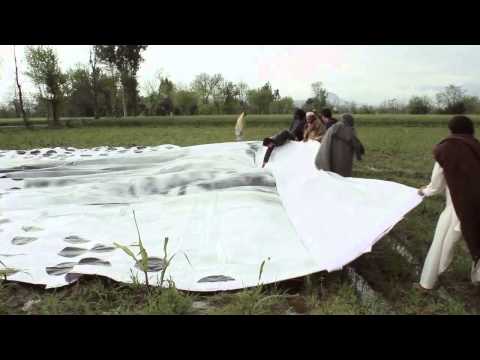 Production was an exercise in extreme bravery. BBDO Pakistan leaders Ali Rez and Assam Khalid were warned by NGOs that a large gathering in an active bombing zone could be misidentified as a military target, potentially triggering a strike on the installation team itself. Furthermore, the team faced threats from local militants suspicious of outsiders. The subject of the massive portrait was a nameless young girl who had lost her parents and brother in a 2009 strike, documented by local photojournalist Noor Behram.
Efficiency and a practical afterlife
With a negligible production budget of just $900, the project generated an estimated $185 million in earned media value. It reached over 3.5 billion people, appearing on the front cover of the Washington Post and reportedly reaching the desk of the President of the United States. Beyond its digital reach, the physical installation served a humble purpose - after the aerial photos were captured, local villagers repurposed the massive waterproof vinyl to repair and weather - proof the roofs of their homes. The campaign eventually transcended advertising to be displayed as fine art at the Tate UK.
Creative Strategy Deconstructed
Company
Reprieve Foundation leveraged its advocacy expertise and network to execute a large-scale, impactful art installation in a remote, sensitive region.
Category
Activism often struggled to gain global attention for remote conflicts, with traditional protests and media campaigns frequently going unnoticed.
Customer
Drone operators dehumanized casualties as 'bug splats,' needing a direct, undeniable visual confrontation to challenge their detached perception.
Culture
The global rise of drone warfare and the increasing detachment from its human cost created a critical need for a powerful, viral counter-narrative.
Company
Reprieve Foundation leveraged its advocacy expertise and network to execute a large-scale, impactful art installation in a remote, sensitive region.
Category
Activism often struggled to gain global attention for remote conflicts, with traditional protests and media campaigns frequently going unnoticed.
Strategy:
Humanize the unseen consequences of remote warfare to challenge dehumanizing perspectives and provoke global awareness.
Customer
Drone operators dehumanized casualties as 'bug splats,' needing a direct, undeniable visual confrontation to challenge their detached perception.
Culture
The global rise of drone warfare and the increasing detachment from its human cost created a critical need for a powerful, viral counter-narrative.
Strategy:
Humanize the unseen consequences of remote warfare to challenge dehumanizing perspectives and provoke global awareness.
Results
The campaign put the issue on the world map. It garnered over $2 million+ in free media earned. It achieved 115 million+ impressions. The Guardian reported, "It has the power to startle... and perhaps even render him incapable of using his weapon." The campaign was brought up by members of the National Assembly of Pakistan. It was picked up by activists in Yemen and the US. The Huffington Post reported, "Negative attention on drone strikes appears to be taking a toll on the people who control these aircraft... with new government report finding that pilots are suffering from low morale." The campaign successfully reached its target audience (drone pilots).
$2M+
free media earned
115M+
impressions
Low morale
among drone pilots (via new gov. report)
Strategy Technique
Make the Invisible Visible
The campaign made the human impact of drone strikes visible to operators who routinely dehumanized victims as 'bug splats.' It forced them to see a child's face, not an anonymous dot.
Explore Technique
Creative Technique
Install it
The campaign physically installed a giant image of a child's face in a rural Pakistani province. This direct, large-scale installation ensured visibility from above, directly confronting drone operators with the human cost.
Explore Technique
Craft Breakdown
This campaign's craft is exceptional in its strategic blending of large-scale art installation, impactful photography, and innovative media placement to create a visceral human connection that transcends the usual abstractness of conflict.
The core of the campaign is the physical installation of a massive, strategically placed image, designed to be 'experienced' by drone operators and satellite imagery, directly confronting their perspective.
The choice and execution of the child's portrait are critical, capturing an innocence and direct gaze that is central to the campaign's emotional appeal and message.
The innovative strategy of targeting drone operators and global audiences through satellite imagery and a viral social media hashtag demonstrates exceptional foresight in media placement.
The aesthetic decision to render the image in a high-contrast, halftone dot style ensures maximum visibility and graphic impact from an aerial perspective, reinforcing the campaign's visual identity.
“The campaign's magic truly comes from the powerful synergy between its experiential design, the evocative photography, and a brilliant media strategy that leveraged both physical space and digital platforms to reach an otherwise inaccessible audience.”