Platform Attention Inequality

Counting views won't save your brand.

You’re still buying reach like it’s 2005, aren’t you? Bless your heart. You think an 'impression' is a universal unit of value because some sales rep with a Patagonia vest and a spreadsheet told you so. Newsflash: half your budget is being set on fire by platforms where the 'attention' spans are shorter than a goldfish on espresso. If you think a pixel-thin banner on a mobile site carries the same weight as a 30-second cinema spot, you’re not doing marketing; you’re donating to tech giants. It's time to stop counting eyes and start measuring the quality of the gaze.
Platform Attention Inequality is the empirical reality that media channels are not created equal in their ability to capture and hold human attention. While traditional media planning treats 'reach' as a commodity, research proves that different platforms possess varying 'Attention Floors' and 'Attention Ceilings.' For example, a platform like Cinema or high-quality TV might command 10+ seconds of active attention, whereas a social media feed might struggle to break 1.5 seconds. This inequality directly impacts memory encoding and brand linkage. High-reach, low-attention platforms often fail to build the long-term mental structures required for brand growth, leading to a 'Reach Paradox' where brands appear to be everywhere but are remembered by no one. Marketers must pivot from Cost Per Thousand (CPM) to Cost Per Second (CPS) of attention to avoid wasting budget on invisible impressions.

PLATFORM ATTENTION INEQUALITY

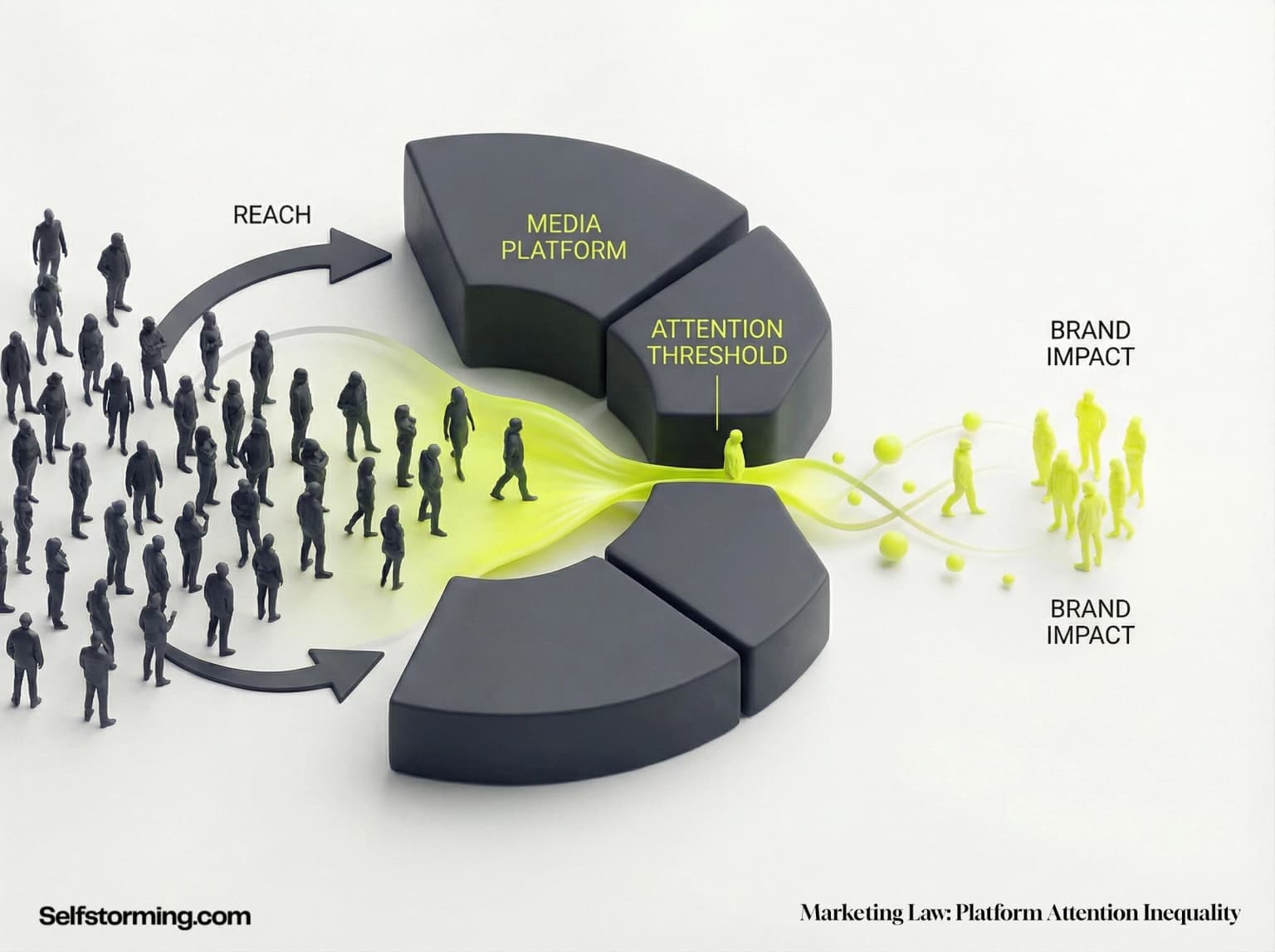
The inherent technical and environmental characteristics of a media platform dictate the maximum threshold of human attention available for advertising, creating a non-linear relationship between reach and brand impact.

Platform Attention Inequality marketing law: Counting views won't save your brand. - Visual illustration showing key concepts and examples

Key Takeaways

  • Not all reach is equal; platform environment dictates the value of the impression.
  • Attention is the primary gatekeeper for memory encoding and brand linkage.
  • Viewability is a technical lie; only 'Eyes-on-Ad' (Active Attention) drives sales.
  • Optimize for Cost Per Second (CPS) to find hidden efficiency in expensive media.
  • Platform 'Attention Ceilings' limit the effectiveness of even the best creative work.

Genesis & Scientific Origin

The formalization of Platform Attention Inequality is primarily attributed to Professor Karen Nelson-Field, founder of Amplified Intelligence and a former Senior Research Media Specialist at the Ehrenberg-Bass Institute. While the industry had long suspected that 'not all reach is equal,' it wasn't until Nelson-Field's 'The Benchmark Series' (2017-2020) and her subsequent book, 'The Attention Economy and How Media Works' (2020), that the phenomenon was quantified using eye-tracking technology and machine learning. Her work was supported by key industry bodies including The Attention Council and various global media agencies. Nelson-Field moved the conversation beyond 'viewability'—a technical metric describing if an ad could be seen—to 'attention,' which measures if an ad was seen and for how long. This shift exposed a massive discrepancy in the value of impressions across different digital and traditional environments.

Ads require at least 2.5 seconds of active attention to trigger long-term memory encoding.

The Mechanism: How & Why It Works

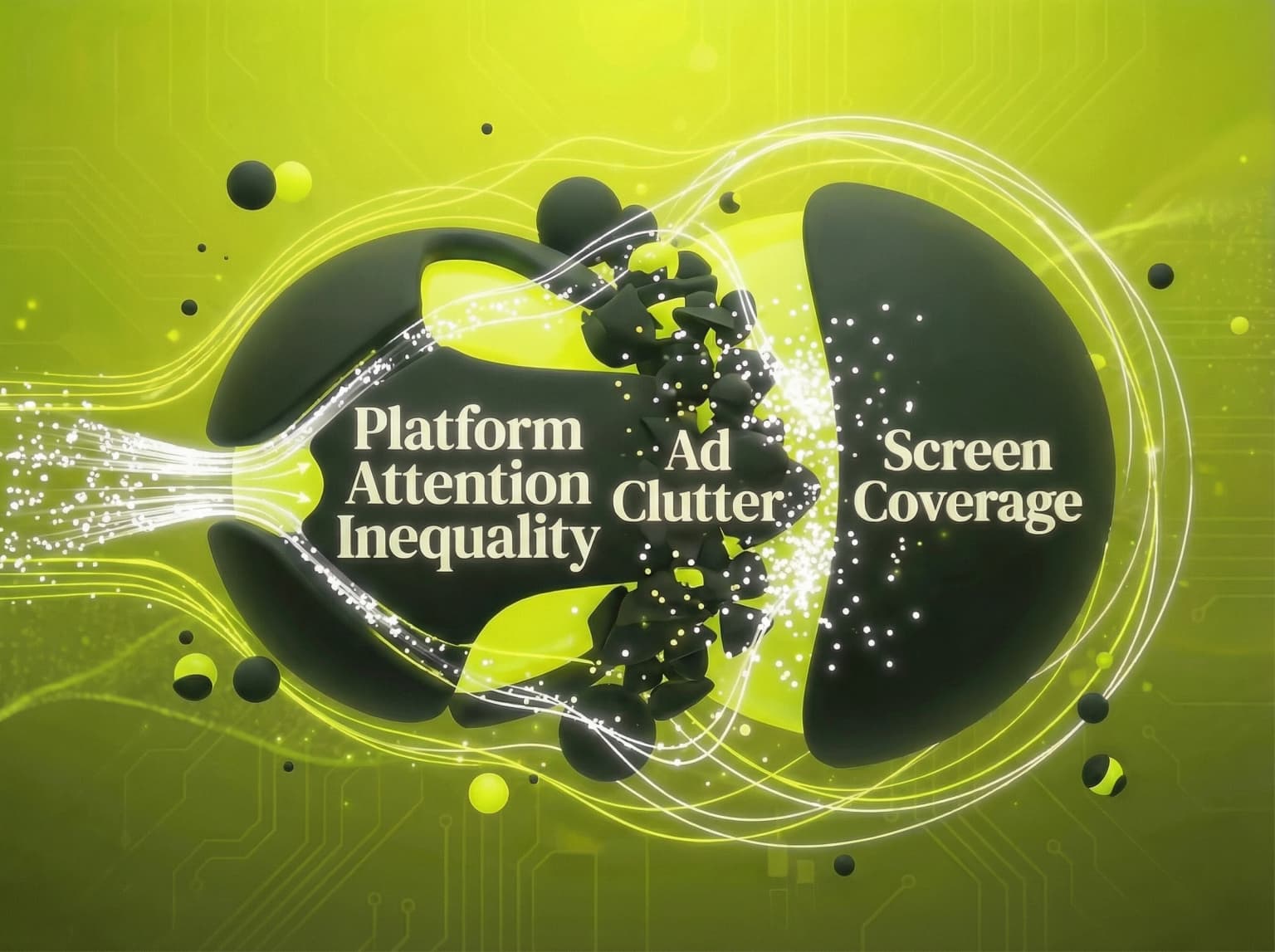
The mechanism of Platform Attention Inequality is driven by three primary factors: Platform Functionality, Ad Clutter, and Screen Coverage.

1. Platform Functionality (The 'Vibe'): Users enter platforms with different psychological 'missions.' On a social media platform, the mission is high-speed discovery and scrolling. This creates a 'low-attention' environment where the thumb is faster than the brain. Conversely, on streaming platforms or in cinemas, the user is in a 'lean-back' mode, prepared for long-form consumption. This environmental context sets the 'Attention Ceiling'—the maximum amount of time a human is likely to spend on an ad before their brain forces a skip or a distraction.

2. Screen Coverage and Pixels: Nelson-Field’s research highlights that the percentage of the screen occupied by the ad is a massive predictor of attention. A mobile feed ad that takes up 30% of the screen cannot compete with a TV ad that takes up 100%. The more 'real estate' an ad occupies, the higher its 'Attention Floor.'

3. The Decay Curve of Memory: Attention is the gatekeeper to memory. There is a critical threshold—often cited around 2.5 to 3 seconds—where memory encoding begins to stabilize. Below this threshold, an ad might be 'viewed' in a technical sense but fails to create a 'Distinctive Asset' link in the consumer's mind. Platform inequality means some platforms naturally keep users above this threshold, while others (like fast-scrolling feeds) keep users below it.

4. Attention Elasticity: This refers to the platform's ability to 'stretch' attention regardless of the creative quality. Some platforms are 'inelastic'—even the best ad in the world can't get more than 2 seconds of attention because the user is conditioned to scroll. Other platforms are 'elastic,' where great creative can significantly extend the viewing time. Understanding which platforms allow your creative to actually work is the core of this law.

Platform Attention Inequality mechanism diagram - How Platform Attention Inequality works in consumer behavior and marketing strategy

Empirical Research & Evidence

In a landmark study published in the 'Journal of Advertising Research (Nelson-Field, Riebe, & Sharp, 2013)' and expanded in 'The Benchmark Series (Nelson-Field, 2020)', researchers utilized AI-powered eye-tracking to monitor thousands of participants across multiple platforms (Facebook, YouTube, TV, and Instagram). The data revealed a staggering disparity: while Facebook reached a massive audience, the average 'Active Attention' (eyes-on-ad) was significantly lower than YouTube or TV. Specifically, the research showed that for every 1,000 impressions, TV generated roughly 4,000 seconds of active attention, whereas social media feeds generated as little as 1,200 to 1,500 seconds for the same reach.

Furthermore, the study quantified the 'STAS' (Short-Term Advertising Strength) and found that platforms with higher attention levels produced a significantly higher sales uplift. A crucial finding was that 'viewability' (the industry standard) had a near-zero correlation with sales, while 'Active Attention' seconds had a strong positive correlation (r = 0.75). This proved that the industry was optimizing for a metric (viewability) that did not actually drive business outcomes, ignoring the fundamental inequality of the platforms themselves.

Real-World Example:
Global FMCG Giant (Confidentialized in Nelson-Field's reports)

Situation

The brand was shifting 70% of its budget into 'High-Reach' mobile social video, lured by low CPMs and 90% viewability scores reported by the platforms.

Result

Despite hitting reach targets, brand tracking showed a decline in 'Mental Availability' and 'Top-of-Mind Awareness.' An attention audit revealed that 85% of their 'viewable' impressions received less than 1.5 seconds of attention—well below the 2.5-second threshold for memory encoding. By reallocating 30% of the budget back to high-attention 'lean-back' video (CTV and Cinema), they saw a 14% increase in brand linkage and a 6% increase in sales volume within 6 months, despite a higher overall CPM. The 'expensive' attention was actually more efficient than the 'cheap' reach.

Strategic Implementation Guide

1

Step 1

Audit your current media mix using 'Cost Per Second of Attention' (CPS) rather than CPM. If you're paying $5 CPM for 1 second of attention and $15 CPM for 5 seconds, the 'expensive' ad is actually 66% cheaper.

2

Step 2

Prioritize 'Attention-Elastic' platforms for brand-building campaigns. Use Cinema, CTV, and high-impact OOH when you need to build new memory structures.

3

Step 3

Tailor creative length to the platform's 'Attention Ceiling.' Don't put a 30-second 'story' on a platform where the average attention is 1.7 seconds. Front-load your brand assets in the first 0.5 seconds.

4

Step 4

Ignore 'Viewability' as a success metric. It’s a technical hygiene factor, not a human one. Demand 'Eyes-on-Ad' data from your agencies.

5

Step 5

Match the 'Mission' to the 'Message.' Use low-attention platforms for reinforcement of existing memories (reminders) and high-attention platforms for complex messages or new product launches.

6

Step 6

Maximize Screen Coverage. In digital buying, prioritize formats that take up the largest percentage of the viewport to raise your 'Attention Floor.'

7

Step 7

Stop chasing 'Frequency' on low-attention platforms to compensate for poor quality. Ten invisible impressions do not equal one visible one; they just annoy the consumer ten times.

Frequently Asked Questions

Does better creative fix low platform attention?

Only to a point. This is the 'Elasticity' trap. On platforms with a low 'Attention Ceiling' (like a fast-scrolling newsfeed), even a masterpiece will struggle to break the 2-3 second barrier because the user's physical behavior—scrolling—is faster than their cognitive processing. You can't out-creative a thumb that's already moved on.

Is social media a waste of money for brand building?

Not a waste, but it's misapplied. Social is excellent for 'Mental Availability' maintenance—reminding people of a brand they already know. It is often too 'attention-poor' to build a brand from scratch or explain a complex value proposition. Use it as the 'Short' in your 'Long and Short of It' strategy.

If I buy high-attention platforms, will my reach suffer?

Your *reported* reach might drop, but your *effective* reach (people who actually saw the ad) will likely increase. 1 million 'impressions' where 90% of people didn't look at the screen is effectively a reach of 100,000. Stop lying to yourself with vanity reach numbers.

What is the 'Attention Floor'?

The Attention Floor is the minimum amount of attention a platform's technical constraints force upon a user. For example, in a non-skippable YouTube ad or a Cinema ad, the floor is high. On a mobile web banner, the floor is zero because the user can scroll past it without ever looking.

How do I measure attention if I don't have an eye-tracking lab?

You don't need your own lab; you need to use platforms that have been independently validated by attention-measurement firms like Amplified Intelligence, Lumen, or Adelaide. Look for 'Attention Adjusted CPM' in your planning tools.

We use cookies on our site to enhance your user experience, provide personalized content, and analyze our traffic. Cookie Policy