Pixels vs Seconds Trade-off
Size buys the time you're losing.
You’re still buying cheap, postage-stamp-sized impressions and wondering why your brand awareness is flatlining like a dead patient. Newsflash: nobody’s ignoring your ad because they hate you; they’re ignoring it because it’s effectively invisible. The Pixels vs Seconds Trade-off is the cold, hard math of how human eyeballs actually work. If you want to stop wasting money, you either pay for the real estate or you pray for a miracle. We’re going with the real estate. Welcome to the physics of not being ignored.
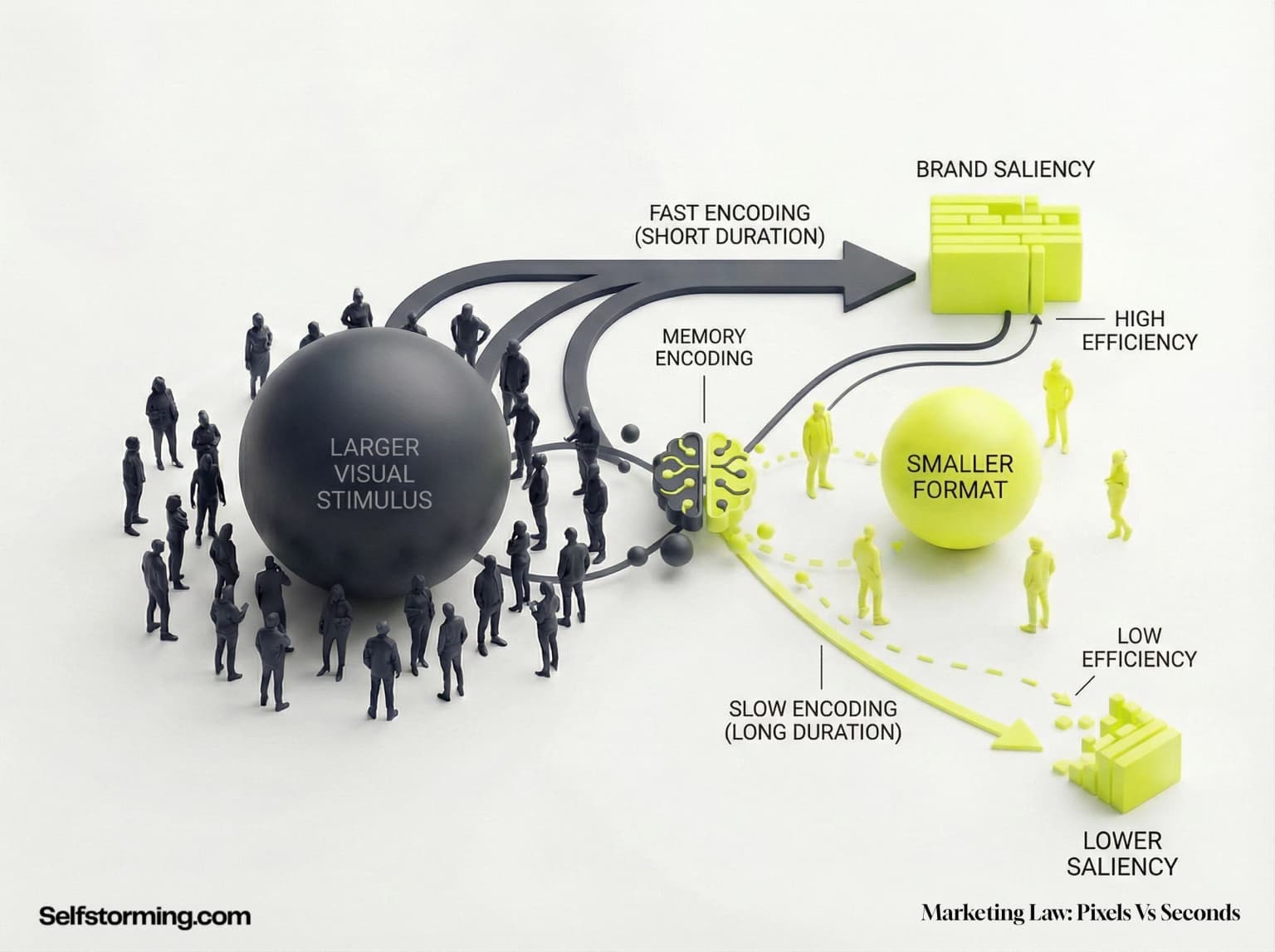
The Pixels vs Seconds Trade-off is a fundamental law of attention science which posits that the physical size of an advertisement (pixels) is inversely proportional to the time required to encode a brand memory (seconds). Research from organizations like Lumen Research demonstrates that larger ad formats achieve visual fixations faster and require significantly less dwell time to register in a consumer's long-term memory than smaller, standard formats. In a digital landscape where most ads are ignored, 'viewability' is a vanity metric; 'attention' is the only currency that correlates with sales. By increasing the pixel footprint, marketers can bypass the 'attention deficit' and trigger memory structures even during fleeting exposures. This law challenges the industry's obsession with low-cost, small-format CPMs, suggesting that fewer, larger impressions often yield a higher return on mental availability.
PIXELS VS SECONDS TRADE-OFF
“Memory encoding efficiency increases proportionally with the physical dimensions of a visual stimulus, allowing larger advertisements to achieve brand saliency in significantly shorter durations than smaller formats.”
Key Takeaways
- •Ad size is a physical shortcut to consumer memory encoding.
- •Larger ads require significantly less dwell time to build mental availability.
- •Standard 'viewability' metrics fail to account for actual human visual attention.
- •High-impact formats often have a lower cost-per-attentive-second than standard banners.
- •Optimize for the 'first second' by placing distinctive assets in large formats.
Genesis & Scientific Origin
The 'Pixels vs Seconds Trade-off' was popularized and empirically validated by Lumen Research, led by Mike Follett, particularly through their extensive eye-tracking studies conducted between 2017 and 2021. While the general concept that 'bigger is better' has existed in print advertising for decades (often referred to as the 'Square Root Rule' of ad size), Lumen applied high-fidelity eye-tracking technology to digital environments to quantify the exact relationship between screen real estate and cognitive processing. Their research, often presented in collaboration with the IPA and various global media agencies, shifted the conversation from technical 'viewability' (whether an ad could be seen) to 'attentional efficacy' (whether it was seen and for how long).
“A Billboard ad is 6x more likely to be fixated upon than a standard MPU. (Lumen Research, 2020)”
The Mechanism: How & Why It Works
The mechanism behind the Pixels vs Seconds Trade-off is rooted in the neurobiology of visual perception and the limitations of the human fovea. The human eye has a very narrow field of high-resolution vision (foveal vision), while the rest of the visual field is processed in lower resolution (peripheral vision).
Larger ads occupy a greater percentage of the visual field, increasing the statistical probability that they will fall within the foveal or near-peripheral range during a natural gaze sweep. From a psychological standpoint, larger stimuli possess higher 'visual salience'—a bottom-up attentional mechanism that forces the brain to prioritize the stimulus regardless of the viewer's current goals.
Mathematically, the trade-off functions as a sliding scale of efficiency. A standard 300x250 MPU (Mid-Page Unit) might require 2.5 seconds of dwell time to achieve a 50% brand recall rate because the brain has to work harder to isolate and process the smaller information set. Conversely, a large-format 'Skin' or 'Billboard' (970x250) might achieve that same 50% recall in just 0.7 seconds. This is because the larger format provides more 'entry points' for the eye and allows for larger, more distinct brand assets (logos, colors, typography) that trigger existing memory structures via the 'Distinctive Assets Law' much faster.
Furthermore, the trade-off addresses the 'decay rate' of attention. In digital environments, users are in a state of high-speed navigation. Smaller ads are often filtered out as 'noise' by the brain’s selective attention filters (Banner Blindness). Larger ads break this filter by creating a physical barrier to the content, essentially 'buying' the time that the creative would otherwise have to 'earn' through engagement.
Empirical Research & Evidence
Lumen Research's (2020) research published in the Lumen Attention Report provided a definitive dataset for this trade-off. The study utilized a proprietary eye-tracking panel to monitor thousands of sessions across various digital platforms. The data revealed that a 'Billboard' ad (970x250 pixels) is approximately six times more likely to be noticed than a standard 'MPU' (300x250 pixels).
Specifically, the research found that while only 15% of viewable MPUs actually received a visual fixation, over 85% of large-format Billboards were fixated upon. More importantly, the 'Time to First Fixation'—the speed at which the eye moves to the ad—was 40% faster for the larger formats. The study concluded that for every 10% increase in screen real estate, there was a non-linear increase in the probability of memory encoding, particularly when the ad occupied more than 20% of the viewport. This empirical data directly contradicts the 'CPM-only' approach, as the cost-per-attentional-second (a metric Lumen calls aCPMO) is often lower for the 'expensive' large formats than for the 'cheap' small formats.
Real-World Example:
Global Consumer Electronics Brand (Anonymized)
Situation
The brand was spending 70% of its programmatic budget on standard 300x250 and 728x90 banners, optimizing for a low CPM of $1.50. Despite high 'viewability' scores (75%), brand lift studies showed zero movement in top-of-mind awareness over six months.
Result
Following the Pixels vs Seconds principle, they shifted 50% of the budget into high-impact 'Skins' and 'Interscroller' formats with a $12.00 CPM. While total impressions dropped by 80%, the 'Attentive Seconds' per thousand impressions increased by 400%. A subsequent brand lift study showed a 12% increase in spontaneous brand recall and a 5% increase in purchase intent, proving that the larger 'pixels' required fewer 'seconds' of total campaign duration to move the needle.
Strategic Implementation Guide
Step 1
Stop buying 'Viewability' and start buying 'Attention'. Use eye-tracking benchmarks (like Lumen or TVision) to evaluate your media plan based on Attentive Seconds, not just whether the pixels loaded.
Step 2
Prioritize 'High-Impact' formats. In your next programmatic buy, cap your investment in standard MPUs and divert the budget to Billboards, Half-pages, and Skins. Yes, the CPM is higher; get over it.
Step 3
Optimize creative for the 'Sub-Second' reality. Since larger ads build memory faster, ensure your brand's distinctive assets (logo, brand colors) are the most prominent elements. Don't hide the logo at the end of an animation.
Step 4
Audit your mobile 'Thumb-Stop' rate. On mobile, 'pixels' are limited by screen size. Use formats that occupy at least 50% of the vertical scroll to force the trade-off in your favor.
Step 5
Calculate your aCPMO (Attentive CPM). Divide your total cost by the number of seconds people actually spent looking at the ad. If your 'cheap' ads have an aCPMO of $50 and your 'expensive' ads are at $10, you’re currently burning money.
Step 6
Test the 'Small-Format Penalty'. Run an A/B test comparing a high-frequency small-ad campaign against a low-frequency large-ad campaign. Measure memory recall, not clicks.
Frequently Asked Questions
Does this mean small ads are completely useless?
Not completely, but they are 'high-maintenance.' Small ads require massive frequency and incredibly high creative resonance to work. They are better suited for 'nudge' marketing or retargeting where the memory structure already exists. For brand building, they are like trying to fill a swimming pool with a teaspoon.
Is the trade-off the same on mobile vs. desktop?
The principle holds, but the scale changes. On mobile, even a 'small' ad takes up a larger percentage of the available screen, but the 'seconds' are more volatile because of fast scrolling. On mobile, the 'Pixels' part of the trade-off is more about vertical height than total area.
Doesn't a larger ad just annoy the user more?
This is the 'Alienation Paranoia' talking. While intrusive ads can be annoying, 'large' does not have to mean 'intrusive.' A well-designed Billboard that sits within the content is far more effective and less annoying than a tiny, flashing MPU that follows you down the page.
How does creative quality factor into the Pixels vs Seconds equation?
Creative is the multiplier. A large ad with terrible creative is a giant waste of space. However, the Pixels vs Seconds law states that *ceteris paribus* (all else being equal), the larger ad will always win on memory encoding speed. Good creative on a large format is the 'God Mode' of advertising.
Can I just use high frequency with small ads to get the same result?
Rarely. Because small ads are often never fixated upon (0 seconds of attention), 10x frequency of 0 is still 0. You need a baseline of attention for frequency to have a compounding effect. Larger ads guarantee that baseline.
Related Marketing Laws
People Pay Less Attention Than You Think
Most advertising is processed passively, if at all.
Attention Is Emotional First
Emotion drives attention faster than logic.
Active vs Passive Attention
Not all attention is equal; active attention builds memory.
Attention Threshold
There's a minimum attention level required for advertising to have an effect.