People Pay Less Attention Than You Think
People care less than you think.
Congratulations, you’ve spent six months and half your yearly budget on a 'brand purpose' manifesto that 99.9% of your target audience will ignore while they’re looking for the 'Skip Ad' button or wiping toddler vomit off their jeans. You think they’re leaning in, weighing your USP against the competition, and admiring your color palette. They aren’t. In reality, your brand is a flickering ghost in the background of their lives. If you want to survive, you need to stop designing for 'engagement' and start designing for the distracted, the disinterested, and the marginally conscious. It’s not an insult; it’s the biological reality of how humans actually process your noise.
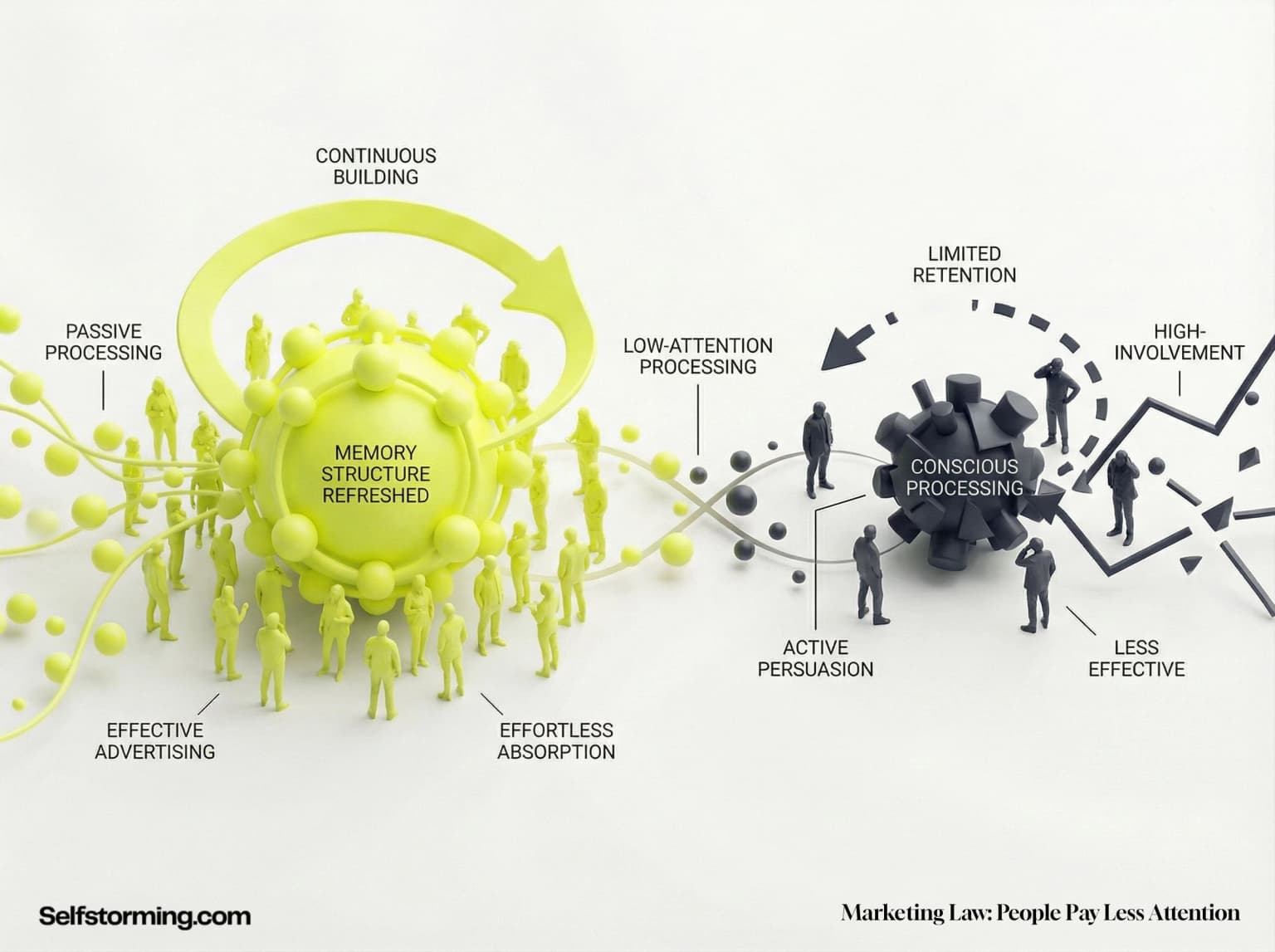
The 'People Pay Less Attention Than You Think' law challenges the traditional advertising myth that consumers must actively 'pay attention' to be influenced. Rooted in the research of Robert Heath and the Ehrenberg-Bass Institute, this principle posits that the vast majority of advertising is processed via 'Low Attention Processing' (LAP). Unlike active learning, which requires conscious effort and is prone to skepticism and counter-arguing, LAP occurs at a subconscious level, building and refreshing memory structures without the consumer even realizing it. For marketers, this means that 'high-engagement' metrics are often red herrings. Success isn't found in winning a debate with the consumer's rational mind, but in ensuring your brand's distinctive assets are easily recognized during the split-second windows of passive exposure that characterize 90% of media consumption.
PEOPLE PAY LESS ATTENTION THAN YOU THINK
“Advertising effectiveness is primarily driven by low-attention, passive processing that builds and refreshes memory structures rather than by active, conscious persuasion or high-involvement cognitive processing.”

Key Takeaways
- •Most advertising is processed subconsciously through System 1, not logically through System 2.
- •Active attention often triggers skepticism; passive processing bypasses the brain's critical filters.
- •Distinctive brand assets (colors, sounds) are the primary drivers of low-attention effectiveness.
- •Creative should be designed for the distracted, front-loading the brand in every execution.
- •Frequency of passive exposure builds mental availability more effectively than one-off 'engaging' stunts.
Genesis & Scientific Origin
The foundational scholarship for this law emerged from the intersection of cognitive psychology and marketing science in the late 20th and early 21st centuries. While the industry was obsessed with 'recall' and 'persuasion' scores, Dr. Robert Heath challenged the status quo with his seminal work on the 'Low Attention Processing Model' (LAPM). In his 2001 monograph, 'The Hidden Power of Advertising,' and subsequent research published in the Journal of Advertising Research, Heath argued that ads processed with low attention are actually more durable in memory because they bypass the conscious mind's critical filters. This line of inquiry was further validated and expanded by the Ehrenberg-Bass Institute for Marketing Science, led by Professor Byron Sharp and Professor Jenni Romaniuk. Their research into 'Mental Availability' confirmed that advertising's primary job is not to change minds through logical arguments, but to build and refresh memory links (Brand Memory Structures) that make a brand easier to notice and buy. More recently, Orlando Wood and the team at System1 have provided neuroscientific evidence showing how 'broad-beam' attention—the kind of passive, right-brain processing used for stories and music—is far more effective at building long-term brand equity than the 'narrow-beam' focus required by hyper-rational, high-attention ads.
“85% of digital ads receive less than two seconds of active visual attention.”
The Mechanism: How & Why It Works
The mechanism behind this law is rooted in the dual-process theory of the human brain, popularized by Daniel Kahneman as System 1 (fast, intuitive, subconscious) and System 2 (slow, rational, conscious). Most marketers mistakenly believe they are talking to System 2. They aren't. System 2 is lazy and expensive to run; the brain avoids using it whenever possible. Consequently, most advertising is filtered through System 1.
When a consumer encounters an ad with low attention, they aren't 'learning' in the traditional sense. Instead, they are experiencing 'perceptual priming.' The brain registers the brand's colors, logos, and sounds without the 'gatekeeper' of the conscious mind questioning the claims. This is why high-attention advertising can sometimes be less effective; when people focus intensely on an ad, they start looking for reasons to disagree with it. They notice the fine print, they question the price, and they build resistance.
In contrast, passive processing allows brand associations to seep into the subconscious. This creates 'Fluency'—the ease with which a brand comes to mind. When a consumer is later standing in a supermarket aisle, they don't recall the specific claims of a 30-second TV spot. Instead, they feel a sense of 'familiarity' with a specific red can or a certain jingle. That familiarity is the result of repeated, low-attention exposures that have built a memory structure over time. The mathematical foundation of this is the 'Decay Rate' of memory versus the 'Reinforcement Rate' of passive exposure. If an ad is too complex, it requires high attention, which happens rarely. If an ad is simple and heavy on distinctive assets, it works every time it’s glimpsed for even half a second, ensuring the reinforcement rate stays ahead of the decay rate.

Empirical Research & Evidence
A definitive study on this phenomenon is 'The Hidden Power of Advertising' published in the Journal of Advertising Research (Heath, 2001). Heath conducted a meta-analysis of advertising campaigns and consumer behavior, measuring the correlation between 'attention levels' and 'brand favorability' over time. The research utilized a methodology that compared ads with high 'Active Recall' (meaning people remembered seeing them) against those with high 'Implicit Memory' (where people didn't remember the ad but showed a shift in brand preference).
The results were staggering: ads that were processed with low levels of conscious attention showed a 25% higher correlation with long-term brand preference shifts than those that were highly recalled but rationally processed. The data indicated that 'conscious' attention often triggers 'counter-arguing'—a psychological defense mechanism where the viewer actively disputes the ad's claims. Conversely, the 'Low Attention Processing' group showed that emotional and rhythmic elements (music, visuals) were absorbed into the subconscious, creating a 'halo effect' that influenced buying behavior weeks later, even when the participants could not consciously remember the ad itself. This research proved that the 'Attention-Interest-Desire-Action' (AIDA) model is a flawed representation of how mass-market advertising actually functions.
Real-World Example:
O2 (Telecommunications)
Situation
In the early 2000s, the UK mobile market was saturated with rational, high-attention ads focusing on minutes, texts, and network coverage. O2 took a radical departure by launching a campaign focused almost entirely on 'blue bubbles' and ethereal music, with very little talking or 'information.'
Result
Industry 'experts' predicted failure because the ads lacked 'persuasive content.' However, the campaign became one of the most successful in UK history. By utilizing the 'Low Attention Processing' model, the ads built a massive, distinctive memory structure around the color blue and the bubble motif. Because the ads were pleasant and non-taxing, they were processed passively over and over again without triggering consumer annoyance. O2's brand preference skyrocketed, proving that building a 'feeling' through passive assets is more powerful than winning a rational argument about data plans.
Strategic Implementation Guide
Kill the Manifesto
Stop writing 60-second scripts that require the viewer to follow a complex narrative arc. Assume your audience is distracted. If the ad doesn't make sense in 3-second chunks, it doesn't work.
Front-Load the Brand
Do not save the logo for the big reveal at the end. Because attention is low, the viewer might look away after 2 seconds. If your brand isn't visible from frame one, you've just paid for a generic category ad.
Double Down on Distinctive Assets
Use your brand's colors, fonts, shapes, and sounds relentlessly. These act as 'beacons' for the subconscious. Even if the viewer isn't 'watching,' their peripheral vision should recognize that 'this is a Coca-Cola ad.'
Prioritize Reach Over Frequency
Since processing is passive and cumulative, it is better to reach 100 people once with a simple message than 10 people 10 times with a complex one. You need to be present in the background of as many lives as possible.
Design for the Mute Button
A significant portion of digital and social video is watched without sound. If your message relies on a voiceover to explain the 'concept,' your ad is effectively invisible to a passive audience.
Embrace the 'Two-Second Rule'
Every frame of your creative should be able to stand alone. If a consumer glances at the screen for two seconds and then looks back at their phone, did they receive a brand signal? If not, fix it.
Stop Measuring 'Engagement'
High click-through rates and 'likes' are often metrics of active attention, which is rare. Focus on 'Mental Availability' and 'Brand Linkage' metrics—did the passive exposure actually reinforce the brand in their mind?
Frequently Asked Questions
If attention is so low, why should I pay for premium placements like the Super Bowl?
Premium placements aren't about 'buying attention' in the way you think. They are about 'Signaling' and 'Reach.' A Super Bowl spot signals that your brand is big, stable, and important (Fame). Even if people are talking over the ad, the sheer scale of the environment reinforces the brand's 'Physical and Mental Availability.' You aren't buying 30 seconds of undivided attention; you are buying a massive, shared cultural moment that validates your brand's existence in the collective subconscious.
Does this law mean creative quality doesn't matter?
Absolutely not. Creative quality matters *more*, but the definition of 'quality' changes. Quality isn't a complex plot or a clever metaphor; quality is 'Brand Linkage' and 'Distinctiveness.' A 'high-quality' ad in this context is one that is so unmistakably *you* that it works even when processed by a distracted brain. Boring, generic ads are the real risk because they don't trigger the memory structures needed for passive processing to work.
How does this apply to B2B marketing where decisions are 'rational'?
B2B buyers are still humans with the same biological hardware. In fact, B2B buyers are often *more* distracted and time-poor than B2C consumers. While the final procurement stage might be rational, the 'shortlist' is created in the mind long before. If your brand hasn't built passive mental availability through consistent, low-attention signals over months or years, you won't even be invited to the 'rational' pitch. B2B is just B2C with more spreadsheets and more boredom.
Can we 'force' attention by being louder or more shocking?
You can force a 'startle response,' but that's not the same as useful attention. Shocking people often leads to 'vampire creativity,' where the viewer remembers the shock but forgets the brand. Or worse, they associate the brand with the irritation of being interrupted. It is much more effective to 'glide' into the subconscious via passive fluency than to try and 'break in' with a sledgehammer.
Are attention metrics (like eye-tracking) a waste of time?
They are useful for identifying 'blind spots' in your creative, but they are often misinterpreted. Just because someone's eyes hit a logo doesn't mean they are 'processing' it consciously. The goal of eye-tracking should be to ensure that your distinctive assets are in the 'flow' of natural, passive scanning, not to prove that people are staring at your ad like it's a Fine Art gallery.
Sources & Further Reading
Related Marketing Laws
Repertoire Buying Behaviour
Consumers buy from a set of acceptable brands, not one favorite.
Fluency Over Persuasion
Easy-to-process messages outperform complex, rational arguments.
Effort Minimisation
People choose the easiest acceptable option, not the best one.
Autopilot Decision-Making
Most brand choices are made without conscious deliberation.