Attention Threshold
Two seconds is not enough attention.
Look, you’re paying for 'impressions' that no one actually sees. Your media agency is high-fiving over 90% viewability while the actual humans on the other side of the screen are treating your ads like digital wallpaper. If you think a half-second glance is 'engagement,' you’re not just wrong—you’re lighting your budget on fire and wondering why it’s getting warm. The Attention Threshold is the brutal reality that your creative needs a minimum 'runway' of human focus before it even has a chance of landing in the brain. Anything less isn't advertising; it's expensive noise that the brain is evolved to ignore.
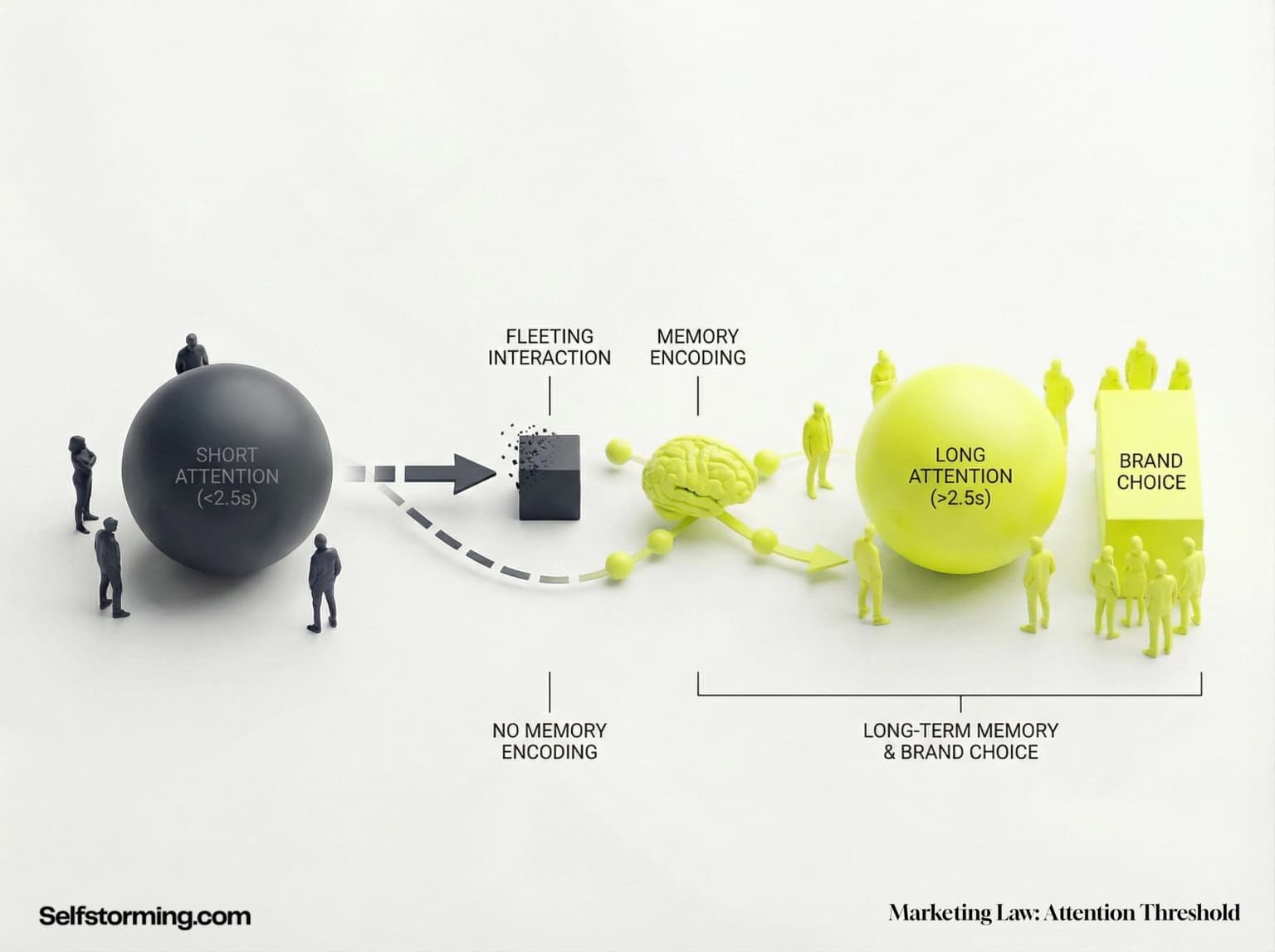
The Attention Threshold is a fundamental principle in Marketing Science asserting that advertising effectiveness is not binary but contingent on a temporal floor of active attention. While the industry standard for 'viewability' (often 50% of pixels for 1-2 seconds) focuses on technical delivery, the Attention Threshold focuses on human cognition. Research by Karen Nelson-Field and Lumen Research indicates that ads require a minimum of approximately 2.5 seconds of active visual attention to initiate the neural encoding necessary for long-term memory formation. Below this threshold, the 'decay rate' of the message is near-instantaneous, rendering the spend effectively useless for building mental availability. This law mandates a shift from buying 'cheap reach' to buying 'attentive reach,' recognizing that not all seconds on screen are created equal.
ATTENTION THRESHOLD
“A critical minimum duration of active visual attention, typically exceeding 2.5 seconds, is required for an advertisement to initiate the neural encoding necessary for long-term memory formation and subsequent brand choice.”

Key Takeaways
- •Viewability is a technical lie; only active attention builds brand memory.
- •The 2.5-second mark is the physiological 'cliff' for advertising effectiveness.
- •Not all reach is equal; platform environment dictates the attention ceiling.
- •Memory decay is near-instantaneous for ads viewed below the threshold.
- •Optimize for 'Cost per Attentive Second' to maximize long-term brand growth.
Genesis & Scientific Origin
The systematic definition of the Attention Threshold emerged from the pioneering work of Professor Karen Nelson-Field, founder of Amplified Intelligence, and Mike Follett of Lumen Research. Their collaborative and independent studies, primarily conducted between 2017 and 2022, challenged the prevailing digital advertising metrics. The concept was solidified through the 'Attention Council' and featured prominently in Nelson-Field's seminal book, 'The Attention Economy and How Media Works' (2020). By using eye-tracking technology across thousands of participants and various platforms (YouTube, Facebook, Instagram, Cinema, TV), they moved the conversation from 'opportunity to see' (OTS) to 'actual attention paid.' This research was supported by the Ehrenberg-Bass Institute's broader findings on mental availability, providing the physiological link between media exposure and memory structure building.
“Ads viewed for less than 2 seconds generate 0% increase in short-term sales lift.”
The Mechanism: How & Why It Works
The Attention Threshold operates on the physiological reality of how the human brain processes external stimuli. The process of moving information from sensory memory into long-term memory (LTM) is not instantaneous; it requires a sustained neural 'handshake.'
Firstly, we must distinguish between 'Passive Attention' (the ad is in the peripheral vision) and 'Active Attention' (the fovea is focused on the creative). The Attention Threshold specifically refers to the cumulative seconds of Active Attention. When an ad is viewed for less than 2 seconds, the brain categorizes it as environmental noise. The hippocampus, responsible for encoding new memories, does not trigger a permanent trace.
Secondly, the mechanism is governed by the 'Decay Curve.' Research shows that the relationship between attention and memory is non-linear. There is a 'cliff' at the 2.5-second mark. Below this, memory of the brand decays to zero within hours. Once the threshold is crossed, the decay curve flattens significantly, allowing the brand to be retrieved during a buying situation days or even weeks later.
Thirdly, the 'Platform Effect' dictates the threshold's ceiling. Different platforms have different 'Attention Elasticity.' A platform like TikTok or Cinema has a high ceiling where attention can be sustained for 10+ seconds, easily clearing the threshold. Conversely, programmatic display or fast-scrolling social feeds often have an 'Attention Ceiling' that sits below the 2.5-second threshold, meaning no matter how good the creative is, the environment prevents it from ever being effective. This creates a structural failure in media planning where 'reach' is bought on platforms that physically cannot sustain the attention required for the law to take effect.

Empirical Research & Evidence
The most definitive data comes from the research published in 'The Attention Economy and How Media Works (Nelson-Field, 2020)'. In a multi-platform study involving over 130,000 ad exposures, Nelson-Field utilized gaze-tracking software to measure 'Active Attention Seconds' and correlated them with 'Short-Term Advertising Strength' (STAS). The results showed that ads receiving 0-2 seconds of attention produced a STAS score barely above the baseline (100), meaning they had zero impact on brand choice. However, once attention crossed the 2.5-second threshold, STAS scores jumped to 120-140.
Furthermore, Lumen Research (2019) conducted a study on 'The Value of Attention' which found that only 9% of digital display ads receive more than 1 second of attention. Their data indicated that for a brand to achieve a 50% chance of being remembered, the ad required at least 1.5 seconds of viewing, but to drive actual purchase intent (the threshold), that figure rose to 2.5 seconds. The study concluded that 'viewable' impressions (as defined by the IAB) are 5x less likely to be seen than 'attentive' impressions, highlighting the massive discrepancy between industry standards and biological reality.
Real-World Example:
Electronic Arts (EA) / Global Media Audit
Situation
EA was investing heavily in programmatic video and display based on traditional viewability metrics (CPM and VCR). Despite high 'viewability' scores, brand lift studies showed stagnant mental availability in key markets.
Result
By applying the Attention Threshold law, EA audited their media buy using Amplified Intelligence’s 'Attention Trace' tool. They discovered that 60% of their 'viewable' impressions were actually falling below the 2.5-second threshold. They shifted 20% of their budget from low-attention social 'feed' environments to high-attention 'forced-view' and long-form video environments. Despite the higher CPMs in these new channels, the 'Cost per Attentive Second' dropped by 35%, and they saw a subsequent 12% increase in brand salience among the target gamer demographic within six months.
Strategic Implementation Guide
Step 1
Stop buying on CPM alone; it’s a vanity metric for the illiterate. Start calculating 'qCPM' (Quality CPM) or 'Cost per Attentive Second.' If you’re paying $5 for a million eyes that look for 0.1 seconds, you’re just donating to a tech mogul's yacht fund.
Step 2
Audit your platform mix for 'Attention Elasticity.' Some platforms, like X (Twitter) or standard display, have a low attention ceiling. No amount of 'disruptive' creative will fix a platform where people are trained to scroll at light speed.
Step 3
Front-load your distinctive assets. Since you're fighting to reach that 2.5-second threshold, your brand needs to be identified in the first 0.5 seconds. If your logo appears at the end of a 15-second skipable ad, you’ve already lost.
Step 4
Prioritize 'High-Stakes' environments. Cinema, TV, and non-skip YouTube ads have structural advantages. They don't just 'get' attention; they hold it hostage long enough to clear the threshold.
Step 5
Optimize creative for 'Visual Flow.' Use eye-tracking heatmaps in the pre-testing phase to ensure the viewer's gaze isn't wandering aimlessly. If they aren't looking at the brand or the key message within the first 2 seconds, they won't hit the threshold.
Step 6
Fire your agency if they only report on 'Viewability.' Demand 'Attentive Reach' metrics. If they can't tell you how many people looked for more than 2.5 seconds, they aren't measuring your success; they're measuring their own activity.
Step 7
Test 'Slow' Creative. In a world of 'fast' content, sometimes a deliberate, slow-moving visual can hook the brain's motion sensors and force the gaze to linger, pushing the viewer past the threshold.
Frequently Asked Questions
Is the Attention Threshold the same for every brand?
The biological threshold is relatively consistent (approx 2.5s), but 'Mental Entry' varies. Famous brands with high Mental Availability can sometimes trigger a memory refresh in slightly less time because the neural pathways are already 'greased.' However, for new brands or complex messages, the threshold is often even higher. Don't gamble on being the exception; aim for the 2.5s floor.
Does better creative lower the Attention Threshold?
No. Creative doesn't lower the threshold; it helps you *reach* it. The threshold is a physiological requirement for memory. Great creative acts as the 'hook' that keeps eyes on the screen long enough to satisfy the brain's encoding requirements. Bad creative on a high-attention platform is a waste; great creative on a low-attention platform is a tragedy.
Are 'Short-Form' ads (6 seconds) useless then?
Not at all, provided they are placed in environments where the 6 seconds are actually watched. A 6-second bumper ad on YouTube often yields 4-5 seconds of active attention, which is well above the threshold. A 15-second ad in a Facebook feed might only get 0.8 seconds of attention. It's the *actual attention*, not the *ad length*, that matters.
How does this relate to the 'Double Jeopardy Law'?
They are symbiotic. Double Jeopardy tells us you need more buyers to grow. The Attention Threshold tells us you won't get those buyers if your 'reach' isn't actually building memory. Low-attention reach is 'empty reach'—it looks good on a spreadsheet but fails to drive the penetration required by Double Jeopardy.
Can audio-only ads (Radio/Spotify) have an Attention Threshold?
Yes, but the metrics are different. Audio attention is 'passive-dominant.' However, the principle remains: the brain needs a minimum duration of auditory processing to move a brand name into LTM. The 'Threshold' for audio is typically longer because the brain can filter out sound more easily than it can filter out direct foveal vision.
Sources & Further Reading
Related Marketing Laws
People Pay Less Attention Than You Think
Most advertising is processed passively, if at all.
Attention Is Emotional First
Emotion drives attention faster than logic.
Active vs Passive Attention
Not all attention is equal; active attention builds memory.
Platform Attention Inequality
Different platforms generate vastly different attention quality.