Active vs Passive Attention

Not all attention is created equal.

You're paying for 'impressions' that no one actually sees while patting yourself on the back for a high reach. Newsflash: a pixel appearing on a screen for two seconds while someone's checking their teeth in the reflection isn't 'marketing'—it's a donation to Big Tech. If you aren't fighting for active attention, you're just lighting money on fire to keep the algorithm warm. Here is the cold, hard science of why your 'efficient' media plan is actually a suicide note for your brand's mental availability.
The law of Active vs Passive Attention, pioneered by Professor Karen Nelson-Field, asserts that attention is not a binary state but a spectrum that determines the strength of memory encoding. While 'passive attention' (peripheral awareness) provides some baseline exposure, only 'active attention' (direct eyes-on-screen) triggers the neural pathways required for long-term brand recall and sales impact. Crucially, the platform—more than the creative—dictates the 'attention floor,' meaning a brilliant ad on a low-attention platform will consistently underperform a mediocre ad on a high-attention one. Marketers must shift from measuring 'viewability' to 'attention seconds' to avoid the 'Attention Decay' that erodes ROI.

ACTIVE VS PASSIVE ATTENTION

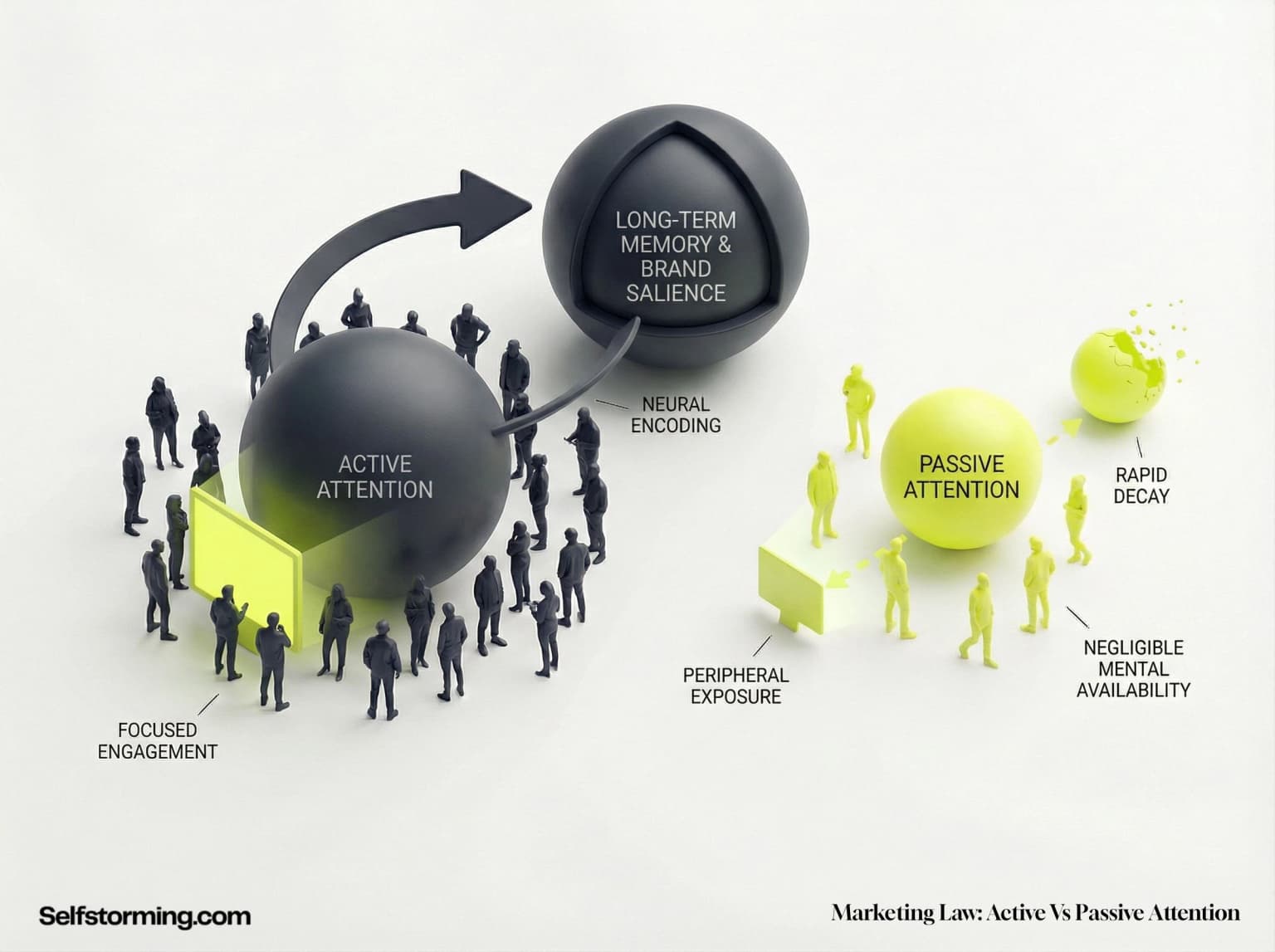
The distinction between active and passive attention posits that only focused, eyes-on-screen engagement facilitates the neural encoding necessary for long-term memory formation and brand salience, whereas peripheral or passive exposure provides negligible decay-resistant mental availability.

Active vs Passive Attention marketing law: Not all attention is created equal. - Visual illustration showing key concepts and examples

Key Takeaways

  • Attention is a spectrum, not a binary 'viewed' or 'not viewed' state.
  • Active attention (eyes-on-screen) is the primary driver of long-term brand memory.
  • Passive attention leads to rapid memory decay and minimal sales impact.
  • The platform environment dictates the maximum attention potential more than the creative.
  • Marketers must optimize for 'Attention Seconds' to ensure mental availability growth.

Genesis & Scientific Origin

The formalization of the Active vs Passive Attention framework is attributed to Professor Karen Nelson-Field, founder of Amplified Intelligence and a former Senior Research Media Specialist at the Ehrenberg-Bass Institute. Her seminal work, largely synthesized in the publication 'The Attention Economy and How Media Works' (2020), challenged the industry-standard 'viewability' metrics. Through extensive gaze-tracking studies across multiple countries and platforms, Nelson-Field and her team at Amplified Intelligence demonstrated that the technical presence of an ad (viewability) has little correlation with the human experience of that ad (attention).

Passive attention results in a memory decay rate that is 3x faster than active attention.

The Mechanism: How & Why It Works

The mechanism of attention is rooted in the cognitive processing of visual stimuli and its relationship to the hippocampus. Active attention occurs when the foveal vision—the center of the eye responsible for sharp, detailed vision—is directed at the stimulus. This high-intensity processing leads to 'Slow Decay' memory structures, which can persist for weeks or months. Passive attention, conversely, utilizes peripheral vision. While the brain registers the presence of the ad, it does not engage in deep semantic processing. This results in 'Fast Decay,' where the brand impact evaporates within hours or even minutes.

Furthermore, the 'Platform Effect' acts as a structural constraint on attention. Every media environment has an 'Attention Ceiling' (the maximum amount of attention a user is likely to give) and an 'Attention Floor' (the minimum baseline). For instance, a mobile scroll environment has a significantly lower attention ceiling than a cinema screen or a high-quality television broadcast. This is due to the 'User State'—the psychological context of the consumer. A user 'snacking' on social media is in a state of high distraction, making active attention difficult to capture regardless of creative quality. Conversely, a 'lean-back' environment facilitates longer durations of active attention.

Mathematically, the relationship between attention and sales is non-linear. There is a threshold of 'Attention Seconds' required before any significant brand lift occurs. Once this threshold is crossed, every additional second of active attention adds incremental value to the 'Mental Availability' of the brand. Passive attention, while not entirely useless, requires significantly higher frequency to achieve the same memory encoding as a single instance of active attention, making it an inefficient pursuit for brands seeking rapid growth.

Active vs Passive Attention mechanism diagram - How Active vs Passive Attention works in consumer behavior and marketing strategy

Empirical Research & Evidence

In the research published in the Journal of Advertising Research (Nelson-Field, Riebe, & Graham, 2017), the authors utilized eye-tracking technology to monitor over 2,500 participants across various digital platforms. The study found that ads on platforms with higher active attention scores (measured in eyes-on-screen seconds) produced a 40% higher lift in Short-Term Advertising Strength (STAS) compared to those on low-attention platforms, even when the ads were identical. The data showed that for every one second of active attention gained, there was a measurable increase in the probability of the brand being chosen in a subsequent simulated shopping trip. Furthermore, the research highlighted that 'passive' viewing (eyes near but not on the ad) resulted in nearly zero STAS lift, effectively debunking the idea that 'subliminal' or peripheral digital impressions drive immediate purchase behavior.

Real-World Example:
A Global FMCG Beverage Brand

Situation

The brand was optimizing its media spend based on CPM (Cost Per Thousand) and technical viewability (MRC standard: 50% of pixels for 1 second). While their 'reach' was high and their 'cost-per-view' was low, their brand tracking showed stagnant mental availability and declining market share.

Result

By shifting their measurement framework from Viewability to 'Active Attention Seconds' (using Amplified Intelligence's benchmarks), they discovered that 70% of their digital spend was going to platforms where the 'Active Attention' was less than 0.5 seconds. They reallocated 30% of their budget toward high-attention environments (Premium Video and Cinema). Despite the higher CPMs, the brand saw a 12% increase in spontaneous brand recall and a 5% lift in sales volume within six months, as they were finally building memory rather than just 'hitting' screens.

Strategic Implementation Guide

1

Step 1

Stop buying on CPM alone; it's a vanity metric that rewards low-quality, high-clutter environments.

2

Step 2

Audit your current media mix using 'Attention Seconds' benchmarks to identify 'waste' platforms where active attention is physically impossible.

3

Step 3

Design creative specifically for the platform's attention ceiling; don't put a 30-second 'story' ad on a platform where the average attention is 1.5 seconds.

4

Step 4

Prioritize 'Eyes-on-Screen' metrics over 'Viewability'; if the human isn't looking, the pixels don't matter.

5

Step 5

Front-load your distinctive brand assets (DBAs) in the first 2 seconds to capitalize on the initial burst of active attention before the 'Attention Decay' kicks in.

6

Step 6

Test your creative in high-clutter vs. low-clutter environments to see how much 'Active Attention' it can actually command against distractions.

7

Step 7

Rebalance your budget toward 'High-Attention' channels for brand-building and use 'Low-Attention' channels only for simple, repetitive reinforcement.

Frequently Asked Questions

Does creative quality matter more than the platform for active attention?

Actually, no. The research shows that the platform environment is the primary determinant of attention. A great ad on a low-attention platform will still get less active attention than a mediocre ad on a high-attention platform. Creative can 'optimize' attention within a platform's limits, but it cannot override the platform's structural constraints.

Is passive attention completely useless for brand growth?

It's not 'zero,' but it's highly inefficient. Passive attention can provide a 'reminder' effect for very well-established brands with strong distinctive assets, but it is almost entirely incapable of building new memory structures or introducing a new brand to a repertoire.

How do I measure active attention without expensive eye-tracking for every campaign?

You don't need to measure every ad. Use industry benchmarks (like those from Amplified Intelligence or Lumen) to understand the average 'Attention Seconds' per platform. Apply these 'Attention Adjusted' weights to your reach and frequency models to get a truer picture of your effective reach.

Does 'forced' attention (like non-skippable ads) count as active attention?

Partially. While the ad is on screen, users often engage in 'Attention Avoidance'—looking away, checking their phone, or mentally tuning out. Active attention is about where the eyes are, not just that the video is playing. Forced formats have higher active attention than skippable ones, but they also risk higher 'negative' emotional resonance.

Should I stop using social media ads if the attention is low?

Not necessarily. You just need to pay the 'correct' price for it. If social media gives you 1.5 seconds of attention and TV gives you 12 seconds, you shouldn't pay the same for an 'impression.' Use social for high-frequency reinforcement of distinctive assets, not for complex brand storytelling.

We use cookies on our site to enhance your user experience, provide personalized content, and analyze our traffic. Cookie Policy