2026LaishaMedia & EntertainmentCase video
Laisha: *6724EVER
Laisha, Israel's leading women's magazine, faced a crisis of record-breaking femicides. The client sought a permanent, non-symbolic way to support victims, moving beyond temporary awareness campaigns. They tasked the agency, No, No, No, No, No, Yes, with creating a solution that provided discreet, long-term access to the domestic violence helpline for women in need, ensuring the resource remained available long after the initial publication date.
Creative Idea
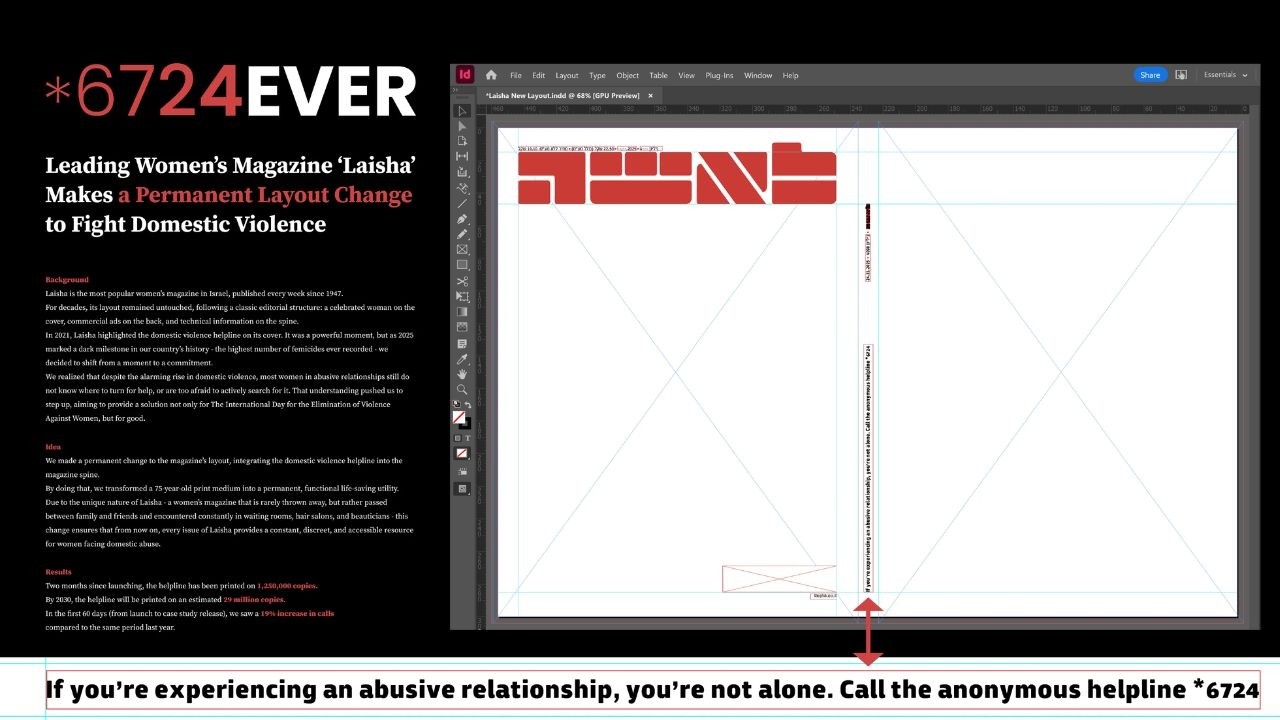
The magazine's spine was permanently redesigned to feature a discreet, life-saving helpline number.
Laisha permanently integrated its domestic violence helpline into the magazine's physical spine. By transforming a technical print element into a discreet, long-lasting resource, the magazine ensures help remains visible for years in homes and waiting rooms, transcending temporary awareness campaigns.
Breaking Twenty-Nine Years of Print Tradition
Redesigning the Magazine DNA
To make this initiative a reality, the team had to overhaul Laisha’s fixed print template for the first time since 1996. This was not merely a design choice but a complex operational shift requiring total alignment across editorial, structural design, commercial distribution, and legal-approval teams. The goal was to ensure the helpline placement was permanent and could never be overridden by commercial advertisers or technical print variations.
A Sustainable Safety Net
Gideon Amichay, founder of No, No, No, No, No, Yes, emphasized that the campaign was designed to reject the "one-off" stunt mentality. By embedding the helpline into the physical product, the agency created a sustainable commitment that lasts as long as the magazine exists on a shelf. Karina Shtotland, Editor-in-Chief of Laisha, noted that this move was intended to provide a permanent editorial resource rather than momentary buzz.
Measurable Lives Impacted
The operational impact was immediate. Within the first 60 days of the launch, the L.A. – Fighting Violence Against Women organization reported a 19% surge in calls to the \*6724 hotline compared to the same period the previous year. With over 1,250,000 copies already in circulation, the project is scaled for long-term reach, with an estimated 29 million copies expected to carry the life-saving number by 2030. The hotline itself remains a critical, accessible resource, operating 24/7 and providing support in 14 languages to ensure inclusivity for all women across Israel.
4C Framework deconstruction
Company
As Israel's leading women's magazine, Laisha possessed a massive, long-circulating physical footprint that reaches women in private and public spaces.
Category
Magazines typically use spines only for technical publishing details, ignoring the potential for functional, life-saving communication.
Customer
Women facing domestic abuse needed a discreet, non-traceable, and permanent way to access help without raising suspicion.
Culture
The 2025 record-breaking spike in femicides created an urgent, national demand for non-symbolic, permanent solutions to domestic violence.
Company
As Israel's leading women's magazine, Laisha possessed a massive, long-circulating physical footprint that reaches women in private and public spaces.
Category
Magazines typically use spines only for technical publishing details, ignoring the potential for functional, life-saving communication.
Strategy:
Transform physical product infrastructure into a permanent, discreet channel for essential social support.
Customer
Women facing domestic abuse needed a discreet, non-traceable, and permanent way to access help without raising suspicion.
Culture
The 2025 record-breaking spike in femicides created an urgent, national demand for non-symbolic, permanent solutions to domestic violence.
Strategy:
Transform physical product infrastructure into a permanent, discreet channel for essential social support.
Results
In the two months since launching, the helpline was printed on 1,250,000 copies. By 2030, the helpline is projected to be printed on an estimated 29 million copies. In the first 60 days following launch, there was a 19% increase in calls to the helpline compared to the same period the previous year. The initiative also received extensive national media coverage, featured across major TV news broadcasts and publications like AdAge, Creative Moment, and Ynet.
+19%
increase in helpline calls
1.25M
copies printed in first 2 months
29M
estimated copies by 2030
Strategy Technique
Build an Utility, Not an Ad
Instead of running a temporary awareness ad, the brand embedded a functional helpline directly into the product's physical structure. This ensures the solution is as permanent as the crisis it addresses.
Explore Technique
Creative Technique
Unexpected Utility
The campaign turns a standard, overlooked technical element of a magazine into a life-saving tool. This provides victims with a discreet, permanent resource that remains accessible long after the issue is published.
Explore Technique
Craft Breakdown
The campaign elevates print media craft by transforming a overlooked technical design space—the magazine spine—into a permanent, life-saving communications channel. By altering the master publication template forever, it bridges editorial design with social action.
Reimagining the functional real estate of a publication's spine layout turns an ignored technical margin into a permanent public utility.
Leveraging the naturally long shelf life of physical magazines in public waiting rooms creates an enduring, recurring ad channel without additional media buy costs.
“The genius lies in combining structural editorial graphic design with medium mechanics—utilizing print shelf-life to deliver ongoing utility for abuse victims.”