Eurofarma: Baby Minder
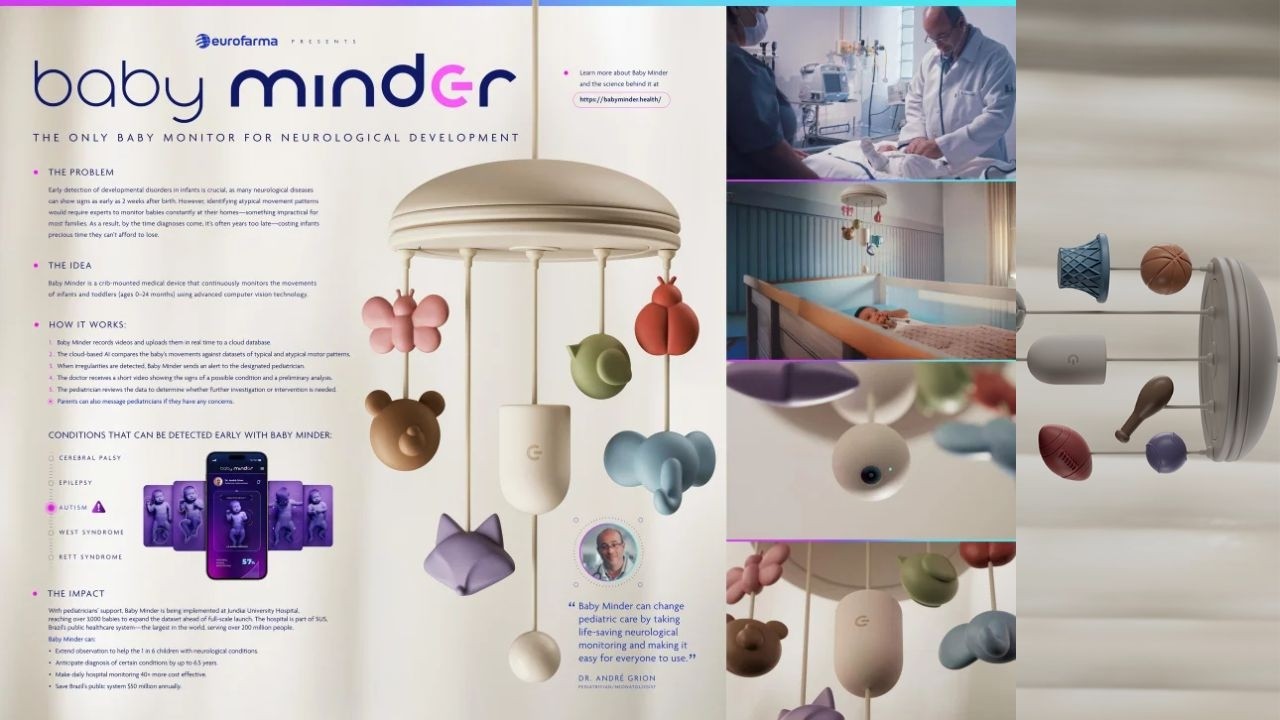
Eurofarma tasked Ogilvy Health with addressing the critical 48-hour window in neonatal care, where doctors lose contact with patients before neurological symptoms often appear. The objective was to develop a scalable, non-intrusive solution that allowed pediatricians to monitor infants at home, enabling earlier diagnosis of neurological conditions and providing parents with greater peace of mind through continuous, expert-backed clinical observation.
Creative Idea
A standard crib mobile was turned into an AI-powered diagnostic tool for infants.
Eurofarma transformed a standard crib mobile into an AI-powered diagnostic tool, using computer vision to monitor infant neurological development at home and alerting pediatricians to early signs of conditions like autism and epilepsy, effectively extending clinical care beyond the hospital.
Turning Nursery Decor into Diagnostic Hardware
Designing for Discretion
The primary design challenge was psychological. The team needed to ensure the device did not turn the home into a clinical environment, which would cause unnecessary parental stress. By housing high-resolution sensors within a standard, colorful baby mobile, the team achieved a "non-intrusive" aesthetic. This design choice was vital for long-term data collection, as it ensured parents felt comfortable leaving the device active in the nursery for months at a time without feeling like they were living under constant surveillance.
Bridging the Data Gap
The AI model, developed by WideLabs, required a massive, specialized dataset to function. Because neurological symptoms in infants are often subtle, the team had to train the computer vision system on thousands of hours of clinical footage. This allowed the software to distinguish between normal infant fidgeting and the specific, rhythmic muscle stiffness or atypical movement patterns that serve as early biomarkers for conditions like epilepsy and autism.
A Sovereign Tech Milestone
A unique aspect of this project is its reliance on sovereign AI. The technology partner, WideLabs, is the same group behind Amazônia 360º, the first large language model developed entirely in Brazil. By keeping the R&D, manufacturing, and clinical piloting within the country, the project avoided the common pitfalls of importing foreign-trained models that may not account for local demographic or environmental variables. This localized approach helped the team secure the support of the Jundiaí University Hospital, ensuring the device was validated by local medical professionals who understood the specific needs of the Brazilian public health system.
Creative Strategy Deconstructed
Company
Eurofarma leveraged its medical expertise and R&D capabilities to integrate advanced AI computer vision into a consumer-friendly pediatric monitoring device.
Category
Pediatric health monitoring typically ends at hospital discharge, leaving a dangerous gap in early detection for neurological conditions.
Customer
Parents and doctors felt anxious about the limited 48-hour window to identify potential developmental issues in newborns.
Culture
The rise of AI-driven health tech and the growing demand for proactive, home-based medical solutions made this innovation highly relevant.
Company
Eurofarma leveraged its medical expertise and R&D capabilities to integrate advanced AI computer vision into a consumer-friendly pediatric monitoring device.
Category
Pediatric health monitoring typically ends at hospital discharge, leaving a dangerous gap in early detection for neurological conditions.
Strategy:
Extend clinical oversight into the home by digitizing the observation of early developmental milestones.
Customer
Parents and doctors felt anxious about the limited 48-hour window to identify potential developmental issues in newborns.
Culture
The rise of AI-driven health tech and the growing demand for proactive, home-based medical solutions made this innovation highly relevant.
Strategy:
Extend clinical oversight into the home by digitizing the observation of early developmental milestones.
Results
The Baby Minder system has been successfully implemented at Jundiaí's University Hospital with pediatrician support. The campaign has collected data and conducted research on over 3,000 babies, helping to extend pediatric care into the home and provide early detection of neurological disorders.
3,000+
babies monitored and researched
Strategy Technique
Make the Invisible Visible
It identifies the critical, invisible gap in neonatal care where neurological symptoms go undetected after hospital discharge. By surfacing these subtle patterns, the brand transforms a silent medical risk into an actionable, life-saving diagnostic opportunity.
Explore Technique
Creative Technique
Unexpected Utility
The campaign turns a common, non-threatening nursery object into a sophisticated diagnostic medical device. This unexpected utility allows for continuous, non-intrusive monitoring that bridges the gap between hospital discharge and long-term neurological health.
Explore Technique
Craft Breakdown
This campaign stands out through its exceptional product design and integration of AI technology, transforming a common nursery object into a life-saving diagnostic tool.
The integration of AI-powered computer vision with a cloud database to analyze infant movement patterns is a highly sophisticated medical application.
Disguising a medical monitoring device as a friendly, colorful crib mobile is an excellent example of empathetic, user-centric product design.