Billie: Billie Lab
Billie tasked Publicis with shifting their brand narrative from activist messaging to product feature superiority. The goal was to highlight the ergonomic engineering of their razors and the innovation of their Shave Glaze. The campaign needed to reach a female audience by proving that Billie products were specifically designed for women, effectively challenging the industry standard of adapting men's razors for female use.
Creative Idea
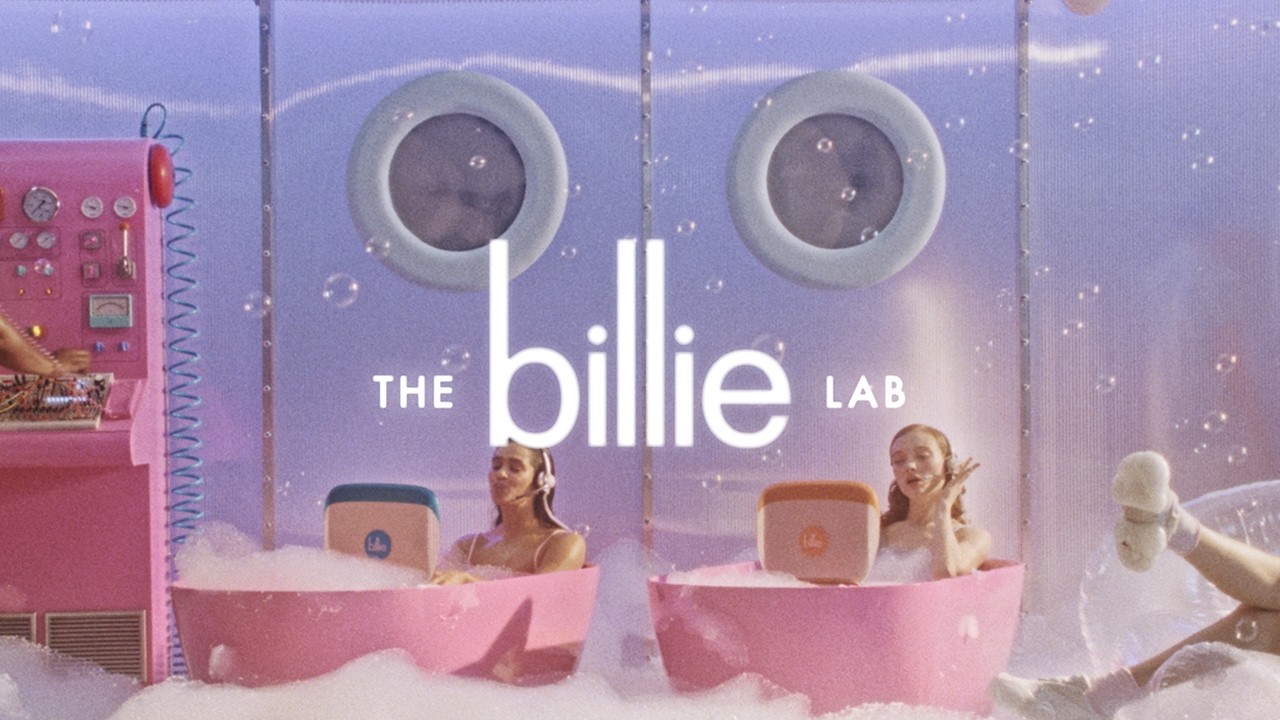
A surreal, retro-futuristic lab dramatizes the engineering of products designed specifically for women.
Billie used a surreal, retro-futuristic lab setting to dramatize the engineering behind their products, proving that women's razors should be designed for actual female anatomy rather than being adapted from men's tools.
Inside the Grooviest Research Lab Ever
Retro Tech Meets Modern Engineering
The visual language of the campaign leans heavily into Y2K nostalgia, utilizing a color palette and hardware aesthetic inspired by the original Apple iMac G3. The set design features translucent tech, CRT monitors, and pastel-colored sci-fi gadgets to create a surreal, playful environment. This aesthetic choice serves as a deliberate contrast to the clinical, sterile white labs typically seen in beauty advertising, positioning Billie as a brand that is bold and whimsical rather than purely functional.
From Activism to Product Superiority
This campaign represents a significant strategic pivot for the brand. While Billie previously focused on purpose-led messaging and anti-Pink Tax advocacy, this initiative shifts the narrative toward humorous product feature superiority. By highlighting the ergonomic engineering of the 5-Blade Razor System and the Shave Glaze, the brand demonstrates that addressing the gender design gap can be both a functional necessity and an entertaining creative exercise.
Testing for the Real World
Production details emphasize the absurdity of traditional corporate R&D. To prove the efficacy of the no-slip grip, researchers were filmed in a high-powered wind-and-rain tunnel while wearing yellow rain gear. The "dolphin-smooth" skin claim was taken literally by incorporating a full-scale aquarium set featuring real dolphins. Furthermore, the Shave Glaze was engineered with a specific "drizzle cap" following user feedback that traditional shave oils created hazardous, slick shower floors. Directed by Olivia De Camps, the campaign relies on comedic actors and lab technicians rather than traditional celebrity endorsements to maintain its satirical, pop-art tone.
4C Framework deconstruction
Company
Billie possesses the unique capability to design ergonomic, high-quality shaving tools specifically engineered for female body curves and needs.
Category
The category traditionally relies on gender-neutral or adapted male razor designs that ignore the specific physical requirements of women.
Customer
Women desired a shaving experience that felt seamless, luxurious, and truly designed for their bodies rather than an afterthought.
Culture
The resurgence of Y2K aesthetics and a demand for brand transparency in product design fueled the campaign's visual and narrative success.
Company
Billie possesses the unique capability to design ergonomic, high-quality shaving tools specifically engineered for female body curves and needs.
Category
The category traditionally relies on gender-neutral or adapted male razor designs that ignore the specific physical requirements of women.
Strategy:
Use surreal world-building to expose category design flaws and establish brand superiority through imaginative proof.
Customer
Women desired a shaving experience that felt seamless, luxurious, and truly designed for their bodies rather than an afterthought.
Culture
The resurgence of Y2K aesthetics and a demand for brand transparency in product design fueled the campaign's visual and narrative success.
Strategy:
Use surreal world-building to expose category design flaws and establish brand superiority through imaginative proof.
Strategy Technique
Create a Parallel World
By placing the brand in a stylized, retro-futuristic lab, Billie makes their product engineering feel like a bold, imaginative mission. This creates a distinct brand universe that elevates simple features into legendary innovations.
Explore Technique
Creative Technique
Create Fantasy Worlds, People and Things
The campaign builds a whimsical, Y2K-inspired lab environment to visualize the product testing process. This surreal setting transforms mundane engineering into a playful, pop-art spectacle that captures viewer attention.
Explore Technique