2026McDonald'sTravel, Leisure, Retail & RestaurantsCase video
McDonald's: GamiFries
McDonald’s Philippines tasked BBH Singapore and Leo Manila with capturing the attention of the gaming community during the Nintendo Switch 2 launch. The challenge was to overcome deep-seated gamer skepticism toward corporate advertising. The objective was to achieve organic brand integration within gaming culture without using traditional paid media, ensuring the brand felt like a native, helpful participant rather than an external interrupter.
Creative Idea
An unbranded, 3D-printable fry holder turned the console itself into a McDonald's accessory.
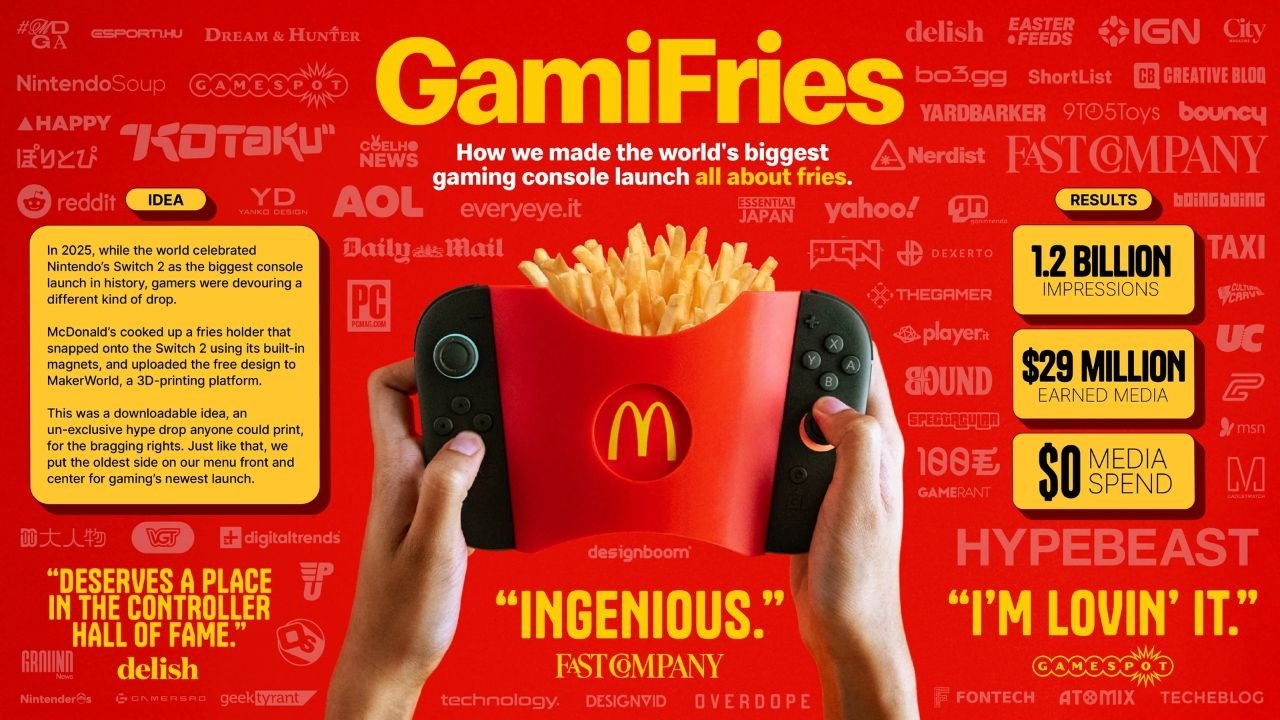
McDonald’s released an open-source 3D-printable fry holder for the Nintendo Switch 2 via a stealthy, unbranded MakerWorld account. By positioning the brand as a tool provider rather than an advertiser, they bypassed gamer skepticism and earned organic global engagement.
Hacking the Switch 2 Launch Without Lawsuits
Stealth R&D in the BBH Office
The entire project was developed as a guerrilla R&D initiative within BBH Singapore with a $0 media budget. The team bypassed traditional production houses, opting for a lean, in-house approach. Art director Jereek Espiritu handled the product photography, while copywriter Syahmina Abyana served as the hand model and camera assistant. This DIY production style was essential to maintaining the "fan-made" aesthetic required to trick the gaming community into believing the accessory was a grassroots invention rather than a corporate marketing stunt.
The Art of the Invisible Brand
To avoid the typical gamer backlash against intrusive advertising, the agency utilized a pseudonymous profile, "user7R135", to upload the 3D print files to MakerWorld. By positioning McDonald's as a tool provider rather than an advertiser, they successfully infiltrated gaming subculture. The strategy relied on the utility of the accessory to drive organic discovery. Within 24 to 48 hours, the project went viral across TikTok, YouTube, Reddit, and X, leading to independent coverage from major tech and gaming outlets like PCMag, GadgetMatch, and Designboom.
Navigating the Nintendo Minefield
The campaign was a calculated risk, specifically timed around the July 2025 excitement for the Nintendo Switch 2. According to Jereek Espiritu, the team was acutely aware of the brand's reputation for legal action, noting they had to "hack the launch without catching a red shell." By avoiding paid celebrity endorsements and press pitch buys, the agency ensured the brand felt native to the gaming space, effectively turning the product's physical utility into the primary distribution mechanism for the campaign.
4C Framework deconstruction
Company
McDonald’s leveraged its iconic fry packaging as a universal cultural symbol of snacking.
Category
Fast food brands typically rely on intrusive, paid media interruptions that gamers actively reject.
Customer
Gamers wanted functional, non-intrusive ways to snack while playing without ruining their controllers.
Culture
The massive hype surrounding the Nintendo Switch 2 launch created a perfect, high-attention cultural moment.
Company
McDonald’s leveraged its iconic fry packaging as a universal cultural symbol of snacking.
Category
Fast food brands typically rely on intrusive, paid media interruptions that gamers actively reject.
Strategy:
Enable community participation by providing functional tools that solve niche cultural frictions.
Customer
Gamers wanted functional, non-intrusive ways to snack while playing without ruining their controllers.
Culture
The massive hype surrounding the Nintendo Switch 2 launch created a perfect, high-attention cultural moment.
Strategy:
Enable community participation by providing functional tools that solve niche cultural frictions.
Results
The GamiFries campaign generated significant global engagement and media coverage: - $29 Million in earned media value - 1.2 Billion total impressions - Featured across major publications and media outlets including Fast Company, Kotaku, Hypebeast, Daily Mail, Gamespot, and IGN - Downloaded and 3D printed by gamers across multiple countries including Japan, USA, Sweden, Egypt, Canada, and Korea
$29M
Earned Media
1.2B
Impressions
Strategy Technique
Celebrate the Subculture
By respecting the gaming community's aversion to overt advertising, the brand acted as a native participant. This earned organic advocacy from influencers who felt the brand was genuinely contributing to their culture.
Explore Technique
Creative Technique
Invent a Complementary Product
The campaign created a functional 3D-printed accessory that solved a specific snacking friction for gamers. This utility-driven approach allowed the product itself to act as the primary marketing vehicle.
Explore Technique
Craft Breakdown
This campaign excels through clever industrial design and guerrilla digital craft, stealthily infiltrating gaming culture with a functional, open-source 3D printable product.
The physical 3D printable holder ingeniously mimics the iconic fry box while perfectly fitting console ergonomics and magnetic attachment points.
Anonymous open-source seeding on MakerWorld perfectly mimicked organic maker-community behavior to trigger global viral pickup.
“The combination of functional hardware design and stealth digital distribution created a seamless guerrilla stunt that felt authentic to gaming culture.”