Harrison's Fund: I Wish My Son Had Cancer
Harrison's Fund, a new charity, needed to urgently raise millions for Duchenne Muscular Dystrophy research. Facing zero public awareness and no budget, the client sought a campaign to dramatically increase public understanding and drive donations from the general public and major businesses.
Creative Idea
A controversial headline reversed expectations to dramatically highlight an unknown disease's plight.
Harrison's Fund leveraged a shocking, counter-intuitive headline - "I Wish My Son Had Cancer" - in a press ad to provoke public debate and awareness, effectively driving donations for Duchenne Muscular Dystrophy by dramatically highlighting its lack of recognition and funding compared to more known diseases.
The Brutal Truth That Outperformed a Dog
From Wills to the Unthinkable
Before landing on the final headline, the creative team at AIS London explored a concept where children with Duchenne Muscular Dystrophy (DMD) wrote their own wills to distribute their toys. The breakthrough occurred during a raw conversation where founder Alex Smith admitted his darkest thought - that a cancer diagnosis offered more hope than the certain fatality of DMD. Despite initial agency fears regarding the backlash, Smith insisted on the blunt honesty. The resulting visual was a high - contrast, unpolished photograph by Alan Powdrill, designed to look as stark as the message itself.
Viral Growth on a Zero Budget
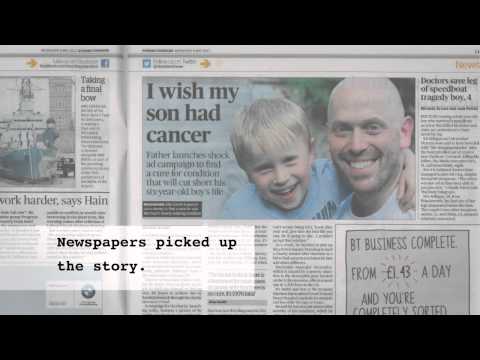 The campaign is a masterclass in earned media. Alex Smith secured the initial full - page ad in the *London Evening Standard* for free before an agency was even attached. Following the launch, website traffic skyrocketed by 17,000% and donations surged by over 200%, raising £65,000 almost instantly. On social media, the reach grew by 800%, with 99% of that engagement being organic. Smith famously managed the fallout himself, spending 36 hours personally responding to critics to ensure the "voice of a father" remained the campaign's heart.
The Bittersweet Dog Experiment
To test British philanthropic biases, the charity later ran a split test featuring an ad with Harrison versus an ad with a dog. The dog received double the clicks, a sobering detail that reinforced the necessity of the original "shock" tactic. The campaign’s legacy remains its proof that a single, provocative sentence can generate millions in earned media value, eventually securing corporate backing from giants like Barclays Capital.
Creative Strategy Deconstructed
Company
Harrison's Fund possessed the founder's raw, shocking truth about Duchenne Muscular Dystrophy and the courage to use a controversial message.
Category
Charity campaigns typically relied on direct emotional appeals or factual information, often avoiding controversial or comparative messaging to gain support.
Customer
The public was largely unaware of Duchenne Muscular Dystrophy's severity and the desperate despair of parents, yet responsive to raw, provocative honesty.
Culture
A culture existed where social media amplified shocking, debate-provoking content, and traditional charity appeals struggled to cut through the noise.
Company
Harrison's Fund possessed the founder's raw, shocking truth about Duchenne Muscular Dystrophy and the courage to use a controversial message.
Category
Charity campaigns typically relied on direct emotional appeals or factual information, often avoiding controversial or comparative messaging to gain support.
Strategy:
Reframe an unknown disease's plight by leveraging a shocking, comparative truth to provoke public awareness.
Customer
The public was largely unaware of Duchenne Muscular Dystrophy's severity and the desperate despair of parents, yet responsive to raw, provocative honesty.
Culture
A culture existed where social media amplified shocking, debate-provoking content, and traditional charity appeals struggled to cut through the noise.
Strategy:
Reframe an unknown disease's plight by leveraging a shocking, comparative truth to provoke public awareness.
Results
In January 2012, Harrison's Fund was set up. The Evening Standard offered some space. Visits to the website went up by 17,000%. Facebook reach increased by 800%, with a 99% viral reach beyond the existing community. People commented, debated and donated to the cause from all over the world. Major businesses, like Barclays Capital, pledged support. A documentary about Harrison and DMD is now in the pipeline. Direct donations have reached £65,000 and rising. The campaign included a 25 x 4 press ad.
17,000%
increase in website visits
800%
increase in Facebook reach
£65,000
direct donations
Strategy Technique
Find the Missing Conversation
The campaign deliberately introduced a shocking, taboo comparison between Duchenne Muscular Dystrophy and cancer. This forced a crucial, previously avoided public conversation about disease awareness, funding disparities, and the desperate plight of rare disease families.
Explore Technique
Creative Technique
Reverse Expectations
The campaign used a shocking headline, "I Wish My Son Had Cancer," to deliberately subvert typical public sentiment regarding disease. This unexpected statement immediately grabbed attention, forcing people to confront the desperate reality of Duchenne Muscular Dystrophy's obscurity and lack of hope.
Explore Technique
Craft Breakdown
This campaign's craft is exceptional due to its audacious and highly effective copywriting, which bravely tackles a difficult subject to generate widespread awareness and donations. The art direction further elevates the message by presenting it in a stark, impactful manner that commands attention.
The headline 'I WISH MY SON HAD CANCER' is a masterclass in provocative, impactful copywriting, instantly grabbing attention and forcing an emotional response that drives engagement and action for an underfunded cause.
The minimalist, black-and-white aesthetic of the press ad, focusing on a tender moment between father and son, allows the powerful headline and body copy to resonate without visual distraction, enhancing its emotional weight.