2026PiquentumConsumer GoodsCase video
Piquentum: Brut Nature - Label Created By The Wine Itself
Piquentum commissioned Studio Sonda to create packaging for its Brut Nature sparkling wine. The project aimed to embody the winemaker's additive-free philosophy by upcycling residual yeast sediment and office paper into a living wine label.
Creative Idea
Studio Sonda crafted living, changing wine labels from Piquentum's own discarded yeast sediment.
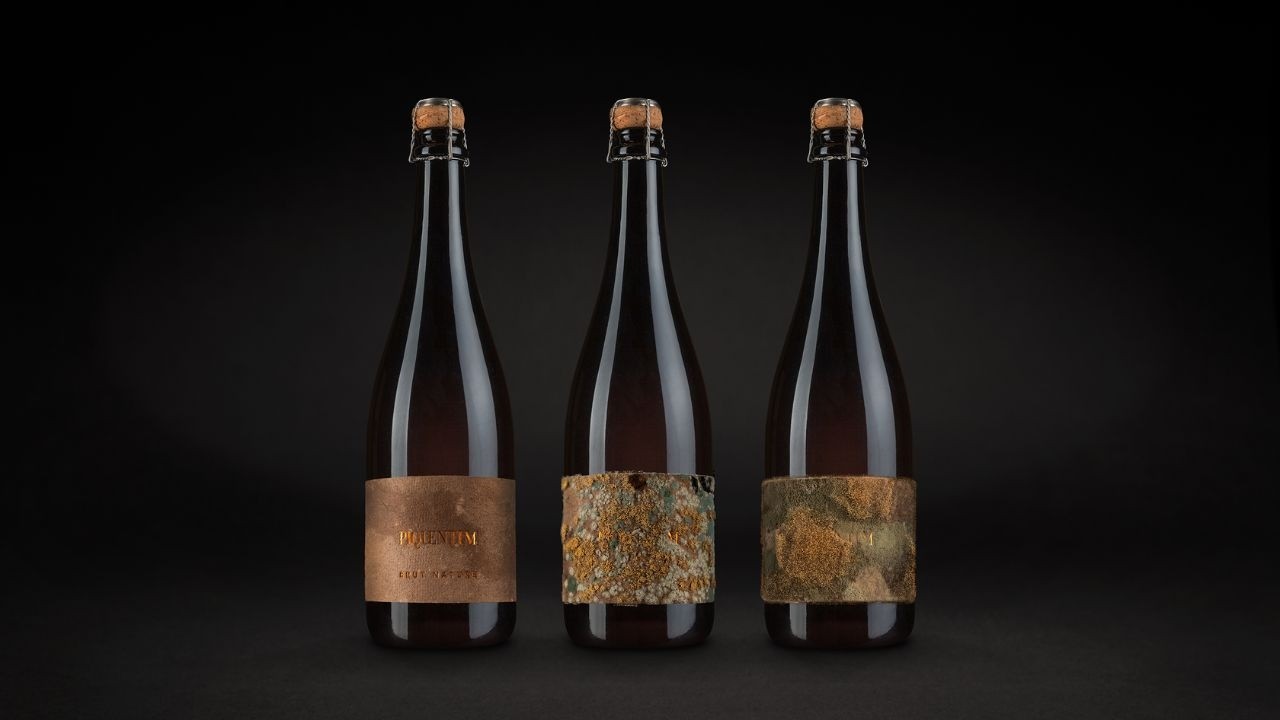
Studio Sonda crafted living wine labels directly from Piquentum's spent yeast sediment and upcycled office paper, creating a dynamic, mold-growing packaging design that visually validates zero-additive winemaking without chemical preservatives.
A Label Born directly from Spent Yeast
Crafting a biological label
Winemaker Dimitri Brečević and Istria-based Studio Sonda (led by creative directors Jelena Fiškuš and Sean Poropat) developed a physical label made from the wine's own organic waste. Production lead Jakov Poropat collected, pressed, and dried natural yeast lees extracted during disgorgement.
This dried sediment was combined with 10% paper pulp recycled directly from the winery's internal office memos, notes, and packaging. The resulting material remains biologically active because no chemical preservatives are added. When exposed to humidity and light, the material slowly changes color and grows noble mold. Technical partner Etikgraf handled specialized label printing while maintaining full compliance with European Union food safety regulations (EC 1935/2004), as the bottle glass provides an impenetrable barrier.
Distribution strategy and reservation demand
 Piquentum launched the work in June 2025 through fine-dining restaurants and natural wine bars, relying on sommeliers to present the story directly to diners. Following a 700-bottle test batch, all quantities for 2026 and 2027 (about 3,000 bottles) were 100% pre-reserved prior to bottling. The studio allocated 33% of total production for international export to the United States and the United Kingdom, while the number of exclusive fine-dining restaurant partners quadrupled to 20 accounts.
> "This recognition is the ultimate validation of our belief that today's true premium lies in authenticity, and a deep respect for the natural process. It proves that there is immense beauty in imperfection."
> - Jelena Fiškuš & Sean Poropat, Creative Directors at Studio Sonda
> "What I loved about this project is that it's a beautiful piece of packaging... deeply rooted in circularity."
> - Suzy Shelley, Sustainability Lead at Pearlfisher
4C Framework deconstruction
Company
Piquentum produces 100% additive-free natural sparkling wine, leaving behind organic yeast sediment during the disgorgement process.
Category
Sparkling wine packaging relies on standardized paper labels that conceal production additives and discard spent yeast as waste.
Customer
Natural wine enthusiasts and sommeliers seek verifiable authenticity in a market full of greenwashing and hidden additives.
Culture
Growing demand for circular design and complete transparency in organic agriculture elevates honest, living materials.
Company
Piquentum produces 100% additive-free natural sparkling wine, leaving behind organic yeast sediment during the disgorgement process.
Category
Sparkling wine packaging relies on standardized paper labels that conceal production additives and discard spent yeast as waste.
Strategy:
Transform discarded fermentation sediment into a living, biologically active label that visually proves unadulterated winemaking.
Customer
Natural wine enthusiasts and sommeliers seek verifiable authenticity in a market full of greenwashing and hidden additives.
Culture
Growing demand for circular design and complete transparency in organic agriculture elevates honest, living materials.
Strategy:
Transform discarded fermentation sediment into a living, biologically active label that visually proves unadulterated winemaking.
Strategy Technique
Find the Brand Truth
Rather than printing claims about organic integrity, the design uses the physical byproduct of the winemaking process to provide undeniable, biological proof on the bottle.
Explore Technique
Creative Technique
Turn Message into Product
By converting discarded disgorgement sediment into the physical label itself, the design transforms the core message of unadulterated purity into an active, tangible medium.
Explore Technique
Craft Breakdown
This packaging design turns wine waste into living paper that evolves dynamically on the bottle without synthetic stabilizers.
Formulating paper from 90% yeast lees and 10% upcycled paper pulp creates an active, evolving organic texture.
Collecting, pressing, and drying raw fermentation sediment ensures structural stability while complying with EU food safety standards.
“The raw material selection directly enables the tactile design, turning chemical activity into a visually changing product wrapper.”