Pop-Tarts - The First Edible Mascot
Kellanova tasked Weber Shandwick with shifting Pop-Tarts' perception from a breakfast staple to a broader snacking brand. They sought to put Pop-Tarts at the center of the inaugural Pop-Tarts Bowl, aiming for significant earned media and consumer engagement among college football fans.
Creative Idea
An edible mascot was created for a bowl game, then dramatically consumed.
Pop-Tarts created the first-ever edible mascot for its college football bowl game, which was dramatically eaten by the winning coach, generating massive earned media and shifting brand perception from breakfast staple to a broader snacking sensation by embracing absurdity and spectacle.
The Pastry Martyr Who Died For Our Sins
Magicians and Hidden Lifts
To execute the viral sacrifice, Weber Shandwick collaborated with Chicago Mascots and Independent Graphics and Display to build a custom 11 foot tall toaster. The production team studied magician swap techniques to ensure a seamless transition. The live performer, Barry Anderson - the veteran behind the Chicago Bulls' "Benny the Bull" - descended into the toaster on a hidden lift while a 4 foot long edible pastry was slid out from a separate compartment. Because no commercial oven could accommodate a human sized tart, the team commissioned a local Florida bakery to bake the massive snack, which was served warm to the winning Kansas State players.
Billions of Impressions and Millions of Tarts
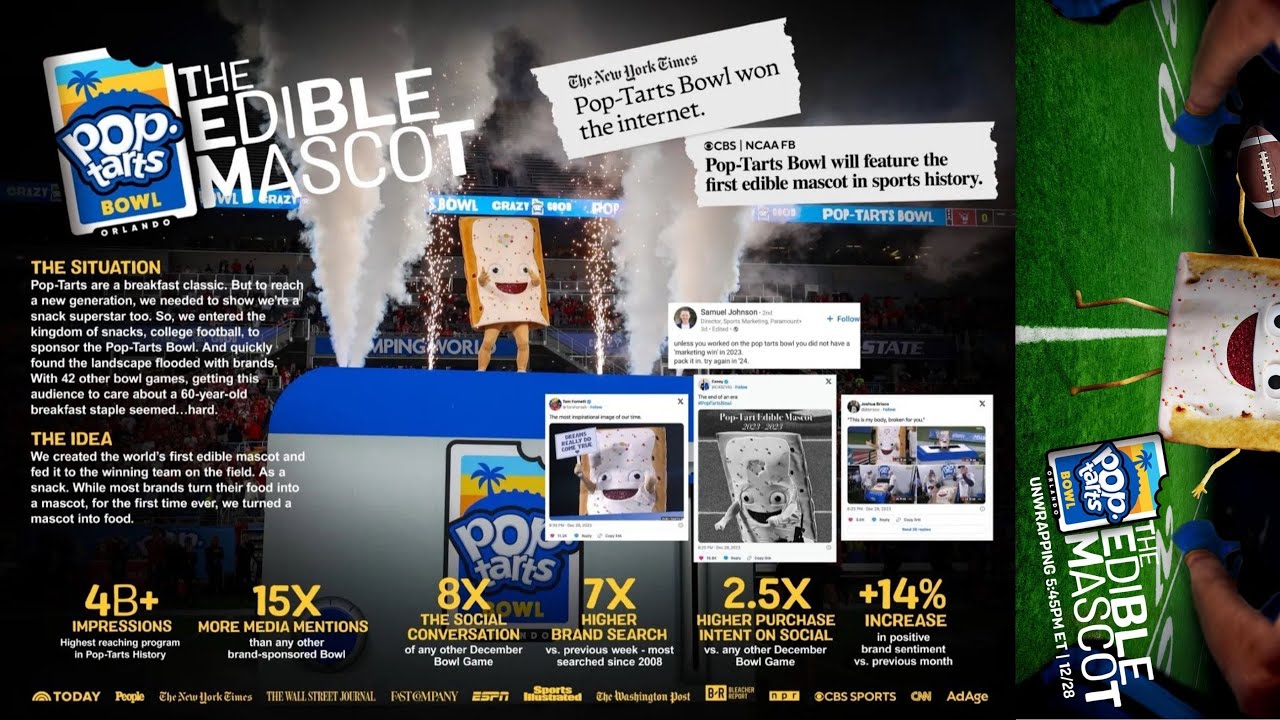
The campaign achieved a 926% return on sponsorship investment, generating over 4 billion earned media impressions. This spectacle translated directly to the shelf, with 21 million more Pop-Tarts sold in the eight weeks following the game compared to the previous period. On game day, brand search volume spiked 7x higher than the annual average, marking the highest consumer interest for the brand since 2008.
Nihilism as a Marketing Strategy
The activation leaned into "absurdist" humor to connect with Gen - Z, featuring a mascot that actively desired to be consumed. Holding a sign reading "Dreams really do come true," the character's descent into the toaster became a "meme - ified" ritual. Art Director Nikki Méndez described the approach as "weird and nihilistic," while fans on social media created "religious" edits of the mascot, crowning it a "pastry martyr." The cultural footprint was so large that the mascot eventually appeared on the red carpet for Jerry Seinfeld’s film *Unfrosted*.
Creative Strategy Deconstructed
Company
Pop-Tarts had a 'Crazy Good' brand identity and a history of putting unique spins on classic flavors, enabling bold, unconventional marketing.
Category
College football bowl games typically feature traditional, non-edible mascots and conventional brand sponsorships, often lacking memorable, integrated spectacle.
Customer
Consumers saw Pop-Tarts as a breakfast staple, but were receptive to engaging with the brand in fun, unexpected ways beyond morning hours.
Culture
A culture of viral content, meme-sharing, and a desire for authentic, unexpected, and humorous moments in live events made the stunt resonate.
Company
Pop-Tarts had a 'Crazy Good' brand identity and a history of putting unique spins on classic flavors, enabling bold, unconventional marketing.
Category
College football bowl games typically feature traditional, non-edible mascots and conventional brand sponsorships, often lacking memorable, integrated spectacle.
Strategy:
Leverage absurdity and spectacle to transcend category norms and generate cultural conversation.
Customer
Consumers saw Pop-Tarts as a breakfast staple, but were receptive to engaging with the brand in fun, unexpected ways beyond morning hours.
Culture
A culture of viral content, meme-sharing, and a desire for authentic, unexpected, and humorous moments in live events made the stunt resonate.
Strategy:
Leverage absurdity and spectacle to transcend category norms and generate cultural conversation.
Results
The Pop-Tarts Bowl was lauded by The New York Times for "winning the internet." The campaign achieved 4 billion impressions. The Pop-Tarts Bowl garnered 4.3 million viewers, making it the most-watched bowl game up until that point. It generated 1500% more mentions than competing sponsors. The campaign yielded a 926% return on sponsorship. Importantly, 21 million more Pop-Tarts were sold in the 8 weeks following the game compared to the 8 weeks prior. The campaign generated extensive media coverage from outlets including CNN, ESPN, The New York Times, TODAY, The Wall Street Journal, USA Today, HuffPost, The Athletic, CBS Sports, BuzzFeed, NPR, Fox, and many more, indicating significant earned media.
4 billion
impressions
926%
return on sponsorship
21 million
more Pop-Tarts sold
Strategy Technique
Use Absurd Logic
The concept of an edible mascot is inherently absurd, yet it perfectly embodied Pop-Tarts' 'Crazy Good' brand ethos. This unexpected, humorous twist captured widespread attention and drove unprecedented engagement.
Explore Technique
Creative Technique
Reverse Expectations
Mascots are typically revered symbols of team spirit. By making their mascot edible and having it dramatically consumed, Pop-Tarts subverted expectations, creating a memorable, shareable, and viral moment.
Explore Technique
Craft Breakdown
The campaign's craft is exceptional in its audacious, self-aware concept and the meticulously executed, highly shareable viral stunt that redefined traditional sports sponsorship.
The flawless creation of the life-sized, edible Pop-Tarts mascot and the giant working toaster was critical to the campaign's visual spectacle and shock value on the field.
The witty and irreverent messaging, particularly the core premise of 'dying for sponsorships' sins,' perfectly framed the campaign's humor and resonated deeply with audiences and media.
“The magic comes from the seamless combination of a bold, category-disrupting idea brought to life through exceptional physical production, amplified by clever messaging and a strategic design for digital virality.”