Nike: Air Max Graffiti Stores
Nike wanted to launch new Air Max models in Brazil while increasing e-commerce relevance among São Paulo's youth. AKQA São Paulo needed to connect the brand to local street culture during a period of political tension where the city government was erasing graffiti. The goal was to drive traffic to Nike.com and boost sales through a unique, culturally resonant phygital experience.
Creative Idea
Turned city graffiti into exclusive e-commerce stores by painting sneakers on character's feet.
Nike transformed São Paulo's street art into exclusive e-commerce portals by painting new Air Max models onto existing graffiti characters, requiring fans to physically visit the murals to unlock limited-edition purchases via geolocation technology.
Turning Street Art Into Direct To Consumer Retail
Hacking the Grey City
The campaign launched during a period of intense political friction. São Paulo’s then-governor, João Doria, had declared a "war on graffiti," systematically painting over hundreds of murals with grey paint. In a move of strategic defiance, AKQA São Paulo and Nike "hacked" the surviving art. By partnering with the Instagrafite collective and artists like Karen Fidelis (Kueia), they updated existing characters with the latest Air Max models. This transformation effectively turned the murals into cultural heritage sites, making it legally impossible for the government to erase them without further controversy. In a poetic turn of events, after the Governor was convicted for damaging the city's heritage, Nike "resurrected" six previously erased characters by repainting them with new sneakers.
Geofencing the Concrete Jungle
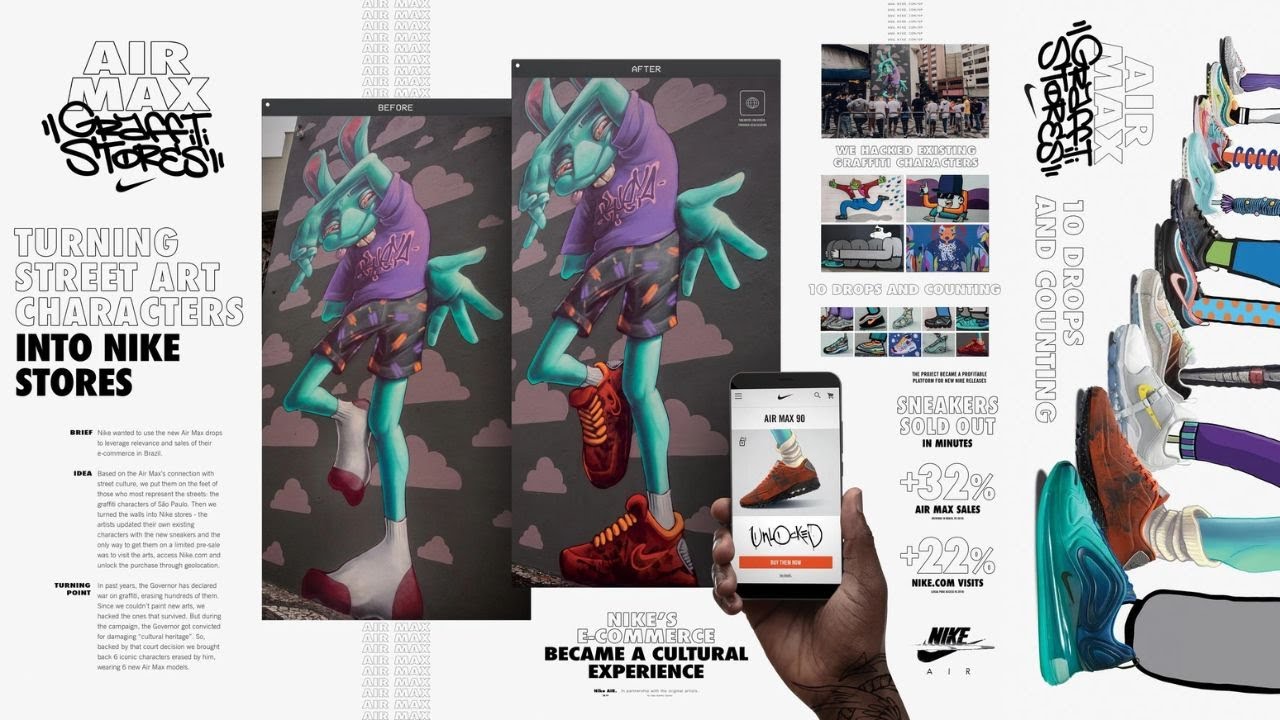 The "phygital" infrastructure relied on sophisticated geo-fencing technology developed by Webcore Interactive. To unlock a purchase, fans had to physically stand in front of the mural and access Nike.com via their mobile devices. The site verified their GPS coordinates before granting access to the exclusive drop. Once the transaction was complete, the experience transitioned into digital storytelling; users were rewarded with an exclusive animated film by Zohar Cinema showing the graffiti character coming to life and walking in the shoes the user had just bought.
Zero Media Spend Results
Despite AKQA having no traditional media buying department, the campaign achieved a reach of 80 million people on social media. The strategy drove a 32% increase in Air Max sales and a 22% spike in local web traffic. The demand was so high that exclusive sneaker drops sold out in as little as 6 minutes, proving that OOH could function as a high-velocity retail channel.
Creative Strategy Deconstructed
Company
Nike's status as a street culture icon and its advanced e-commerce platform capable of geolocation-based triggers.
Category
Traditional retail relies on physical storefronts or standard digital ads that often feel disconnected from authentic urban culture.
Customer
Sneakerheads and street art fans in São Paulo who felt their local culture was under attack by government censorship.
Culture
A political 'war on graffiti' in São Paulo made street art a symbol of resistance and high-value cultural currency.
Company
Nike's status as a street culture icon and its advanced e-commerce platform capable of geolocation-based triggers.
Category
Traditional retail relies on physical storefronts or standard digital ads that often feel disconnected from authentic urban culture.
Strategy:
Transform threatened cultural landmarks into exclusive access points to turn brand consumption into an act of cultural preservation.
Customer
Sneakerheads and street art fans in São Paulo who felt their local culture was under attack by government censorship.
Culture
A political 'war on graffiti' in São Paulo made street art a symbol of resistance and high-value cultural currency.
Strategy:
Transform threatened cultural landmarks into exclusive access points to turn brand consumption into an act of cultural preservation.
Results
The campaign achieved significant impact: +22% increase in Nike.com visits compared to 2018, +32% increase in Air Max sales revenue in Brazil, and over 80M social media reach. Sneakers sold out in minutes during each drop. The project successfully turned e-commerce into a cultural experience while preserving local street art heritage.
+32%
Air Max sales revenue increase
80M
Social media reach
+22%
Nike.com visits
Strategy Technique
Borrow Equity
Nike leveraged the deep cultural significance of São Paulo's graffiti scene to bypass traditional media, turning beloved local landmarks into exclusive brand touchpoints that resonated with street-savvy audiences.
Explore Technique
Creative Technique
Hijack the Medium
By turning existing city murals into functional e-commerce portals, Nike bypassed traditional advertising spaces to transform the urban environment itself into a direct-to-consumer retail platform.
Explore Technique
Craft Breakdown
This campaign's excellence lies in its seamless integration of physical street culture with digital commerce, using geolocation to turn public art into a retail channel.
The use of physical city walls as 'storefronts' via geolocation is a masterclass in non-traditional media placement.
The curation of high-quality graffiti that perfectly integrates the product design into existing street art is visually stunning and authentic.
The narrative framing of 'hacking' the city and turning e-commerce into a 'cultural experience' is compelling.
The use of geolocation to gate-keep a product drop creates a unique 'treasure hunt' mechanic that drives physical foot traffic.
“The magic comes from the synergy between street art (Art Direction) and mobile technology (Media Planning), making the city itself the interface for the brand.”