Pepsi: The Choice
Pepsi tasked BBDO New York with reclaiming market share by directly challenging the category leader during Super Bowl LX. The goal was to prove the superior taste of Pepsi Zero Sugar to a skeptical audience. The client needed a disruptive, high-impact campaign that would reignite the cola wars and force consumers to reconsider their habitual brand loyalty through a bold, memorable narrative.
Creative Idea
Pepsi forced a rival's iconic mascot to defect after a blind taste test.
Pepsi hijacked Coca-Cola's iconic polar bear mascot to perform a blind taste test, forcing the bear to choose Pepsi Zero Sugar and sparking a humorous identity crisis that highlights the brand's superior taste over its rival.
Hijacking the Mascot Behind the Cola Wars
The Eleven Week Sprint
To bring the polar bear to life, Framestore deployed a 30-person global VFX team tasked with an aggressive 11-week production window. Eschewing the industry trend toward generative AI, the team relied on traditional keyframe animation to ensure the bear’s facial expressions conveyed nuanced, human-like emotional complexity. Animators conducted extensive anatomical research, studying real-world bears to accurately map skeletal structure, weight distribution, and fur grooming for a feature-film-quality result.
Virtual Production and Directing
Director Taika Waititi utilized fARsight, a proprietary virtual production tool, to bridge the gap between live-action and digital elements. This technology allowed Waititi and his cinematographer to visualize the CG bear’s scale and performance in real-time on set. Waititi, who also appears on-screen as the bear’s deadpan therapist, noted that he views commercial filmmaking as a "filmmaking gym" to refine his craft.
Sales and Cultural Reach
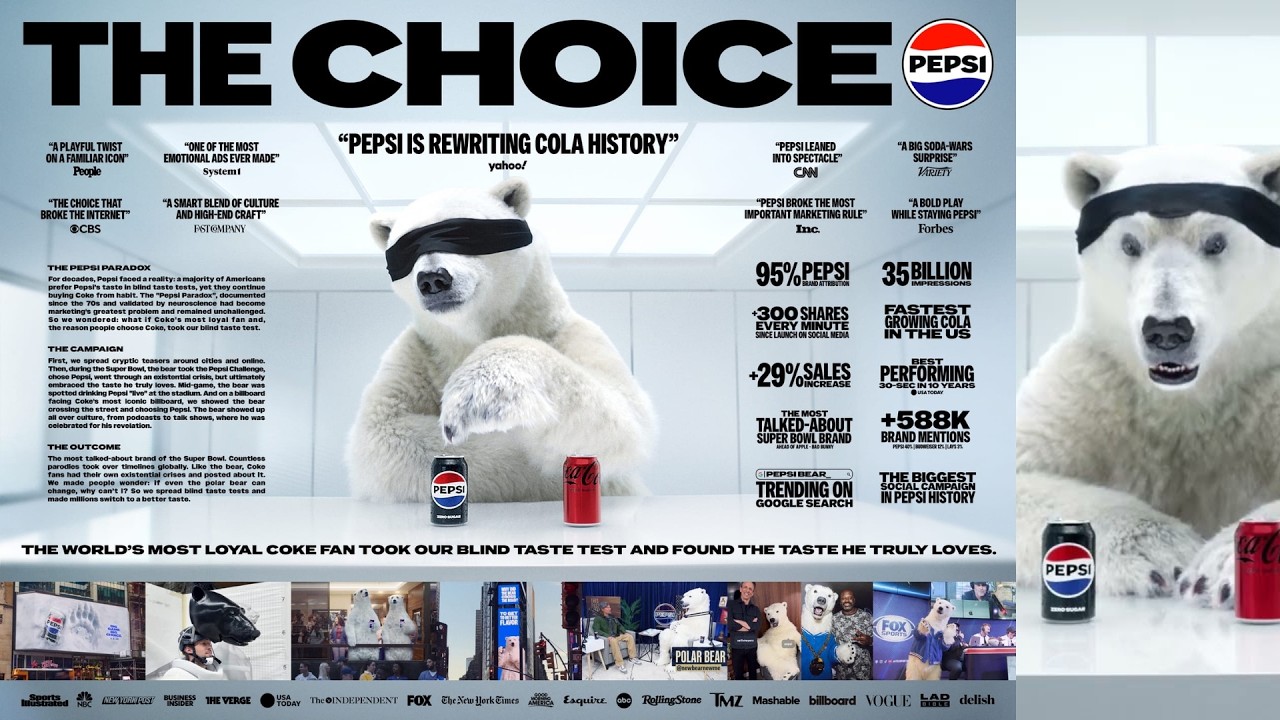
The campaign achieved massive scale, generating over 35 billion impressions across all platforms. This visibility translated into tangible market performance, contributing to a 29% year-over-year sales growth for Pepsi Zero Sugar. The narrative centered on the "Pepsi Paradox"—the phenomenon where consumers prefer Pepsi in blind tests despite habitual loyalty to competitors. By forcing the bear to choose Pepsi in a blind test, the agency turned a symbol of Coca-Cola’s heritage into a vehicle for an existential identity crisis. The spot concluded with a viral-style "kiss cam" spoof, cementing its status as a top-performing ad, ranking 3rd overall on the USA Today Super Bowl Ad Meter.
Creative Strategy Deconstructed
Company
Pepsi leveraged its proven taste superiority from the Pepsi Challenge to challenge the status quo of cola loyalty.
Category
The cola category typically relies on safe, sentimental mascot-driven advertising to maintain long-term brand loyalty.
Customer
Consumers often prefer the taste of Pepsi but habitually purchase the competitor due to deep-seated brand conditioning.
Culture
The Super Bowl provided the perfect high-stakes stage to disrupt the cola wars through bold, satirical storytelling.
Company
Pepsi leveraged its proven taste superiority from the Pepsi Challenge to challenge the status quo of cola loyalty.
Category
The cola category typically relies on safe, sentimental mascot-driven advertising to maintain long-term brand loyalty.
Strategy:
Disrupt established brand loyalty by weaponizing a competitor's own iconography against them.
Customer
Consumers often prefer the taste of Pepsi but habitually purchase the competitor due to deep-seated brand conditioning.
Culture
The Super Bowl provided the perfect high-stakes stage to disrupt the cola wars through bold, satirical storytelling.
Strategy:
Disrupt established brand loyalty by weaponizing a competitor's own iconography against them.
Results
The campaign achieved historic success, becoming the #1 Ad Meter 30-sec in 10 years according to USA Today. It achieved 95% Pepsi Brand Attribution via System1 and was named #1 The Most Recalled Brand by Ipsos. In terms of market performance, Pepsi became the Fastest Growing Cola in the US with +1.2 PP Brand Health, +1.2 PP HHP, and +3 PTS Share Gains vs Coke. The campaign drove a +29% sales increase year-over-year and became the biggest social campaign in Pepsi history.
95%
Pepsi Brand Attribution
+29%
Sales Increase Year-Over-Year
#1
Most Recalled Brand (Ipsos)
Strategy Technique
Roast the Competition
By aggressively mocking the competitor's mascot, Pepsi creates memorable drama that builds brand confidence. It effectively uses the rival's own equity to highlight the 'Pepsi Paradox' and assert taste superiority.
Explore Technique
Creative Technique
Take a Shot at the Competition
The campaign directly uses the competitor's most recognizable brand asset to deliver a stinging, humorous critique. By forcing the mascot to defect, it turns a symbol of the rival into a powerful endorsement for Pepsi.
Explore Technique
Craft Breakdown
This campaign's craft is elevated by its exceptional production design and experiential execution, choosing high-fidelity physical puppetry over digital CGI to create a tangible, highly shareable cultural icon.
The creation of a highly realistic, expressive physical polar bear puppet allowed for authentic real-world interactions that CGI could not replicate.
The seamless integration of the physical mascot into live events, luxury suites, and real-world locations turned a commercial into a living PR stunt.
The narrative cleverly frames the campaign around breaking the 'rules' of marketing, turning a competitive attack into an intellectual victory.
Strategically placing the bear in Times Square directly opposite Coca-Cola's primary billboard maximized the competitive tension and earned media.
“The magic of the campaign lies in the synergy between physical production design and real-time experiential stunts, making the polar bear feel like a real celebrity roaming the Super Bowl.”