JCDecaux: The Route
JCDecaux challenged Y&R São Paulo to demonstrate the brand's commitment to the city's well-being beyond just selling ad space. In São Paulo, extreme traffic congestion frequently delayed ambulances, putting lives at risk. The brand needed to prove the innovative potential of its digital OOH network to city officials and the public by solving a critical urban problem using real-time data.
Creative Idea
Synced ambulance GPS data with digital billboards to clear traffic lanes in real-time.
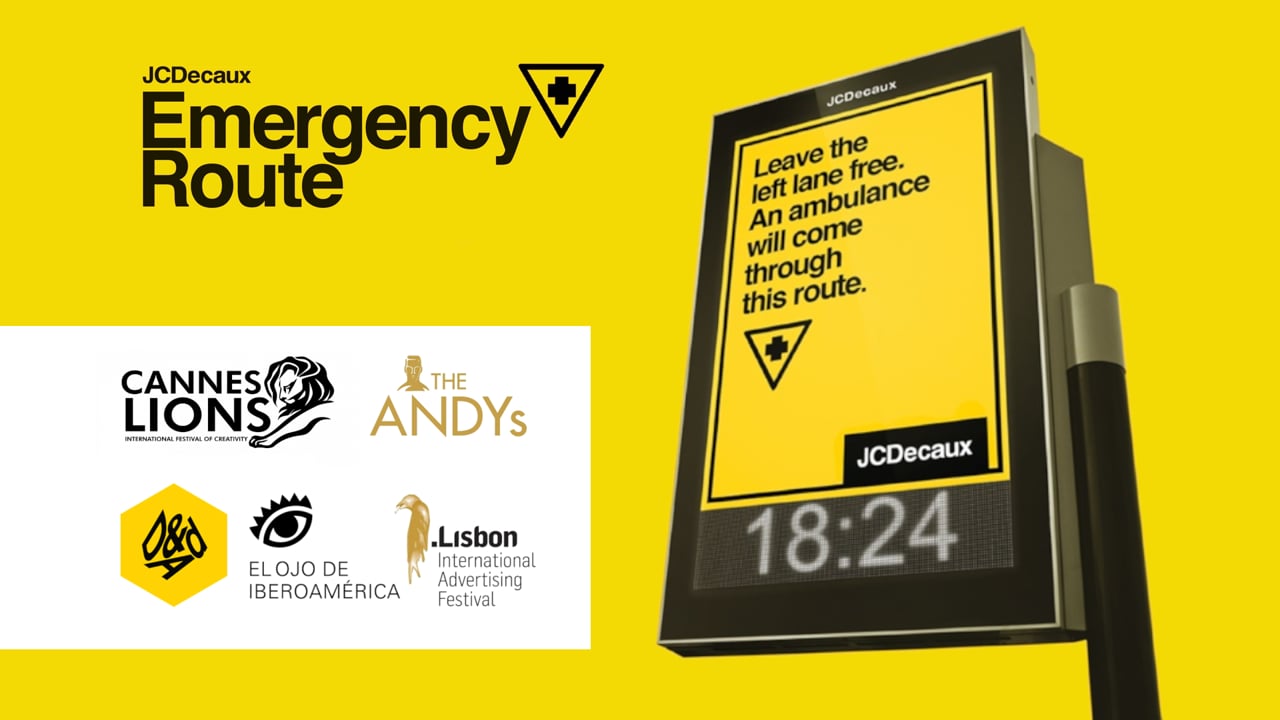
JCDecaux transformed its digital billboards into a real-time emergency system by syncing ambulance GPS data to screens, clearing traffic lanes 1km ahead of the vehicle to save critical minutes during life-threatening rescues in congested São Paulo.
Turning Digital Billboards Into Life Saving Infrastructure
Zero Latency for Critical Seconds
The technical backbone of the campaign relied on a custom-built app that bridged the gap between mobile GPS and programmatic Out-of-Home (OOH) displays. By integrating directly with ambulance dispatch systems, the software identified the vehicle's precise trajectory in real-time. As the ambulance entered a 1km radius of a JCDecaux screen, the commercial loop was instantly overridden. This required a system with zero latency to ensure the "Leave the left lane free" alert appeared exactly when drivers had enough time to react, but before the siren was even audible.
Minutes Saved on the Road
The Rise of Utility Advertising
VP Creative Rafael Pitanguy noted that the project represented a shift in how agencies view traditional media, stating, "Data goes from mobile to OOH to save lives." Beyond the initial launch, the campaign sparked high-level discussions among city officials about integrating this technology into São Paulo’s permanent smart city infrastructure. By moving away from traditional messaging and toward Utility Advertising, JCDecaux demonstrated that private ad networks could function as essential components of urban emergency management.
Creative Strategy Deconstructed
Company
A massive network of strategically placed digital billboards across the world's most congested urban corridors.
Category
Out-of-home advertising usually focuses on passive brand awareness and commercial messaging for commuters.
Customer
Drivers in São Paulo feel helpless and frustrated by gridlock that delays emergency services.
Culture
The rise of smart city technology and real-time data integration to solve systemic urban infrastructure failures.
Company
A massive network of strategically placed digital billboards across the world's most congested urban corridors.
Category
Out-of-home advertising usually focuses on passive brand awareness and commercial messaging for commuters.
Strategy:
Transform passive media assets into active urban infrastructure to demonstrate brand utility through life-saving civic service.
Customer
Drivers in São Paulo feel helpless and frustrated by gridlock that delays emergency services.
Culture
The rise of smart city technology and real-time data integration to solve systemic urban infrastructure failures.
Strategy:
Transform passive media assets into active urban infrastructure to demonstrate brand utility through life-saving civic service.
Results
The 'Emergency Route' system is currently being tested by three major ambulance companies in São Paulo: RY Remoções Ypiranga, SOS Ambulâncias, and Medicall. The project represents a strategic shift for JCDecaux to collaborate with city infrastructure and improve urban safety through digital innovation.
3
ambulance companies testing the app
200km
of traffic during peak hours in São Paulo
12M
inhabitants impacted by traffic solutions
Strategy Technique
Build an Utility, Not an Ad
Rather than just claiming the brand cares about the city, JCDecaux built a functional infrastructure that actively improves urban safety, proving its value through action rather than words.
Explore Technique
Creative Technique
Unexpected Utility
It repurposes a standard advertising medium into a functional urban tool, providing a life-saving service that transcends traditional messaging by solving a physical logistical problem in real-time.
Explore Technique
Craft Breakdown
This campaign excels by transforming passive advertising real estate into active life-saving infrastructure through seamless technological integration.
The real-time synchronization between ambulance GPS data and public OOH displays is a sophisticated use of API integration for social good.
Reimagining the utility of billboard placements based on emergency vehicle routes is a brilliant subversion of traditional media buying.
The high-visibility yellow and black iconography ensures the emergency messages are instantly legible to drivers in high-stress traffic.
The closing line 'The most important message we could advertise' perfectly bridges the gap between commercial interests and public service.
“The synergy between data technology and physical media placement turns a standard advertising network into a dynamic emergency response system.”