Customer Persona
Turn Real Research Into One Person You Can Design For
The Customer Persona is the framework that gives your imaginary user a name, a face, and a set of goals - so the whole team stops arguing about a vague 'them' and starts designing for one specific somebody. Done well, it's a research artifact that fits on a card and settles a hundred small decisions. Done badly, it's a stock photo, an invented name, and a row of demographics nobody acted on.
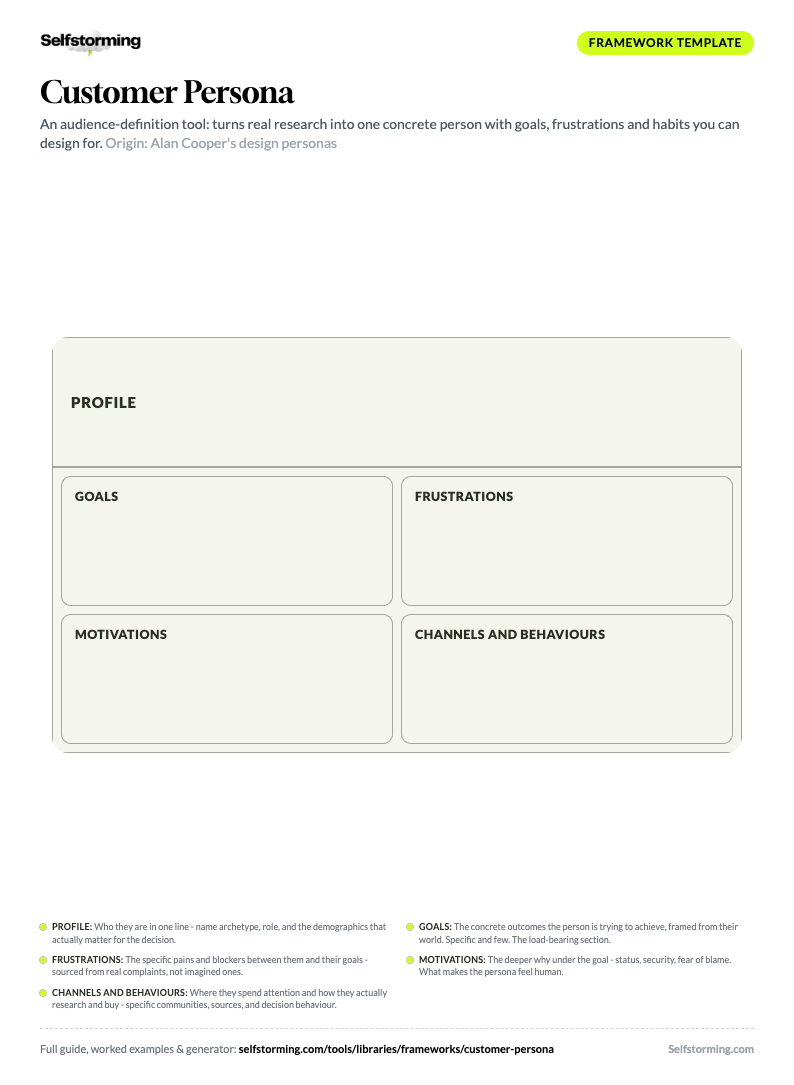
Print it. Fill it in.
The Customer Persona as a printable A4 worksheet - write straight into the framework, on paper or in any PDF app.
Download the PDF templateKnowledge Worth Paying For
A working library of brand strategy frameworks - with worked examples on real brands, sources, and decision criteria. Not vibes.
One good deck covers the subscription. The rest is profit.
A Customer Persona compresses real research into one archetypal person you can design and write for. Five parts: Profile (who they are in one line), Goals (what they're trying to achieve), Frustrations (the pains blocking them), Motivations (what actually drives them), and Channels (where they are and how they buy). Build it from interviews, not imagination. The heart of a useful persona is its Goals - if those are vague, the whole card is decoration.
Notion
Productivity and collaboration software (USA, founded 2013)A persona where the Motivations section explains a behaviour the demographics never would. The early power user isn't defined by job title but by a drive to craft their own system - which is why Notion invested in templates and a community rather than rigid, prescriptive workflows.
Oura
Smart-ring health tracker (Finland, founded 2013)Shows a persona where Frustrations and Motivations diverge from the obvious 'wants to be healthy.' The real driver is recovery and anxiety management, not fitness performance - which steered Oura toward sleep and readiness scores instead of competing head-on with step-counting wearables.
Duolingo
Language-learning app (USA, founded 2011)A persona built around a motivation most ed-tech ignores: not fluency, but the small daily win and the streak. Duolingo designed for the casual learner's real driver - habit and a sense of progress - rather than the serious learner the category assumes, which is why gamification, not grammar depth, won.
Notion, Oura, Duolingo - filled in, line by line. Unlock to read them.
Notion (Productivity and collaboration software (USA, founded 2013))
A persona where the Motivations section explains a behaviour the demographics never would. The early power user isn't defined by job title but by a drive to craft their own system - which is why Notion invested in templates and a community rather than rigid, prescriptive workflows.
Profile: Tinkerer Theo, a 29-year-old solo founder and serial tool-switcher who treats his workspace as a personal project.
Goals: Build one system that holds his whole company instead of ten disconnected apps. Show off a setup other founders ask him to copy.
Frustrations: Hates rigid tools that force their workflow on him. Sick of paying for five apps that half-overlap. Lost data once to a tool that shut down.
Motivations: Driven by craft and control - wants his tools to feel like an extension of how his brain works. Quietly enjoys being the person friends ask 'how is your setup built?'
Channels and behaviours: Lives on X and YouTube tutorials, lurks in productivity subreddits and Discords, discovers tools through templates other people share, commits only after rebuilding his whole system in a free trial.
Oura (Smart-ring health tracker (Finland, founded 2013))
Shows a persona where Frustrations and Motivations diverge from the obvious 'wants to be healthy.' The real driver is recovery and anxiety management, not fitness performance - which steered Oura toward sleep and readiness scores instead of competing head-on with step-counting wearables.
Profile: Burnt-out Bianca, a 41-year-old senior consultant who travels constantly and feels permanently behind on rest.
Goals: Understand why she wakes up exhausted despite eight hours in bed. Catch burnout before it forces a sick week.
Frustrations: Other wearables nag her to hit step goals she doesn't care about. Bulky watches feel like another work device. Generic 'you slept 7h' data with no 'so what.'
Motivations: Driven by a fear of crashing - she's seen colleagues burn out and wants early warning. Wants permission to rest backed by data, not guilt.
Channels and behaviours: Reads longevity and biohacking newsletters, trusts podcasts over ads, asks one health-obsessed friend before buying, researches for weeks then commits to a premium price.
Duolingo (Language-learning app (USA, founded 2011))
A persona built around a motivation most ed-tech ignores: not fluency, but the small daily win and the streak. Duolingo designed for the casual learner's real driver - habit and a sense of progress - rather than the serious learner the category assumes, which is why gamification, not grammar depth, won.
Profile: Streaky Sam, a 24-year-old graduate who 'has always wanted to learn Spanish' but has never finished a course.
Goals: Feel like he's making progress without it eating his evenings. Not embarrass himself ordering coffee on his next trip.
Frustrations: Textbooks and classes feel like school again. Has abandoned three apps that got boring by week two. Feels guilty every time he doesn't 'do the thing.'
Motivations: Driven by the small daily win and the dopamine of a streak, not by fluency. Wants the identity of 'someone who's learning a language' more than the grammar itself.
Channels and behaviours: Discovers apps through TikTok and friends, responds to push notifications more than email, never reads the help docs, sticks with whatever makes the daily habit feel effortless and slightly fun.
1. Profile
In one line, who is this person - their archetype, role, and the context that frames everything else?
The header. A name that signals the archetype, a role, and the demographics that actually matter for the decision - all in a sentence. Demographics here are scaffolding, not the substance. The job of the Profile is orientation, not a census.
Good answer: Cautious Carla, a 38-year-old operations lead at a 200-person logistics firm, the one who gets blamed when a new tool fails. The role and the stakes do the work, not her age.
Wrong answer: Female, 35-44, urban, household income £50-75k, two children. A market-research cell, not a person. You could design for that segment forever and never picture who you're actually helping.
2. Goals
What is this person genuinely trying to achieve - the outcome that would make their week?
The load-bearing section. The concrete outcomes the person wants, framed from their world, not yours. Good goals predict decisions: if you know what someone is trying to achieve, you can guess what they'll click, skip, and pay for. Keep them specific and few.
Good answer: Roll out the new tool without a single angry email from the warehouse team. Look competent to a boss who didn't want to spend the money. Outcomes you can design directly against.
Wrong answer: Wants to be more efficient and save time. Every human alive wants that. A goal this generic could belong to any persona, which means it guides no decision and earns its place on no card.
3. Frustrations
What pains and blockers stand between this person and their goals right now?
The friction. The specific obstacles, annoyances, and fears that get in the way - ideally sourced from real complaints, not imagined ones. Frustrations are where product opportunities hide: every sharp frustration is a feature, a copy line, or a support fix waiting to happen.
Good answer: Last tool needed a two-day training before anyone could use it. Burned once by a vendor who vanished after the contract was signed. Real scars that explain real hesitation.
Wrong answer: Finds current solutions frustrating and time-consuming. A frustration-shaped sentence with no actual frustration in it. It names a feeling, not a cause, so nobody can build against it.
4. Motivations
What actually drives this person - the deeper want beneath the surface goal?
The why under the goal. The emotional and professional drivers - status, security, curiosity, belonging, the fear of being blamed - that explain why the goal matters. Motivations are what make a persona feel like a person instead of a task list.
Good answer: Driven by not wanting to be the one who picked the tool that failed. Quietly wants to be seen as the person who modernises the team. The career stakes behind the rational goal.
Wrong answer: Motivated by success and growth. A motivation so universal it's invisible. It applies to a CEO, an intern, and a houseplant. If it doesn't distinguish this person, it isn't a motivation worth writing down.
5. Channels and behaviours
Where does this person spend attention, and how do they actually research and buy?
The where and how. The platforms, communities, and information sources this person trusts, plus how they make a buying decision - who they ask, what they read, how long they deliberate. This is what turns a persona from a portrait into a media and sales plan.
Good answer: Lurks in two industry Slack groups, trusts peer reviews over vendor demos, forwards a shortlist to a colleague before committing, buys only after a free trial. A persona you can actually reach.
Wrong answer: Active on social media and uses search engines. True of nearly everyone with a phone. It tells your media team nothing about where to spend a budget or how this person decides.
Decide your starting point: You don't have to start with a stock photo and a blank template. Right here on Selfstorming you can generate a first-draft Customer Persona in minutes from what you already know about your market. Treat that draft as a proto-persona - a hypothesis, clearly labelled as assumption - then run it through the steps below to replace guesses with evidence. Workshop-from-scratch and AI-draft-then-validate are both valid; most teams move faster starting from a draft and then proving or killing each claim.
Gather real research before you name anyone: Pull interview notes, sales-call transcripts, support tickets, reviews, and analytics. A persona is a compression of people you've actually heard from. Skip this and you've built demographic theatre - a character that reflects nobody.
Cluster by goals and behaviour, not demographics: Sort your research by what people are trying to achieve and how they behave, not by age or job title. Two people with different demographics but identical goals are the same persona; two with the same demographics but opposite goals are not.
Write the Goals section first: Goals are load-bearing - everything else explains or serves them. Make them specific outcomes from the person's world ('roll this out without angry emails'), not generic wants ('be more efficient'). If the goals are vague, the card will be too.
Source every Frustration from a real complaint: Each frustration should trace to something a real person actually said or did. Imagined frustrations produce imagined features. The sharper and more specific the frustration, the more directly it points at a fix.
Separate Motivations from Goals: The goal is what they want to achieve; the motivation is why it matters to them personally. 'Avoid being blamed for a failed rollout' is a motivation that explains a dozen surface behaviours. This layer is what makes the persona feel human.
Make Channels actionable, not generic: Name the specific communities, publications, and decision behaviours - who they ask, what they trust, how they buy. 'Uses social media' is useless; 'trusts two niche Slack groups over vendor demos' is a media plan.
Keep the set small and label its confidence: Most teams need two to four personas, not ten. If two would make the same product decision, merge them. And mark each one proto-persona (assumption-based) or research-based, so nobody mistakes a hypothesis for a finding.
Best for: Giving a team a durable, shared archetype to design, write, and target for - consolidating research into a memorable reference that settles everyday decisions. / Statistical segmentation, market sizing, or any decision needing representativeness across a whole base. A persona is a vivid archetype, not a data model.
Output: A one-card profile - name, role, goals, frustrations, motivations, channels - built from research and reusable across the org for months. / A single-moment snapshot of one person's inner state (that's an empathy map) or a time-based experience flow (that's a journey map).
Time to complete: A few hours to draft once the research exists, plus iteration. The work is in the interviews and clustering, not the card itself. / Instant - a persona invented on the spot with no research is fast but worthless. The speed comes from the synthesis, not from skipping the evidence.
vs Empathy Map: A Customer Persona is a durable, consolidated archetype across many people, with goals, demographics, and channels. Use it as the long-lived team reference. / An Empathy Map is a single-moment snapshot of one person's Says/Thinks/Does/Feels - faster and narrower. It's often the raw input you build the persona from.
vs Jobs To Be Done: A persona centres on who the customer is and what they want. Stronger for marketing targeting, copy, and giving the team a human to picture. / Jobs To Be Done centres on the progress a customer is hiring a product to make, deliberately downplaying who they are. Use JTBD when the 'why' matters more than the 'who.'
vs Bullseye Customer: A persona describes a representative archetype you serve broadly. Good for ongoing design and communication decisions across the customer base. / The Bullseye Customer names the single most ideal, highest-fit customer to focus a launch or positioning on. Use it to narrow ruthlessly; use the persona to design for the range.
The Customer Persona traces to software designer Alan Cooper, who began modelling design around archetypal users in the early 1980s and formalised the technique in his 1999 book The Inmates Are Running the Asylum: Why High Tech Products Drive Us Crazy and How to Restore the Sanity. Cooper introduced personas as part of his Goal-Directed design method - fictional but research-grounded characters that stand in for real user types, so teams design for one specific archetype rather than an elastic 'everyone.' The technique jumped from interaction design into UX and then into marketing and brand strategy, where the buyer-persona variant (formalised for B2B by Tony Zambito in 2001) added goals, channels, and buying behaviour. The core idea has stayed constant across all of them: a persona is a research compression, not a creative-writing exercise.
The sharpest criticism is that most personas are fiction - a stock photo and an invented name layered over demographic data nobody researched. Critics call this 'demographic theatre' and warn it manufactures false confidence: a sanitised, stereotyped version of reality that feels like understanding while reflecting no actual customer. There's a related worry about bias, where gendered or racial detail gets added for 'realism' and quietly bakes in assumptions instead of insight. Practitioners like Tony Zambito argue the rot comes from teams building too many personas of dubious merit without the qualitative research underneath. The defence is to keep the proto-persona vs research-based distinction explicit: a clearly-labelled assumption-based persona is a fine starting hypothesis, but treating it as evidence is where personas earn their bad reputation.
What is a Customer Persona?
A Customer Persona is a fictional but research-grounded archetype that represents a real segment of your customers, compressed onto a single card. It captures who they are, their goals, frustrations, motivations, and the channels they use - so a whole team can design, write, and target for one specific, memorable person instead of a vague 'everyone.' The defining feature is that a real persona is built from research, not invented in a meeting.
Who created the Customer Persona?
The persona technique is credited to software designer Alan Cooper, who started modelling users as archetypes in the early 1980s and formalised it in his 1999 book The Inmates Are Running the Asylum. It originated in interaction design as part of his Goal-Directed method, then spread into UX and marketing. The B2B buyer-persona variant was later formalised by Tony Zambito in 2001.
What's the difference between a Customer Persona and an Empathy Map?
A Customer Persona is a durable archetype consolidated across many people, with goals, demographics, and channels - a long-lived reference the whole team uses for months. An Empathy Map is a single-moment snapshot of one person's Says, Thinks, Does, and Feels. The Empathy Map is often the raw input: you run several, spot the patterns, and compress them into a persona.
Does a Customer Persona need real research?
Yes - this is the line between a useful persona and demographic theatre. A persona invented from assumption is confident fiction that misleads everyone who trusts it. Build from interviews, support tickets, reviews, and analytics. If you genuinely have to start from assumptions, call it a proto-persona, treat it as a hypothesis, and validate it before any big decision rides on it.
What's a proto-persona versus a research-based Customer Persona?
A proto-persona is built from the team's existing assumptions in a quick workshop - a fast, legitimate starting point for aligning a hypothesis. A research-based persona is grounded in actual customer data. Both are valid; the failure mode is conflating them and acting on a proto-persona as if it were proven. Always label which one you're looking at.
How many Customer Personas should we have?
Usually two to four. The common mistake is producing a deck of eight, several of which would make identical product decisions. Run the merge test: if two personas would click, skip, and pay for the same things, they're really one persona wearing two stock photos. Fewer, sharper personas guide decisions; a crowd of them just clutters the wall.
Does the Customer Persona work for B2B?
Yes - the buyer-persona variant was formalised for B2B precisely because complex sales need it. In B2B, the Motivations section does heavy lifting: career risk, internal politics, and the fear of championing a tool that fails drive decisions a feature sheet never captures. Build the persona around a specific buying role - 'the operations lead who gets blamed if the rollout flops' - not a generic job title.
An audience-definition tool: turns real research into one concrete person with goals, frustrations and habits you can design for.
The honest version of a persona earns the word 'archetype.' It compresses dozens of real interviews into one believable human whose goals, frustrations, and behaviour you can actually predict. The dishonest version is what critics call demographic theatre: a made-up character in a slide that flatters the team and reflects nobody.
A persona is only as good as the research underneath it. This page walks through the five sections that matter - Profile, Goals, Frustrations, Motivations, Channels - the question that unlocks each one, and how to tell a persona built from evidence from one built from a stock-photo library.
Related Frameworks
Value Proposition Canvas
Two halves, one rule. The customer profile (a circle) maps Customer Jobs (what they're trying to get done), Pains (what gets in the way), an
Jobs To Be Done
Jobs To Be Done says customers hire products to make progress in a situation, not because of who they are demographically. The mechanism is
Bullseye Customer
The Bullseye Customer is three concentric rings of audience. The core is your sharpest, single best-fit early customer - the beachhead you w
Empathy Map Canvas
One person, one situation, six sections. Four sectors around their head: Think & Feel (what occupies their mind and the emotions attached),