PrincipleBrand Strategy
Share of voice above share of market drives growth
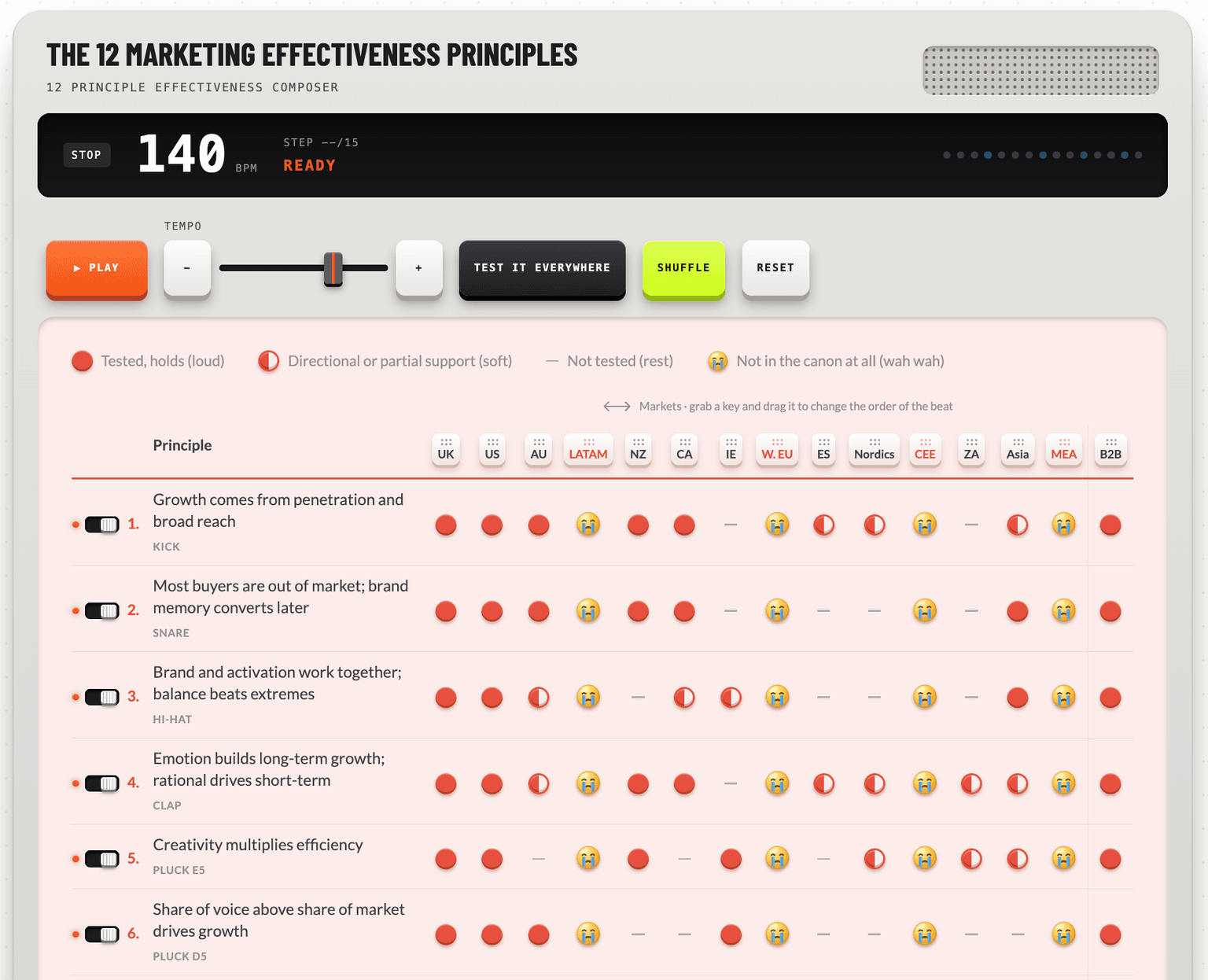
Brands that hold share of voice above their share of market tend to grow. Fully replicated in the UK, US, Australia, Ireland and B2B, and untested in the other six columns.
The evidence
6% / 12%The share of annual market share growth explained by excess share of voice (ESOV) rose from 6% before the digital era to 12% after it.Media in Focus: Marketing Effectiveness in the Digital Era - IPA, in association with Google and Thinkbox (EffWorks)0.25 → 0.81Adding creative quality to a share of voice model roughly triples its predictive powerFluent Devices Case Study - Creativity & Effectiveness: Developing creative best practice for long-term growth in a multi-platform world (System1 Group)PrincipleEmotional response acts as a multiplier on share of voice, not an alternative to itFluent Devices Case Study - Creativity & Effectiveness: Developing creative best practice for long-term growth in a multi-platform world (System1 Group)23% → 49%Creative advantage backed by media raises the odds of market share growth in a straight lineThe Creative Dividend - a partnership between Effie and System1
We wrote about this
More from this source
PrincipleNo market has disproved the core effectiveness principlesPrincipleGrowth comes from penetration and broad reachPrincipleMost buyers are out of market; brand memory converts laterPrincipleBrand and activation work together; balance beats extremesPrincipleEmotion builds long-term growth; rational drives short-termPrincipleCreativity multiplies efficiencyPrincipleDuration and consistency compound; short-termism destroys valueStatTV- or video-anchored multichannel reach is the best-replicated effectiveness principlePrincipleLong-term effects match or exceed short-term onesPrincipleBigger brands earn bigger returns (double jeopardy)StatPricing power from brand is widely supported but rarely fully proven outside the UKPrincipleThe medium itself signals brand quality